
Napata
For nearly a century in the eighth and seventh centuries BCE, a single family of African kings ruled a state that stretched from the Mediterranean coast of Egypt deep into Sudan -- an empire bigger than any Egypt had seen in centuries. They came from Napata, a city at the Fourth Cataract of the Nile, and they worshipped Amun from a temple at the base of a sandstone mountain called Jebel Barkal. The mountain has a natural pinnacle at its southern end that ancient eyes read as a rearing cobra -- the uraeus that crowns a pharaoh. The Kushite rulers took that rock face as proof that their god Amun lived here, and that he chose their kings. When Taharqa marched his army north in 690 BCE, he already ruled Egypt. The capital of that rule was upstream, at the mountain, at Napata.
Founded by a Conqueror, Claimed by Kush
The city traces to Thutmose III, the fifteenth-century BCE Egyptian pharaoh whose armies pushed the New Kingdom's frontier deep into Nubia. He established Napata as the southernmost permanent settlement in his empire. Because Egyptians believed the inundation of the Nile equated to divine creation, Napata's position as the southernmost point -- the source-direction, from the Egyptian view -- made it religiously powerful. The Temple of Amun at Jebel Barkal grew into a major cult center. When the New Kingdom faded in the eleventh century BCE, Napata was left in Kushite hands, and the temple tradition continued under local rule. By 750 BCE, while Egypt was fragmented into competing polities, Napata was a developed city ruled by kings who had taken up Egyptian titles and Egyptian theology. Kashta -- whose name simply means the Kushite -- began moving into Upper Egypt. His successors Piye and Shabaka brought the whole Nile valley under their control.
The Twenty-Fifth Dynasty
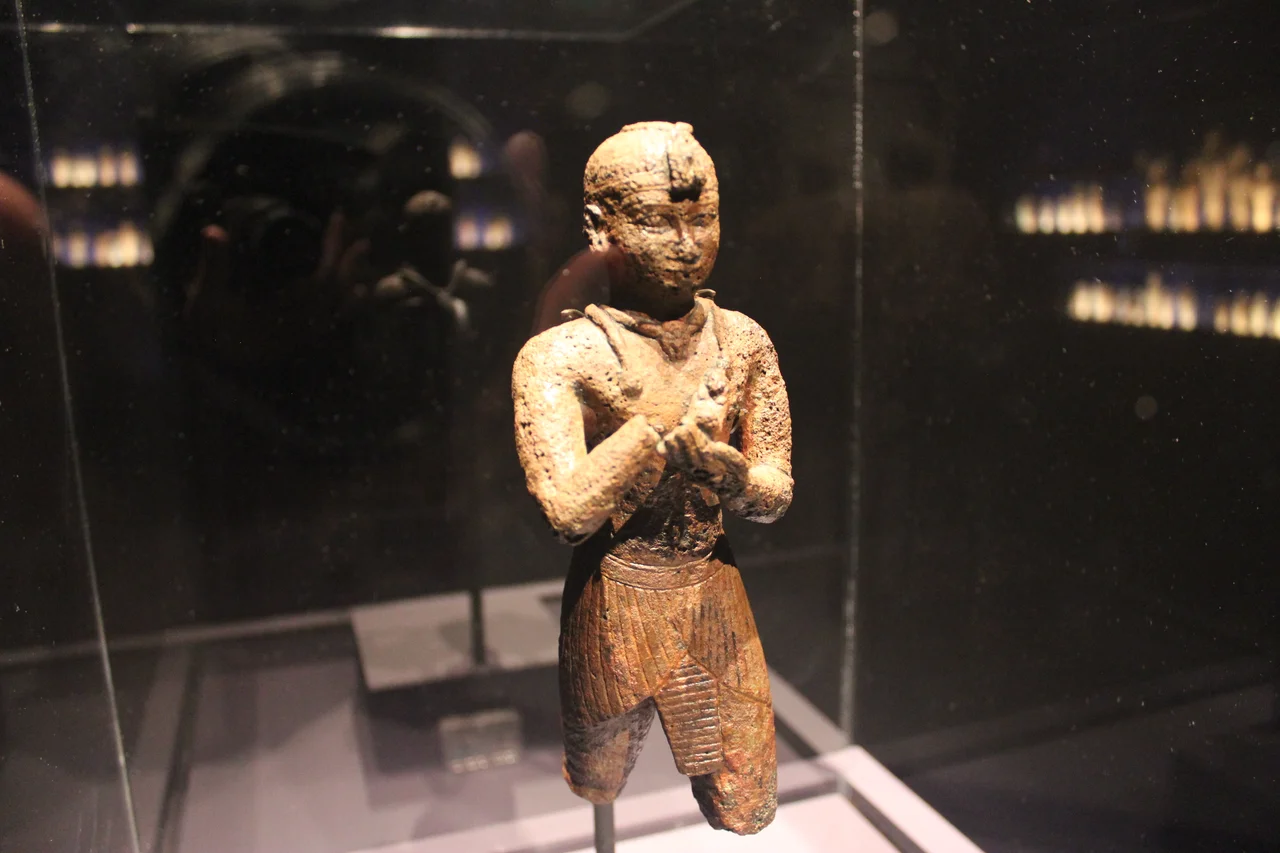
The Kushite kings who ruled Egypt for most of a century between 747 and 656 BCE are known to Egyptologists as the Twenty-Fifth Dynasty and to a wider audience, sometimes, as the Black Pharaohs. They saw themselves as restorers. After centuries of what they perceived as religious and cultural drift, they brought Egyptian art, religion, and architecture back to the standards of the Old, Middle, and New Kingdoms. Taharqa, who ruled from 690 to 664 BCE and is the most famous of the dynasty, built and restored temples and monuments from Memphis to Karnak to Kawa to Jebel Barkal itself. His Louvre statue shows a king in full pharaonic regalia, unmistakably African features rendered with the idealization and precision of the finest Egyptian sculpture. He was supported by the Amun priesthood at Thebes, who traced their god's authority through both Egypt and Jebel Barkal -- a theological double-chain that reinforced Kushite legitimacy to rule.
Assyria Breaks In
The dynasty's ascendancy ended in the face of an Assyrian empire that had become the ancient Near East's most ruthless military power. Esarhaddon conquered Lower Egypt around 670 BCE and allowed local Egyptian kings to rule as his allies against the Kushites to the south. When Ashurbanipal succeeded him, Taharqa persuaded the Lower Egyptian kings to break with Assyria. The revolt was crushed. In 664 BCE the Assyrians sacked Thebes and Memphis. Taharqa died the same year. His successor Tantamani killed the Assyrian-backed king Necho I the same year, but could not hold Lower Egypt. He retreated to Napata. Psamtik I, Necho's son, completed the Assyrian settlement and by 656 BCE placed all of Egypt under his own control. The pharaohs of the Twenty-Fifth Dynasty retreated upriver and were buried at El-Kurru and Nuri, under the first pyramids built in the Nile valley since the Middle Kingdom of Egypt a thousand years earlier.
The Long Twilight
Losing Egypt did not mean losing power. The Napatan kings continued to rule Kush for another 300 years, with the city functioning as political capital and religious center. The economy ran on gold, and Egypt under the 26th Dynasty was a major trading partner. Napatan architecture, painting, and script kept Kushite style alive. Egyptian gods were worshipped alongside Kushite ones; Amun of Jebel Barkal remained preeminent. The Temple of Amun and the neighboring Temple of Mut, both at the mountain's foot, were rebuilt and expanded. In 593 BCE, Egyptian pharaoh Psamtik II sent a punitive expedition that sacked the city. The Kushites responded by moving their capital upstream to Meroe, where iron ore and Atbara River access offered a better economic base than drying Napata could provide. Even after the move, Napata remained sacred. Kushite kings continued to be buried near it until about 270 BCE.
The Roman Raid
In 23 BCE, the Roman prefect of Egypt, Gaius Petronius, marched 10,000 men south in retaliation for a Meroitic raid on Roman Aswan led by the Kushite queen Amanirenas. Petronius reached Napata. Augustus boasted in his Res Gestae that a penetration was made as far as the town of Napata, which is next to Meroe. The town was sacked. Yet it was rebuilt. King Natakamani, a later Meroitic ruler, renovated the Amun temple and built a new palace. Eventually, through causes that may have included religious change, the site was abandoned, its buildings plundered, destroyed by the rock falls that kept breaking loose from the Jebel Barkal cliff. George Reisner's 1916-1920 excavations turned up caches of monumental granite statues depicting Taharqa and his successors -- Tantamani, Senkamanisken, Anlamani, Aspelta -- some of them broken deliberately, covered in ash from what may have been a ritual destruction. The statues now rank, as one recent catalogue put it, among the greatest in art history. The mountain still looks like a cobra. The city at its base sleeps beside the river.
From the Air
Napata is located at approximately 18.53 degrees north, 31.82 degrees east on the Nile's east bank at the modern town of Karima in Sudan's Northern State, about 40 km downstream of the Merowe Dam. Best viewed at 5,000 to 15,000 feet to appreciate the dramatic sandstone mesa of Jebel Barkal rising above the plain. Nearest airport: Merowe Airport (HSMN). The pyramids at El-Kurru, Nuri, and Jebel Barkal cluster across this area -- visible as distinctive steep-sided stepped structures. Clear desert flying conditions with extreme heat year-round and occasional dust storms. Note: the ongoing Sudanese civil war may affect airspace.
Nearby Stories
- Dar al-Manasir 21 km away
- Nubia 34 km away
- Banganarti 55 km away
- Northern Sudan 64 km away
- Throne Hall of Dongola 68 km away
- R12 (cemetery) 87 km away
- Pyramids of Meroë 211 km away
- Nubian pyramids 233 km away