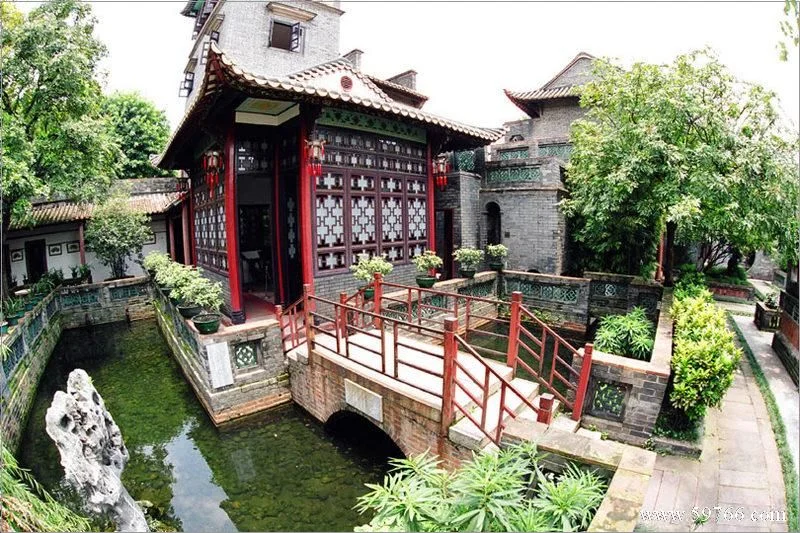

Keyuan Garden
Zhang Jingxiu had served as a vice-governor-level official in two provinces before he came home to Dongguan to build a garden. What he built became something larger than a retirement retreat. Completed in 1850, Keyuan — the name means roughly "Garden of Possibility" or "Can-Do Garden" — is one of the Four Great Gardens of Guangdong, a classical Lingnan landscape of pavilions, rockeries, and water that Zhang filled with poets, painters, scholars, and chess players. In the salons of Keyuan, Lingnan-style painting emerged as a distinct school of Chinese art. The garden that Zhang built to satisfy his love of beauty became, almost incidentally, one of the birthplaces of Guangdong's cultural identity.
A Official's Homecoming
Zhang Jingxiu arrived in Dongguan as a man of considerable official standing. He had served twice as an Anchashi — a position roughly equivalent to a provincial vice-governor in the Qing bureaucratic hierarchy — in Guangxi and then Jiangxi provinces. Imperial service of that rank required spending years away from home, navigating the machinery of Qing governance, maintaining relationships across enormous geographic distances. When he retired and returned to his home city of Dongguan, he built Keyuan not as a monument to his career but as a space for the things he actually cared about: Chinese calligraphy, painting, chess, poetry, antiquing, and the collection of unusual stones. The garden began as an expression of personal taste and grew into something more significant as Zhang invited his circle of friends, scholars, and artists to use it as a gathering place. What started as private cultivation became cultural institution.
Lingnan Stone and Water
Keyuan represents the Lingnan tradition of classical garden design — a distinct regional approach that differs from the more famous gardens of Suzhou and Hangzhou to the north. Lingnan gardens tend to work with the subtropical climate of southern Guangdong rather than against it: they emphasize shade, water, and the play of light through vegetation dense enough to flourish in heat and humidity. Rocks are central to the aesthetic. Zhang Jingxiu was a stone collector, and Keyuan's rockeries reflect that personal obsession: irregular limestone formations of the kind prized in classical Chinese gardens are arranged throughout the grounds to create miniature landscapes-within-landscapes, each offering a different prospect. Water moves through canals and ponds. Covered walkways connect pavilions that frame views rather than blocking them. The garden is located in the Boxia neighborhood of Guancheng District in western Dongguan — compact enough to walk in an afternoon, complex enough to repay repeated visits.
Where Lingnan Painting Was Born
Of the Four Great Gardens of Guangdong — a group that also includes Qinghui Garden in Shunde, Liang Yuan in Foshan, and Yu Yin Shan Fang in Panyu — Keyuan is the one whose cultural significance extends furthest beyond its garden walls. The Lingnan school of painting, a major branch of Chinese art that synthesized traditional ink painting with influences from Japanese and Western techniques, traces its origins in part to the artistic circles that gathered in Keyuan during the mid-to-late Qing dynasty. Zhang Jingxiu's habit of inviting painters and scholars to gather in his garden created a milieu where styles were shared, debated, and evolved. The garden was not a painting academy with formal instruction — it was something more organic and perhaps more powerful: a place where creative people met regularly over decades, and where an approach to painting developed through conversation, collaboration, and the shared experience of a beautiful space.
Four Great Gardens, One Particular Meaning
The designation "Four Great Gardens of Guangdong" carries real weight in the cultural geography of southern China, comparable in prestige to famous scholar's gardens elsewhere. Keyuan earned its place in this group not through size — it is not the largest of the four — but through the density of its cultural associations. In a region where Lingnan culture (the culture of the land south of the Nanling Mountains, encompassing Cantonese-speaking Guangdong and parts of Guangxi) has long maintained a distinct identity from the cultural centers of the north, places like Keyuan served as anchors of local artistic and intellectual life. The garden has been expanded and reconstructed several times since its completion in 1850, but its essential character — intimate, learned, devoted to the intersection of natural beauty and human creativity — has remained consistent. Visiting Keyuan today means stepping into a place where the act of making a garden was understood as inseparable from the act of making a culture.
From the Air
Keyuan Garden is located at approximately 23.045°N, 113.738°E in the Guancheng District of western Dongguan, Guangdong. The nearest major airport is Shenzhen Bao'an International (ZGSZ), roughly 55 km to the south. Guangzhou Baiyun International (ZGGG) lies approximately 65 km to the northwest. From altitude, the garden's compact green footprint is set within the dense urban fabric of central Dongguan; it is not easily identifiable from high altitude but becomes visible on lower approaches as a small green oasis amid the surrounding built environment. The East River (Dongjiang) flows nearby to the north, offering a useful navigation reference at lower altitudes in clear conditions.
Nearby Stories
- Fengjian Village 6.5 km away
- Opium War Museum 8.2 km away
- Liang's Garden 13 km away
- West Lake (Huizhou) 14 km away
- Qingyuan Maglev Tourist Line 21 km away
- Horizontal Skyscraper – Vanke Center 28 km away
- Heyuan 61 km away
- Qingyuan 77 km away