
King George Square
Two bronze lions sit at the foot of Brisbane City Hall, paws forward, manes catching the subtropical light. They have watched this square for nearly ninety years, through royal tours and rallies, through a heatwave of glare off pale granite and the cool green memory of a fountain long since gone. Children clamber onto them for photographs. Few stop to read the inscription, or to notice that the lions were once raised on tall sandstone plinths, part of a city's farewell to a dead king. King George Square is not a quiet place. It is Brisbane's front room, and the city has done much of its arguing, mourning, and celebrating right here.
Market Square to Albert Square
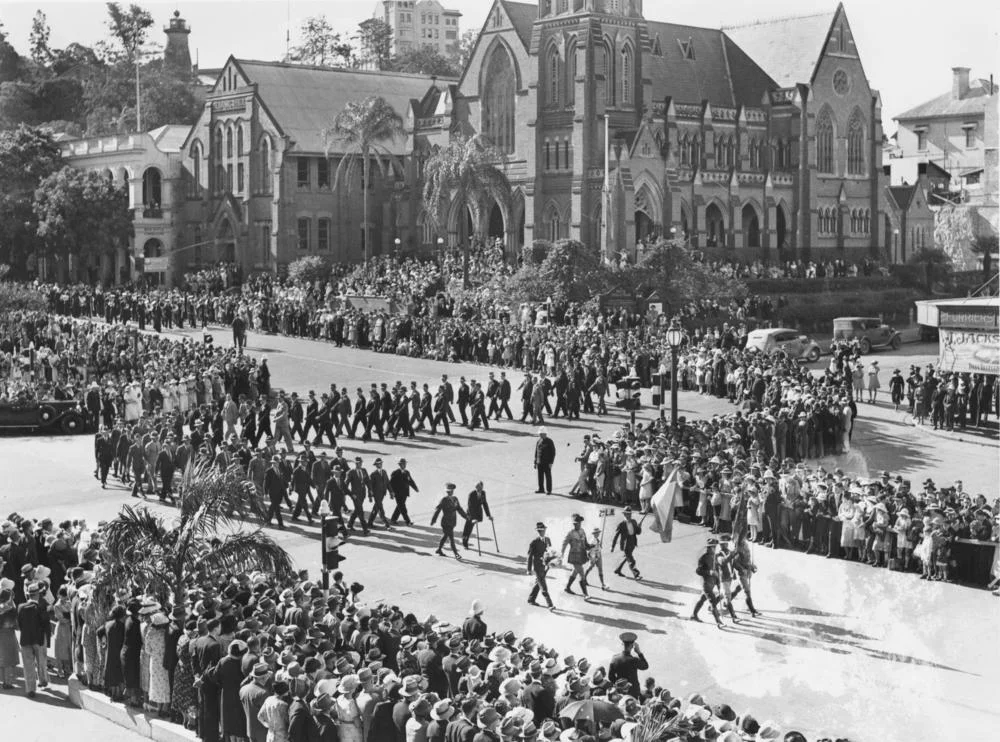
Before the lions, before the king, there was a marketplace. Albert Street once ran west from the Botanic Gardens to the original city markets, and the open ground here was simply Market Square. That changed in 1930, when Brisbane City Hall rose at its edge, a sandstone giant with a clock tower that was, for a time, the tallest structure in the city. The council widened the street, set the hall back behind a generous apron of open space, and named it Albert Square after Prince Albert, the husband of Queen Victoria. It was a place built for ceremony from the start, a stage with the grandest backdrop Brisbane could muster.
Black Friday
In 1912, before it had even been formally named, this ground saw one of the most violent days in Brisbane's history. More than fifteen thousand trade unionists gathered here during the general strike, having been refused a permit to march. On the orders of Police Commissioner Cahill, mounted officers charged the crowd and struck at peaceful demonstrators. The day became known as Black Friday, Australia's first general strike turned bloody on the streets of the capital. The square that would later host kings and popes had first earned its place in the city's memory as a site of confrontation between workers and the state, and that history sits quietly beneath the paving.
A King's Memorial
King George V died in 1936, and Brisbane responded the way cities did then. The square was widened to absorb what had been Albert Street and renamed in the king's honour. Two years later, in 1938, the citizens unveiled their tribute: a memorial to George V, flanked by those bronze lions on heavy sandstone plinths. For decades, traffic still rolled through the square, including a trolley-bus route, until 1969, when the road was finally closed and an underground car park hollowed out beneath. The statues were shifted to where they stand today, the lions lowered closer to the people who would one day climb on them.
The People Who Stood Here
The square has a gift for gathering crowds around a single figure. Eleanor Roosevelt stood here in 1943, during the Second World War, when Brisbane was a hub for Allied forces in the Pacific. Queen Elizabeth II appeared during her 1954 royal tour. Pope John Paul II addressed the public here in 1986. In a corner the city calls Speakers' Corner, bronze statues honour three Queenslanders: the writer Steele Rudd, the suffragist and union organiser Emma Miller, and Sir Charles Lilley, a former premier and chief justice. Sculptures salvaged from the 1988 World Expo were folded into the design as well, layering the square with the city's own keepsakes.
The Hottest Square in Brisbane
The square reopened in October 2009 after sixteen months of redevelopment, its design chosen in a national competition. The new look stripped away grass and shade in favour of broad, pale paving, and Brisbane, a subtropical city, noticed immediately. Critics called it too hot to handle, blistering with reflected glare and offering almost nowhere to escape the sun. During the millennium drought, which gripped southeast Australia for much of the 2000s, the central fountain had already been drained and replaced with a water-wise garden of hardy plants. The criticism stuck, a reminder that a civic space must serve the climate it sits in, not just the architect's drawings.
From the Air
King George Square sits in central Brisbane at 27.468 degrees south, 153.024 degrees east, immediately northwest of the distinctive clock tower of Brisbane City Hall, your best visual landmark from the air. The Brisbane River loops around the city centre to the south and east. Brisbane Airport (ICAO YBBN) lies about 12 kilometres to the northeast; Archerfield Airport (YBAF), the city's general-aviation field, is roughly 12 kilometres to the southwest. Best viewed from 1,500 to 3,000 feet on a clear day, when the grid of the CBD and the green ribbon of the City Botanic Gardens stand out sharply against the river bends.
Nearby Stories
- Redcliffe Peninsula 2.7 km away
- Tamborine National Park 12 km away
- Cressbrook Homestead 27 km away
- Main Range National Park 31 km away
- 2010-2011 Queensland Floods 38 km away
- Cape Byron 96 km away
- Cape Byron Light 126 km away
- HMS Porpoise (1799) 588 km away