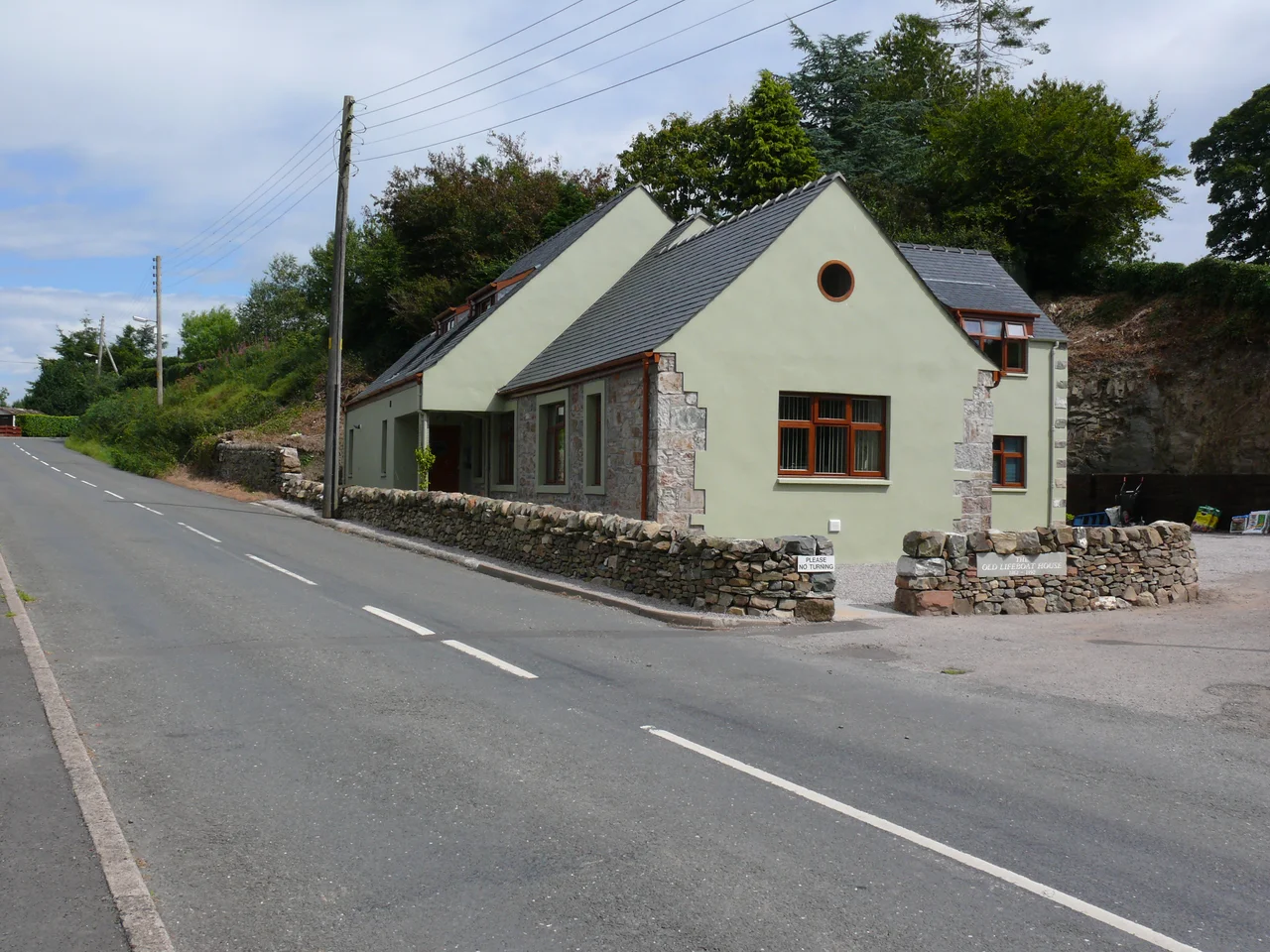

Kirkcudbright Lifeboat Station
On 29 February 1928, the Kirkcudbright lifeboat crew set out from Cutlers Pool for Maryport, on the English side of the Solway Firth, to swap their old pulling-and-sailing boat for a brand-new prototype motor lifeboat. The wind got up. After eleven hours of fighting heavy seas and headwinds in an open rowing boat, they turned around and came home. The next day they tried again - sixteen hours at the oars to reach Maryport, an overnight to recover, and then just three hours back home in the new boat, the Priscilla MacBean, gifted by the estate of Edward MacBean of Helensburgh. That single weekend, more than anything else, explains why a small Galloway town needed - and still needs - a lifeboat.
An Anonymous Gentleman, 1861
On 4 July 1861, the RNLI committee in London received a letter from Mr Samuel Cavan of Kirkcudbright. An anonymous benefactor, identified only as 'N. L.,' had pledged the cost of a lifeboat and carriage for the port. The Institution agreed at once, and the following year a 30-foot self-righting pulling-and-sailing lifeboat - six oars, sails, £153 - was railed by the London and North Western and the Glasgow and South Western Railways as far as Castle Douglas. From there it was hauled by its own carriage down to Kirkcudbright. The boat was named Helen Lees. A boathouse went up at Creekhead, at the top of St Cuthbert Street, for £144 - the equivalent of a year's wages for a skilled tradesman.
The Schooner William Henry
The earliest documented service came on 30 November 1868. The schooner William Henry, out of Belfast and bound for Maryport with cargo, was driven ashore and wrecked on St Mary's Isle just south of the town. The Helen Lees launched into the November sea; five lives were saved. By 1892 the lifeboat had been moved to Cutlers Pool at the mouth of the River Dee, and a new boathouse and slipway followed in 1893 at a cost of £1,200. The old boathouse was sold for £20. The new location was awkward - the crew had to be driven to the edge of Lake Wood and then walk a mile through trees to the boat - but it was still quicker than rowing out of the town harbour.
The Bottle in the Sand
On 14 October 1934, a bottle washed up at West Preston Shore at Kirkbean. Inside was a message dated a week earlier: 'We are stranded in Barlocco Caves. Rescue us quick or too late.' The Kirkcudbright lifeboat launched. Nobody was there. Whether the message was a prank, a confused walker, or someone who had managed to get themselves out before help arrived, was never determined. The crew rowed home in the dark. It is a story the station still tells - because it captures, almost perfectly, what lifeboat crews actually do: launch on incomplete information, search empty water, and accept that sometimes the rescue you do not make is the one where there is, mercifully, nobody to find.
Honours and Names
Awards line the wall of the modern station. Andrew Lusk, a farmer, received the RNLI Silver Medal in 1865 for a rescue conducted before the lifeboat itself was on station. George Parkhill won the Royal Humane Society's Bronze Medal in 1908. Coxswain/Mechanic George Cossar Davidson got the Thanks of the Institution on Vellum in 1976 and the Queen Elizabeth II Silver Jubilee Medal in 1977. Acting Coxswain/Mechanic Stephen Unsworth received Vellum in 1985. And in 2023, William John Collins, Lifeboat Operations Manager, was made a member of the British Empire in the New Year Honours - sixty-plus years on a single station, quietly running the place that runs the rescues.
Sheila Stenhouse
The station today operates an Atlantic 85 inshore lifeboat named Sheila Stenhouse (B-814), on station since 2009. She lives 3.5 miles south of the town proper, at the boathouse near the mouth of the River Dee where it spills into the Solway Firth. The Solway is a treacherous body of water - vast tidal flats that fill faster than a person can walk, sandbanks that shift between visits, currents that take swimmers and small boats by surprise. The crew here have inherited 160 years of local knowledge about exactly how that water moves. They use it on every callout.
From the Air
Kirkcudbright Lifeboat Station sits at 54.795°N, 4.062°W near the mouth of the River Dee on the north shore of the Solway Firth. Best viewed at 2,000-4,000 feet, where the wide tidal estuary, St Mary's Isle and the town itself line up clearly. Carlisle Lake District (EGNC) lies about 35nm east; Prestwick (EGPK) is 50nm north-northwest. The Isle of Man (EGNS) sits 40nm south across the Irish Sea. The Solway Firth's huge tidal range means the visible coastline changes substantially through the day - a useful navigation feature, and a hazard.
Nearby Stories
- Port William, Dumfries and Galloway 1 km away
- Alauna (Maryport) 4.1 km away
- Calder Abbey 6.3 km away
- Kenmure Castle 7.8 km away
- Lochmaben Castle 12 km away
- Bishopscourt, Isle of Man 21 km away
- Point of Ayre Lighthouse 23 km away
- Ballantrae Lifeboat Station 29 km away