
Kirkcudbright Tolbooth
Bessie Paine died in the winter of 1671, locked in what the record calls the 'dark dungeon' of the Kirkcudbright Tolbooth. She had been arrested in Dumfries with four other women - Janet Hewat, Grissall McNae, Margaret McGuffok, Margaret Fleming - accused of casting charms on animals and trying to cure children with witchcraft. They were transported in chains to this building, denied food, denied their own possessions, and held 'at the point of starving.' The other four were eventually released the following summer, the court conceding they had been 'maliciously misrepresented as guiltie of the most horrid crymes.' Bessie was already dead, killed by 'cold, hunger and other inconveniences of the prison.' The tolbooth she died in is still standing on Kirkcudbright's high street. It is now an art gallery.
What a Tolbooth Was
From the medieval period onward, every Scottish royal burgh had a tolbooth. The name comes from the building's original role as a place to collect tolls and customs on the markets and international trade that royal burghs were licensed to conduct from the twelfth century. But the tolbooth was always much more than a customs house. Councils met inside it. Courts convened. Civic ceremonies happened on its steps. From the seventeenth century onward, every tolbooth was required to have a clock - the steeple of its tower was a mark of civic pride. And almost without exception, the lower floor held a prison: debtors above, criminals below, or some grim variant of the same arrangement. By the 1700s, 'tolbooth' had become a near-synonym for jail.
Built Between 1627 and 1629
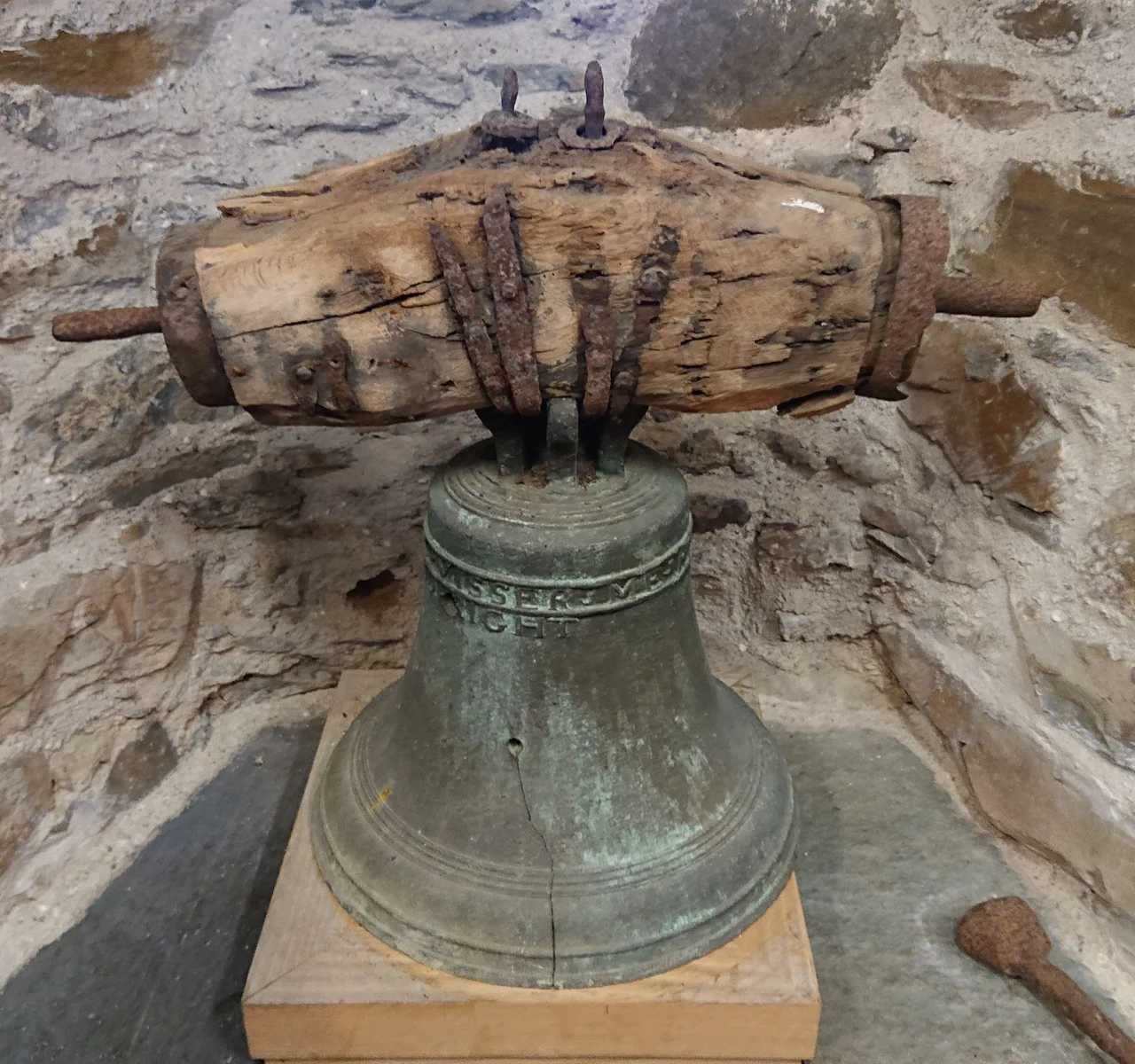
Kirkcudbright already had a tolbooth - a converted church - but by 1625 the councillors were complaining about its condition. They raised money by selling rights to the booths inside the planned new building, by claiming a portion of fines collected by local magistrates, and through a £2,000 loan from Sir John Gordon of Lochinvar. Construction began in 1627 and finished in 1629. The result was a three-storey rubble block with red sandstone dressings, 22.1 metres long, with a square tower at the east end. The clock and bell didn't come until 1644, when a new tower was built specifically to hold them - and the principal bell, still hanging in the steeple, was cast in the Netherlands in 1646 and inscribed 'SOLI DEO GLORIA MICHAEL BVRGERHVYS ME FECIT' (Glory to God alone, Michael Burgerhuys made me).
Covenanters and the 1684 Raid
After the Restoration of Charles II in 1660, the Covenanters - Presbyterians who refused to accept royal authority over the Scottish church - became a hunted minority. The Tolbooth held many of them during the years known as the Killing Time (1679-1688). John Neilson of Corsock was imprisoned here for letting Covenanter ministers preach in his house; he was fined 2,000 pounds Scots, released, captured later at the Battle of Rullion Green, and hanged at Edinburgh. In late 1684, a band of over a hundred Covenanters mounted a raid on the tolbooth. They freed their brethren but killed one of the guards. John Graham of Claverhouse - 'Bonnie Dundee' to some, 'Bloody Clavers' to others - pursued the attackers; at Auchencloy he captured William Hunter and Robert Smith, who were brought back here, tried, and executed.
Iron Jougs and a Pretended Witch
Two sets of iron jougs - neck restraints - still hang from the tolbooth wall. One is at the north-west corner about 1.5 metres above street level; the other is at the top of the forestair. People convicted of minor offences were locked into them in front of their neighbours. By 1735 Parliament had decided witchcraft was not a real-world possibility, but the law was rewritten so that anyone profiting from claiming to have supernatural powers could still be punished. In 1805 Jean Maxwell - whom her community believed to be a witch - was sentenced to a year in this tolbooth for 'pretending to exercise witchcraft, sorcery, inchantment, conjuration, &c.' Elspeth McEwen, the 'old wife of Bogha' from Balmaclellan, had not been so lucky in an earlier era: imprisoned here from 1696 to 1698, she eventually confessed and was executed and burned on 24 August 1698.
John Paul Jones and the Long Afterlife
John Paul Jones - the man who would later become celebrated as a hero of the American Revolutionary War - was held in this building in 1770. He had ordered a sailor named Mungo Maxwell flogged on the brig John; Maxwell later died of yellow fever on another ship, and Maxwell's father blamed Jones. He was acquitted when the master of the second ship testified Maxwell had been healthy when he came aboard. The tolbooth held its last prisoner in the early 1800s, was used as a coastguard station, a rifle company office and a glove factory in the nineteenth and twentieth centuries, and was renovated in 1993. Queen Elizabeth II reopened it as an arts centre. The same building that killed Bessie Paine now sells paintings.
From the Air
Kirkcudbright Tolbooth stands at 54.836°N, 4.056°W, in the heart of the town at the corner of the right-angled High Street. Best viewed at 1,500-3,000 feet, the conical stone spire and boat-shaped weathervane are unmistakable above the slate roofs of Kirkcudbright. Carlisle Lake District (EGNC) sits 35nm east, Prestwick (EGPK) 50nm north-northwest. The wide tidal estuary of the River Dee opens to the south-southeast; MacLellan's Castle and the harbour are within half a mile of the tolbooth.
Nearby Stories
- Port William, Dumfries and Galloway 1 km away
- Alauna (Maryport) 4.1 km away
- Calder Abbey 6.3 km away
- Kenmure Castle 7.8 km away
- Lochmaben Castle 12 km away
- Bishopscourt, Isle of Man 21 km away
- Point of Ayre Lighthouse 23 km away
- Ballantrae Lifeboat Station 29 km away