,_with_posters_for_%22Cosi%22.jpg)
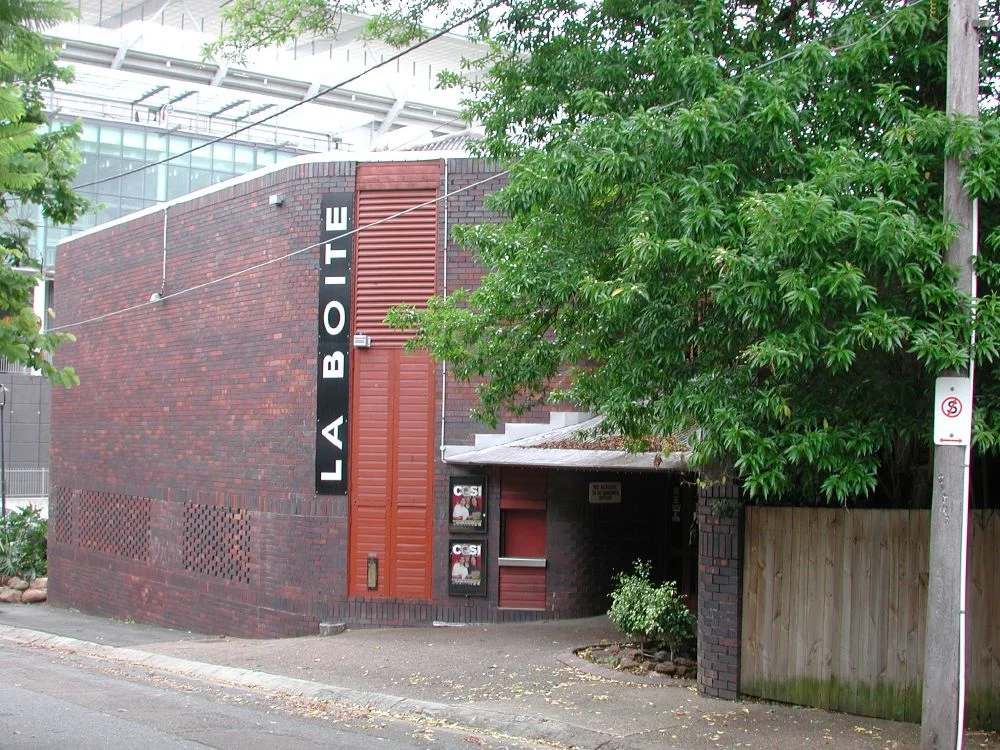
La Boite Theatre Building
The building tells you its name before you step inside. Squat, dark-bricked, its corners rounded like a hand-thrown clay box, it sits on Hale Street in Petrie Terrace looking less like a theatre than a piece of sculpture. La Boite means "the box" in French, and when the company moved here from a converted cottage in 1972, they carried the name with them and built a structure to match it. What happened inside was a quiet revolution. There was no proscenium arch, no safe dark distance between performer and crowd. The audience sat in a full ring around the stage, and an actor in the centre of that room had nowhere to turn that was not someone's front row.
A First for Australia
When it opened on 11 June 1972, La Boite became the first purpose-built theatre-in-the-round in Australia, a 200-seat arena designed from the ground up so the play could happen in the middle of the audience rather than in front of it. Governor Sir Colin Hannah did the honours at the opening. The form was not invented here; theatres in Europe and America had been experimenting with arena staging, chasing something more intimate and immediate than the traditional picture-frame stage. But this was Brisbane's, and Queensland's, leap into that world, a deliberate bet that audiences wanted to be inside the story rather than watching it from the dark.
The Architect and the Box
The design came from Brisbane architect Blair Wilson, of the firm R Martin Wilson and Sons, working with input from the theatre's artistic director, Jennifer Blocksidge. Wilson built the exterior from dark reject bricks, the kind a builder might ordinarily discard, laying them in shifting patterns so the lower walls carry a rough, deliberate texture. The work won him the 1972 Clay Brick Award for inventive use of the material. The roof is low-pitched and metal-clad. Everything about the form expresses the name: a box with softened edges, brick and concrete and timber, honest about what it is. The Queensland Heritage Register, which listed the building on 30 January 2004, singled out exactly this marriage of name and shape.
Inside the Ring
The building works across three levels. The ground floor holds the foyer, flanked by small lobbies and a ticket office, with the 200-seat auditorium behind. The seating rakes up on all sides around a central acting space, and here is the clever part: tunnels run beneath the raked seats, letting actors slip in and out and appear at any point in the room without ever being seen to walk on. There is no wing to hide in, no curtain to fall, no comfortable fourth wall between the performer and the watching faces. A play staged in this room had to work in the round, legible from every seat, intimate by force of architecture. Below the stage, a basement holds rehearsal space, a workshop, storage, offices, and dressing rooms. A gallery sits above. A brick-paved courtyard opens off the foyer, a place to gather before the lights go down.
The Company That Took the Name
The theatre was built for the Brisbane Repertory Theatre Company, founded decades earlier and one of the longest-running theatre groups in the state. The connection ran so deep that the company eventually took the building's own name, becoming La Boite when it incorporated. For thirty years this box on Petrie Terrace was its home, the place where it helped rejuvenate amateur and then professional theatre across Queensland, presenting the kind of modern, flexible, intimate work the arena form made possible. The company has since moved on to a newer venue, but the heritage-listed building remains, a small, stubborn monument to the night Brisbane decided to surround its actors.
From the Air
The La Boite Theatre Building stands at 69 Hale Street, Petrie Terrace, on the western edge of central Brisbane at 27.465 degrees south, 153.011 degrees east, close to the inner-city bypass and just northwest of the CBD's clustered towers. The Brisbane River curls to the south. Brisbane Airport (ICAO YBBN) is about 12 kilometres to the northeast, and Archerfield Airport (YBAF) roughly 11 kilometres to the south-southwest. The building itself is small and dark and easy to lose from altitude; navigate instead by the City Hall clock tower a kilometre to the east. Best appreciated on the ground, but visible from 1,500 to 2,500 feet in clear conditions against the inner-suburban grid.
Nearby Stories
- Redcliffe Peninsula 2.7 km away
- Tamborine National Park 12 km away
- Cressbrook Homestead 27 km away
- Main Range National Park 31 km away
- 2010-2011 Queensland Floods 38 km away
- Cape Byron 96 km away
- Cape Byron Light 126 km away
- HMS Porpoise (1799) 588 km away