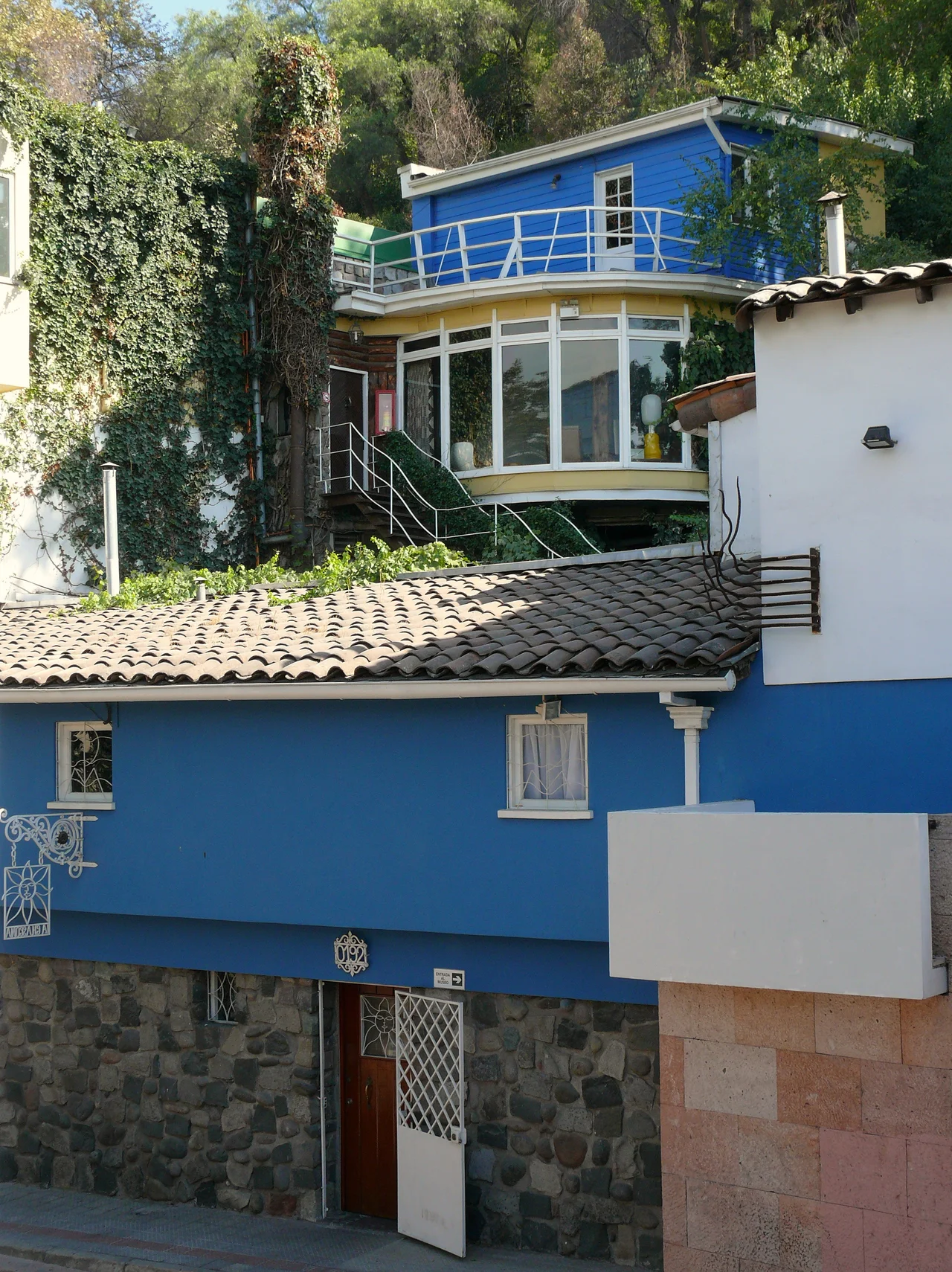

La Chascona
Pablo Neruda named the house after his lover's hair. Chascona is a Chilean word borrowed from Quechua, meaning tangled or disheveled, and it was how the poet teased Matilde Urrutia about the unruly red curls piled on her head. When he began building a house for her in 1953 on the slope of Cerro San Cristóbal, in Santiago's bohemian Bellavista quarter, he was still married to someone else, and Matilde was a secret. So he built the secret a home, full of trick passages, narrow stairs, and rooms that climb the hillside like an afterthought, a house shaped less by an architect than by a poet's appetite for the playful and the hidden.
A House for a Secret
Neruda kept three houses in Chile, and each was a self-portrait. La Chascona is the most intimate of them, a place designed to hide a relationship in plain sight. Its construction began in 1953 as a residence for Matilde Urrutia, the singer who would eventually become his third wife. The poet had a lifelong fascination with the sea, and he indulged it here far from any coast: rooms styled like a ship's cabin, low ceilings, porthole logic, a dining room that feels as though it might pitch in a swell. The house does not flow in a sensible line. It scrambles uphill in stages, rewarding the visitor who is willing to get a little lost, much as Neruda's verse rewards the reader who lingers.
The Portrait with Two Faces
On a wall inside hangs a 1955 portrait of Matilde painted by the Mexican muralist Diego Rivera, one of the friends let in on the secret. Rivera gave her two faces in a single head. One looks outward, the public Matilde, the concert singer the world was allowed to see. The other turns inward, the private woman who belonged to Neruda's hidden life. The painter hid one more thing in the canvas: tucked into the loose red curls that gave the house its name, Neruda's own profile appears, faint and dissolving, the lover concealed in his beloved's hair. It is a portrait that keeps a secret the way the whole house does, by holding two truths at once and asking you to look twice.
The House After the Coup
By 1971 Neruda had won the Nobel Prize in Literature, and he was Chile's most celebrated voice, a poet who was also a diplomat and a committed leftist. Then came September 1973. Days after the coup that toppled his friend President Allende, Neruda died on September 23 at a Santiago clinic, officially of complications from cancer, though the circumstances have been argued over ever since. La Chascona was ransacked and flooded in the chaos, its windows smashed and its rooms left in ruin. Matilde insisted that his wake be held there anyway, amid the broken glass. Mourners laid planks across the mud to carry his body through the wreckage. To grieve openly that week, in that city, was itself an act of quiet defiance.
Restored by the Widow
Matilde Urrutia refused to let the house die with its poet. She repaired the damage room by room and went on living in La Chascona until her own death in 1985, tending the home she had built with Neruda and keeping his memory present in a country where his name had become dangerous. Today the house is a museum run by the Pablo Neruda Foundation, and visitors climb the same crooked stairs, past the seafaring rooms and the two-faced portrait, into the private world of a man who collected ships' figureheads, colored glass, and words. La Chascona was conceived as a hiding place. It survives as the opposite, an open door into one of the great love stories and great tragedies of twentieth-century Chile.
From the Air
La Chascona sits at the foot of Cerro San Cristóbal in the Bellavista neighborhood of Santiago, at 33.4311°S, 70.6344°W, tucked into the dense streets just north of the Mapocho River. The forested dome of San Cristóbal, crowned by its white statue of the Virgin, rises immediately to the northeast and is the dominant landmark for the area; the river and the towers of the Providencia district frame the scene to the south and east. The house itself is small and embedded in the urban grid, best seen on the ground, but the surrounding bohemian quarter and the green hill make a striking overflight at 1,500 to 2,500 feet AGL on a clear morning before the basin hazes over. Arturo Merino Benítez International (ICAO SCEL) lies roughly 13 km to the northwest; the smaller Tobalaba aerodrome (ICAO SCTB) is to the east toward the Andean foothills.
Nearby Stories
- Paine Memorial 21 km away
- 1947 BSAA Avro Lancastrian Star Dust accident 23 km away
- Battle of Chacabuco 31 km away
- La Campana National Park 36 km away
- Puente del Inca 44 km away
- Casa de Isla Negra 62 km away
- Santa Cruz, Chile 103 km away
- Pierre Auger Observatory 172 km away