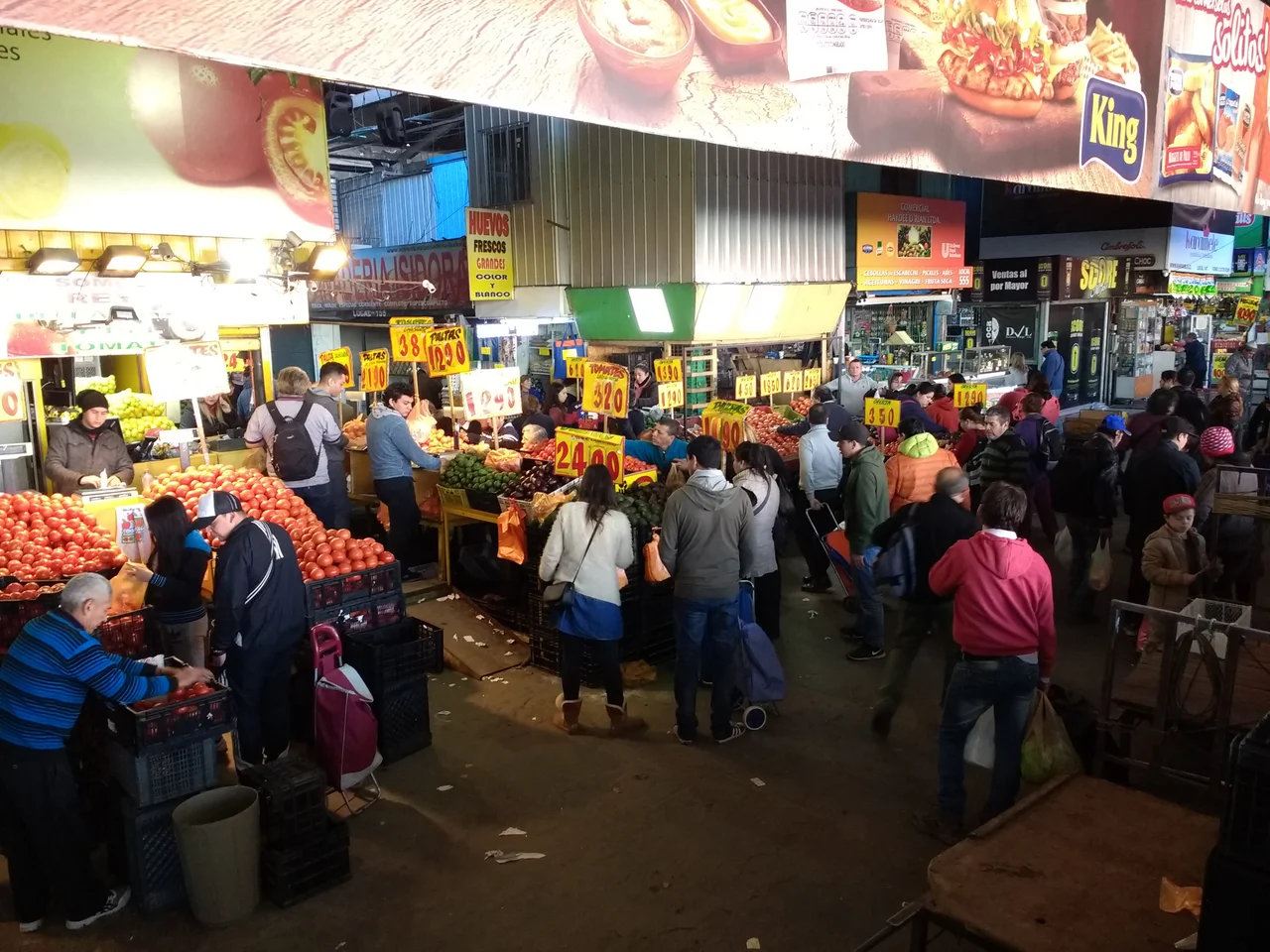

La Vega Central
"Markets today compete for customers with marketing," a longtime vendor at La Vega Central once said. "La Vega has never needed to. It survives on what it is, and that is its magic." He was right, and the proof is the noise. Walk into this market on the north bank of the Mapocho River and the city's polite downtown falls away instantly: crates of avocados stacked higher than your head, fishmongers shouting prices, the wet smell of just-hosed concrete, the thump of porters wheeling produce through impossibly crowded aisles. La Vega does not perform for tourists. It feeds Santiago, and it has done so for well over a hundred years.
Where the Valley Comes to the City
La Vega Central spreads across 60,000 square meters at the southern edge of the Recoleta commune, in the old quarter known as La Chimba, just across the river from the city center. Through its stalls flows the harvest of the Chilean Central Valley, the long fertile corridor between the Andes and the coastal range that makes Chile one of the world's great exporters of fruit. Here that bounty is sold close to its source: towers of tomatoes and grapes, sacks of potatoes, mountains of citrus, alongside more than 500 stalls dealing in dairy, meat, dry goods, and home cooking. Thousands of people pass through every single day, from restaurant buyers stocking their kitchens at dawn to families filling bags for the week.
A Market Born of the River
The trade is far older than the building. Since colonial times, farmers had gathered in La Chimba to sell what they grew, and once the Calicanto bridge spanned the Mapocho in the eighteenth century, merchants clustered at its approaches. In the nineteenth century, after the Mapocho was channeled and tamed, the land was formally set aside for the sale of produce and fitted with storage for loading and selling. The market we know took shape through one man's initiative: in 1895, the merchant Agustín Gómez García, a resident of the La Chimba neighborhood, organized the effort that founded La Vega Central. Its solid-walled warehouses were inaugurated in 1916, giving permanence to a marketplace that had until then been a sprawl of stalls and carts.
The Taste of Chile
To eat at La Vega is to eat as Santiago eats. Tucked among the produce stalls are cocinerías, no-frills counters where cooks ladle out hearty Chilean staples to vendors and shoppers alike: cazuela, the brothy meat-and-vegetable stew; pastel de choclo under its sweet corn crust; empanadas; plates piled with whatever is freshest that morning. The fish section, fed by Chile's enormous Pacific coastline, lays out the cold-water catch on ice. Nothing here is curated for atmosphere, which is precisely the atmosphere. You eat elbow to elbow with porters and produce sellers on a break, the spoons clatter, and the cook calls the next order over your shoulder. The flavors are unguarded and the portions generous, and a meal costs a fraction of what the restaurants across the river charge for a tamer version of the same dishes.
The Beating Heart of La Chimba
La Vega has achieved a kind of iconic status in the capital, the sort of place Santiaguinos send visitors to not because it is pretty but because it is true. It anchors La Chimba, historically the working-class district on the wrong side of the river, a neighborhood of immigrants, vendors, and arrivals that has fed and clothed the city for generations. The market endures because it is woven into how Santiago actually lives, its rhythms set by the harvest calendar and the pre-dawn arrival of trucks rather than by trends. Loud, crowded, fragrant, and entirely unsentimental about itself, La Vega Central is the place where the abundance of an entire country lands each morning and the city comes to carry it home.
From the Air
La Vega Central lies on the north bank of the Mapocho River at 33.4302°S, 70.6497°W, in the La Chimba quarter at the southern edge of Recoleta, immediately across the water from downtown Santiago. From the air the long warehouse roofs and the ribbon of the channeled Mapocho are the key references, with the city's central grid spread to the south and the wooded hill of Cerro San Cristóbal rising to the east. The Andes wall the eastern horizon. Clear mornings before the basin haze builds give the best view; 1,500 to 2,500 feet AGL frames the riverside market district well. Arturo Merino Benítez International (ICAO SCEL) sits about 13 km to the northwest in Pudahuel, with the smaller Tobalaba aerodrome (ICAO SCTB) to the east toward the foothills.
Nearby Stories
- Paine Memorial 21 km away
- 1947 BSAA Avro Lancastrian Star Dust accident 23 km away
- Battle of Chacabuco 31 km away
- La Campana National Park 36 km away
- Puente del Inca 44 km away
- Casa de Isla Negra 62 km away
- Santa Cruz, Chile 103 km away
- Pierre Auger Observatory 172 km away