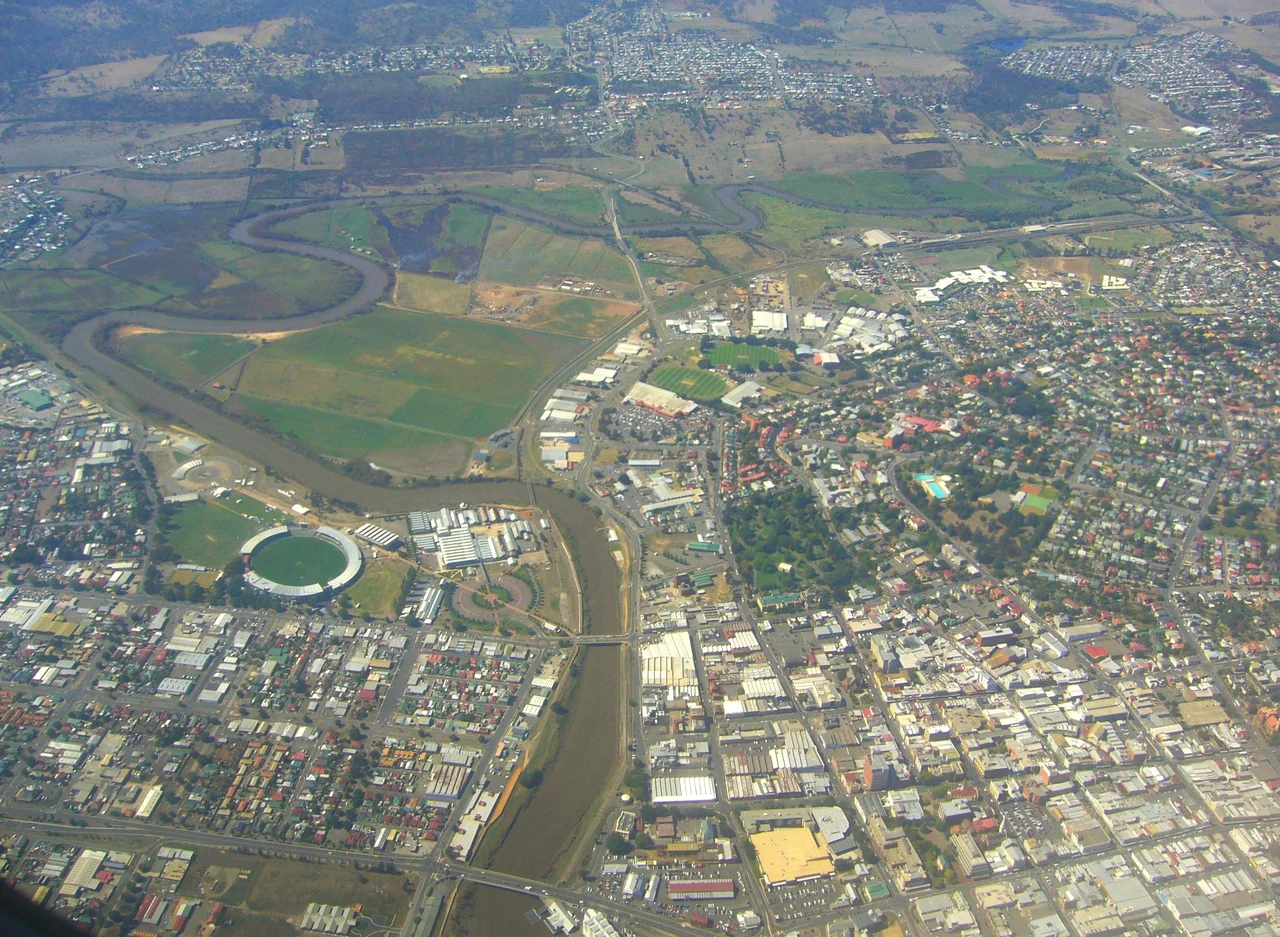

Launceston
Stand in central Launceston and you are standing where three rivers decide to become one. The North Esk and the South Esk arrive from opposite corners of northern Tasmania and join here to form the Tamar, the wide estuary the palawa people knew as kanamaluka, running north to Bass Strait. The rivers chose the site; the Europeans only confirmed it, settling here in 1806 and making this one of Australia's oldest cities. The result is a place that feels older and more lived-in than its size suggests, full of Georgian and Victorian streets, art-deco corners, and a low skyline its residents have deliberately kept that way.
An Older Country Than the City
Long before any settlement, this was the country of the Northern Midlands nations, among them the Letteremairrener, who moved with the seasons. They wintered near the coast at George Town and spent summers on Ben Lomond, returning to the Tamar for the mutton-bird season, a rhythm archaeologists trace back at least seven thousand years and probably far longer. Colonisation shattered that rhythm. After clashes from 1806 onward, often in response to settlers hunting on their land, the violence deepened into the genocidal expeditions of the Black War between 1827 and 1831. To walk Launceston's old streets honestly is to remember that the rivers gathered people here for millennia before the surveyors arrived, and to hold the cost of what followed.
A City of Firsts
For a regional city, Launceston has an unusual habit of going first. It saw the first use of anaesthetic in the Southern Hemisphere. It was the first Australian city to lay underground sewers. And in 1895, powered by the Duck Reach station on the South Esk, it became the first Australian city lit by hydroelectricity, turning a Tasmanian river into streetlight. These were not the gestures of a sleepy town but the ambitions of a confident one, grown rich first on northern wool and pastoral trade, then on the minerals boom that followed the discovery of tin at Mount Bischoff in 1871 and gold at nearby Beaconsfield in 1877. The wealth left its mark in stone, in the federation-era houses and grand public buildings that still give the centre its period air.
Macaques, Museums and a Town of the Year
Some of Launceston's pleasures are quietly unexpected. In City Park, beside the centre, a troop of Japanese macaques chatters in a large enclosure, a gift from the sister city of Ikeda, Japan. The Queen Victoria Museum and Art Gallery, founded in 1891 and now the largest museum outside an Australian capital, spreads across two sites, including the atmospheric former railway workshops at Inveresk. The General Post Office clock has chimed the quarter-hours, day and night, since the late nineteenth century. The city has gathered modern honours to match its old ones: named a UNESCO City of Gastronomy in 2021 on the strength of the surrounding farms, vineyards and produce, and Australian Town of the Year in 2022.
The Cradle of Cricketers
For a place of around ninety thousand people, Launceston has produced a remarkable share of sporting fame, especially with bat and ball. It is the birthplace of former Australian captain Ricky Ponting and of David Boon, the moustachioed stalwart of the national side, as well as cricketer James Faulkner; all three share the rare distinction of having been named player of the match in a World Cup final. It also gave Australia its most famous NASCAR export, Marcos Ambrose. Sport here has deep roots: in 1851, the Northern Tasmania Cricket Association Ground hosted the first first-class cricket match ever played in Australia. The city now waits on the next chapter, a Tasmanian team set to enter the AFL by 2028, with York Park, the state's largest stadium, ready and waiting in the heart of town.
From the Air
Launceston sits at 41.43 degrees south, 147.14 degrees east, at the head of the Tamar River estuary in northern Tasmania, about 45 km south of Bass Strait. From the air the city is unmistakable: three rivers converging into the broad Tamar, which then runs arrow-straight northwest toward the coast, with the dark slash of Cataract Gorge biting into the southwestern suburbs. Launceston Airport (YMLT/LST) lies about 15 km southeast of the centre and is one of Australia's most fog-bound commercial airports, thanks to the cool air that pools in the Tamar Valley; plan arrivals for late morning once the fog burns off. Devonport (YMDV) is roughly 99 km to the northwest along the coast. The encircling hills and frequent winter inversions make a clear, calm afternoon the best time to take in the valley.
Nearby Stories
- Van Diemen's Land 39 km away
- Cradle Mountain-Lake St Clair National Park 59 km away
- Overland Track 61 km away
- Bay of Fires 62 km away
- Freycinet National Park 68 km away
- Stanley (Tasmania) 117 km away
- Wybalenna Aboriginal Establishment 127 km away
- Flinders Island 151 km away