.jpg)
Lier
On the Zimmertoren in the center of Lier, an astronomical clock built by Louis Zimmer in 1930 tracks thirteen separate things at once. Mean solar time. Earth's rotation. Lunar phases. The tides at Antwerp. A dial for the equation of time. Another for the precession of the equinoxes. Zimmer, a self-taught Lier clockmaker, designed the whole face so that a visitor with no scientific training could read the cosmos at a glance. The tower has been doing this, faithfully, for nearly a century. It is the strangest, most patient thing in a town full of strange and patient things.
The Sheep-Head Decision
In the 14th century, Duke Jan II of Brabant offered Lier a reward for backing him against Mechelen. The choice was simple, the duke said: a university, or a livestock market. Lier picked the livestock market. The duke is said to have sighed about "those wretched sheep heads," and the university went to Leuven instead, opening in 1425 and becoming one of Europe's most important. Lier got cattle. To this day, Flemish people call anyone from Lier a Schapekop, a sheep head, and a bronze flock near the Zimmer Tower commemorates the choice with cheerful self-deprecation. It is the kind of joke a town only makes when it has long since stopped feeling small.
A Marriage That Reshaped Europe
In 1496, the wedding of Philip the Handsome and Joanna of Castile took place in Lier. Philip was the son of Maximilian of Austria. Joanna was a Spanish infanta who would later be remembered, fairly or not, as Joanna the Mad. Their first son, born in Ghent in 1500, would become Charles V, ruler of the Holy Roman Empire and the Spanish Empire at once. The empire on which the sun never set traced its founding moment to a ceremony in this market town. A generation later, Christian II of Denmark, deposed and stateless, lived out his exile here with his wife Isabella until 1523. He kept hoping his brother-in-law Charles would send troops to retake his throne. The troops never came.
The 1914 Erasure
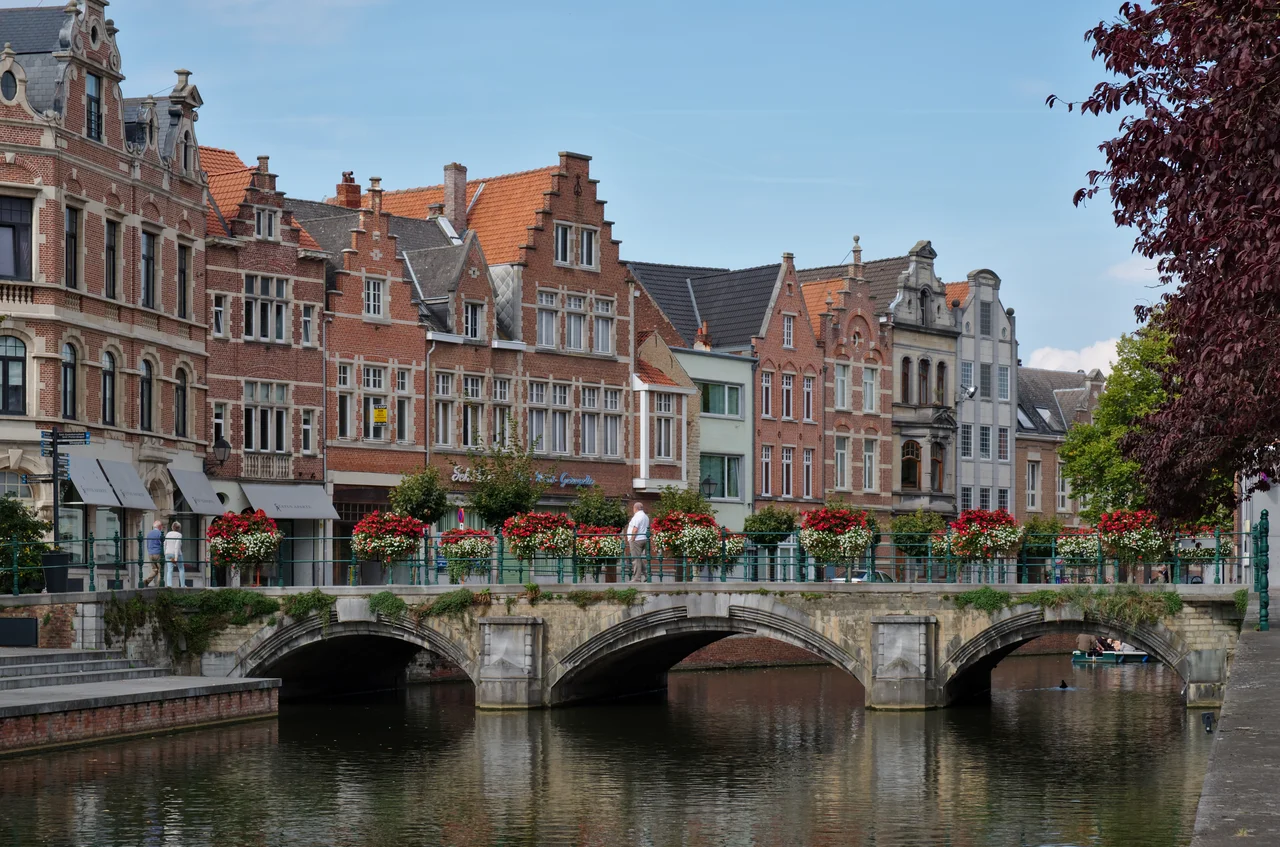
When the Germans advanced into Belgium in August 1914, King Albert and his Chiefs of Staff briefly headquartered in Lier before retreating to Temse. The city sat inside the redoubt of Antwerp, and German artillery treated it accordingly. By the time the shelling stopped, much of medieval Lier was rubble. The town hall, the belfry, the rows of guild houses that had stood since the duke's century, gone. What stands today looks medieval because the people who rebuilt it after the war made it look medieval. The replicas are good. They are also, undeniably, replicas. Only the Beguinage, founded in 1258 and now a UNESCO World Heritage Site as part of the Flemish Beguinages, survived largely intact. The last surviving beguine of Lier died there in 1994.
The Patient Tower
Which brings you back to Zimmer. Louis Zimmer was a Lier-born clockmaker who taught himself astronomy because the available instruments could not show him what he wanted to know. He built the Jubilee Clock for Belgium's 100th anniversary of independence in 1930, then a studio beside it housing the Wonder Clock with 93 separate dials, then a planetarium. Lier kept all of it. Walk through the old town today and you find a place that took something quirky from one of its own and decided it was worth keeping forever. The patron is Saint Gummarus, who died here in 714. The local cake is the vlaaike. The local rhyme, Lierke Plezierke, was coined by the writer Felix Timmermans in 1928 for a neighbour's golden wedding. Almost nothing about Lier is grand. Almost everything about it is specific.
From the Air
Located at 51.13N, 4.57E in Antwerp Province, Belgium, roughly 15 km southeast of Antwerp city. The city centre sits in a loop of the Nete river, which makes the town readable from cruising altitude on a clear day. Nearest major airport is Antwerp International (EBAW), about 18 km northwest; Brussels (EBBR) is 35 km south. Recommended viewing altitude 3,000 to 5,000 ft for the river loop and the Zimmertoren clearly visible against the medieval-replica town centre.
Nearby Stories
- Sonian Forest 2 km away
- Laarne Castle 4.5 km away
- Battle of Landen 8.6 km away
- Basilica of Our Lady of Scherpenheuvel 10 km away
- Baarle-Hertog 12 km away
- Hertogin Hedwigepolder 13 km away
- Borssele Nuclear Power Station 16 km away
- Ronse 20 km away