
Llanbedrog
Lady Elizabeth Love Jones-Parry, widowed in 1856 and finding herself in possession of a substantial dower allowance, decided to spend it on a Gothic Revival house in a south-facing cove on the Llyn Peninsula. She called it Plas Glyn-y-Weddw, the Mansion of the Widow's Glen. Forty years later, in 1896, the property opened its doors as a public art gallery, the oldest in Wales. It is still hanging Welsh painters today.
Saint Petroc's Village
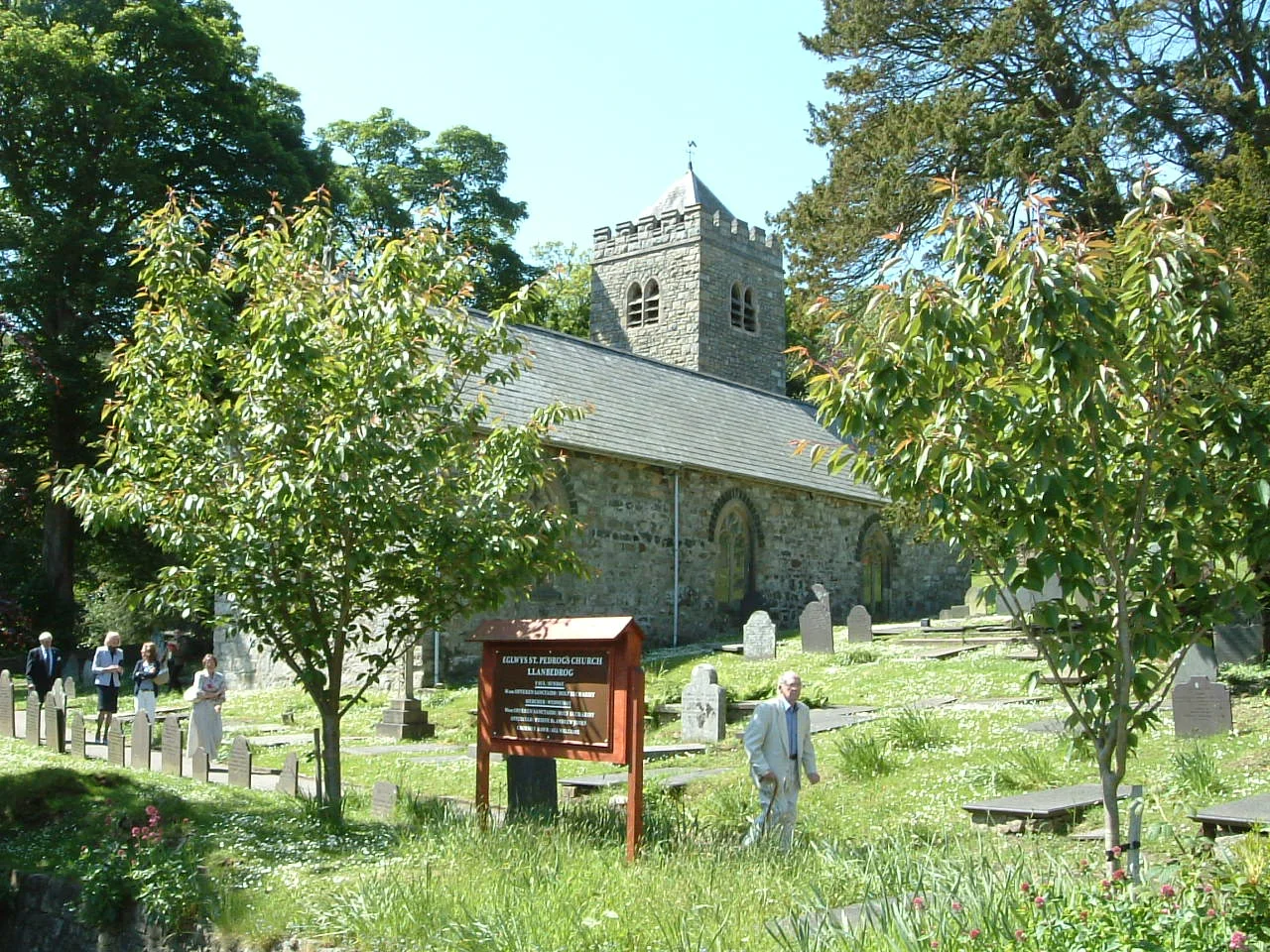
The name Llanbedrog means the church-enclosure of Petroc, a sixth-century Celtic saint who travelled out of Wales to convert the Cornish and gave his name to villages from Padstow to here. Petroc may be a form of Patrick, though he is a different man entirely from Saint Patrick of Ireland. The parish church that bears his name is a Grade II*-listed building whose oldest stonework dates back to the medieval period. The village wraps around the church on the south coast of the Llyn Peninsula, on the A499 between the busier resort of Abersoch four miles west and the market town of Pwllheli four miles east. The 2011 census counted 1,002 souls, and 54 per cent of residents aged three and over reported being able to speak Welsh.
Granite, Beaches, and a Tramway
South of the village rises Mynydd Tir-y-Cwmwd, a granite headland whose pink-grey stone was cut commercially through the late nineteenth century and the first half of the twentieth. The quarry finally closed in 1949 after almost a century of work, and the headland is now National Trust land, its old workings softened by gorse and bracken. The sweep of sandy beach at the foot of the cliffs drew the first generation of Victorian and Edwardian holidaymakers. To meet that demand the entrepreneur Solomon Andrews built a narrow-gauge horse tramway in 1894, extended to Llanbedrog in 1897, that ran along the seafront from Pwllheli. Most of the track was washed away in the great storm of 1927, but sections of the route can still be picked out below the cliffs and one preserved tramcar sits on a stretch of rail at Plas Glyn-y-Weddw.
Plas Glyn-y-Weddw
Lady Jones-Parry's house has had a longer afterlife than most dower houses. Originally built in 1856 in a Tudor-Gothic style to designs by the Bangor architect Henry Kennedy, it passed through several hands before Solomon Andrews acquired it as part of his Llanbedrog estate in 1896 and immediately opened it to the public as an art gallery. The opening predates every other public gallery in Wales. Today the gallery still shows work by Welsh and Wales-based artists, and visitors come for the changing exhibitions, the tea room, the formal gardens that fall away toward the bay, and the chance to climb up through the woods to the unmissable cliff-top sculpture known as the Tin Man, replacing an older figurehead that once stood here as a landmark for ships.
A Refuge Above the Cove
Beyond the village, on land that once belonged to the wartime RAF Penrhos bombing station, sits a quieter and more recent history. Since 1949 the former camp has served as a refuge community for Polish exiles, originally for soldiers and their families who could not return home after the war and the imposition of communist rule. The settlement persists today as one of the longer-running Polish communities in Wales, a small cultural island unsigned on most maps. Llanbedrog is small enough that all of these things, the saint's church, the gallery, the granite cliffs, the lost tramway, and the Polish refuge, fit inside the same parish.
From the Air
Llanbedrog sits on the south coast of the Llyn Peninsula at 52.858N 4.485W, between Pwllheli (4 miles east) and Abersoch (4 miles west) on the A499. From the air, look for the small sandy bay with the dark wooded headland of Mynydd Tir-y-Cwmwd to the south, and the white Tin Man sculpture on the cliff above the bay. Plas Glyn-y-Weddw shows as a pale Gothic facade among trees just inland. Nearest airfield is Caernarfon (EGCK) 15 nm north-east; Valley (EGOV) 33 nm north.
Nearby Stories
- Swallow Falls 2.3 km away
- Dinas Dinlle 3.9 km away
- Cardigan Bay 6.7 km away
- Battle of Mynydd Hyddgen 7.5 km away
- Irish Sea Bridge 20 km away
- Ysbyty Ifan 24 km away
- Cantre'r Gwaelod 29 km away
- Irish Sea 46 km away