
Llyn Peninsula
Drive west from Pwllheli and the road keeps narrowing until you reach a point where there is simply no more land. The Llyn Peninsula runs thirty miles into the Irish Sea, and at its tip is Bardsey Island, where medieval pilgrims came to die. The peninsula's relative remoteness has done two things at once: it has preserved one of the strongest concentrations of native Welsh speakers anywhere in the world, and it has made the coastline irresistible to anyone wealthy enough to buy a second home overlooking it. Both pressures coexist, sometimes uneasily, on the same hundred and fifty square miles of land.
A Welsh Stronghold
Llyn was a cantref of the medieval kingdom of Gwynedd, absorbed into Caernarfonshire after Edward I's conquest of 1284 and held in that administrative shape until 1974. The name itself is thought to be Irish in origin, sharing a root with Leinster and Laigin and surfacing too in the name of the village of Porthdinllaen on the north coast. The peninsula's isolation kept Welsh alive when industrialised regions saw it eroded. As late as the 1960s there were still villages here where elderly residents spoke no English at all, and the 2001 census recorded that 73 per cent of the local population could speak Welsh. The Welsh Language and Heritage Centre at Nant Gwrtheyrn, set in a restored quarrying village on the north coast, offers immersion courses to learners from across the world.
Fire in Llyn
In 1936 the British government announced it would build an RAF bombing school at Penyberth, a farmhouse on the peninsula that had been a way-station for medieval pilgrims and the home of generations of patrons of Welsh poetry. Similar proposals for sites in Northumberland and Dorset had already been withdrawn after local protests; Prime Minister Stanley Baldwin refused to receive a deputation representing half a million Welsh objectors. On 8 September 1936 three Plaid Cymru members, dramatist and lecturer Saunders Lewis, Baptist minister and poet Lewis Valentine, and novelist D. J. Williams, set fire to the bombing school and presented themselves at Pwllheli police station, in deliberate emulation of Gandhi's principle of non-violent civil disobedience. The trial at Caernarfon ended with a hung jury; the case was transferred to the Old Bailey in London, where the three men were sentenced to nine months in Wormwood Scrubs. On their release in 1937, fifteen thousand people greeted them as heroes at a pavilion in Caernarfon. The event, known in Welsh as Tan yn Llyn, the Fire in Llyn, is a foundational moment in the modern Welsh nationalist movement.
Volcanic Bones
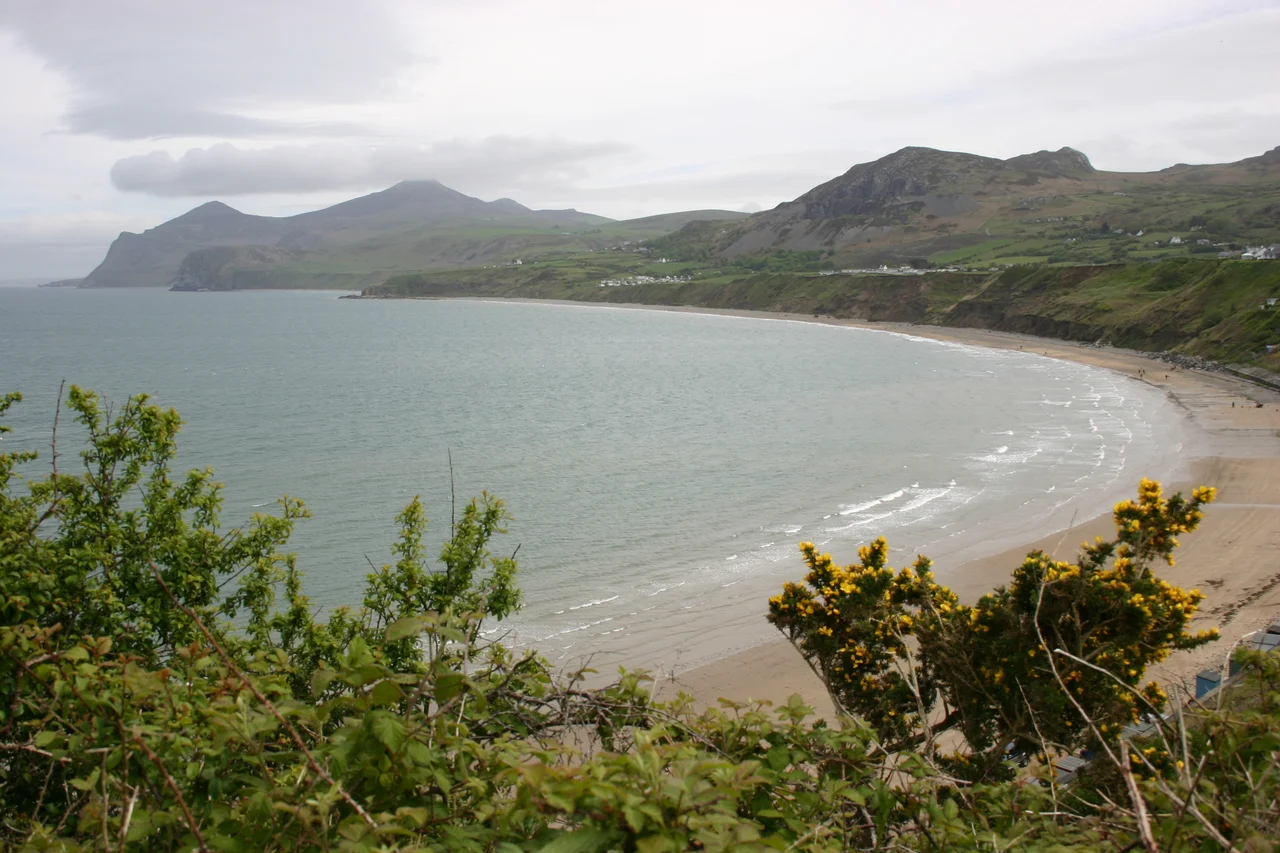
The peninsula is a plateau studded with volcanic hills, the kind of cone-shaped landmarks (Yr Eifl, Garn Boduan, Garn Fadryn, Mynydd Rhiw) that sailors and pilgrims used to navigate by. The geology is complicated: Ordovician volcanics dominate, with older Cambrian rocks south of Abersoch and Precambrian Monian Complex outcrops in the far west sharing kin with Anglesey. In 1984 an earthquake measuring 5.4 on the Richter scale shook the peninsula, felt as far as western Ireland. Northern Llyn has a rugged cliffed coast broken by tiny coves, the old herring-port of Nefyn among them. The southern coast offers long sandy beaches: Porth Neigwl (whose English name, Hell's Mouth, hints at its reputation among sailors), Castellmarch, and the sheltered bay at Abersoch. The peninsula gives its name to the Lleyn breed of sheep, a hardy white-faced animal prolific enough to have become one of the most popular commercial breeds across Britain.
The Holiday-Home Question
The same beauty that drew medieval pilgrims now draws tourists from north-west England and the West Midlands, and the question of holiday homes has become as charged as any local issue in Wales. Between the 1970s and 1990s a clandestine group calling itself Meibion Glyndwr (Sons of Glendower) claimed responsibility for several hundred arson attacks on holiday properties in Wales, some of them in Llyn. The fires stopped without anyone ever being convicted, but the underlying tensions did not disappear. Today Gwynedd Council has formally asked the Welsh Government for legal powers to limit the number of holiday lets in any given community. Abersoch lost its Welsh-language primary school in 2021 for lack of pupils. The peninsula is not the open-air museum some visitors imagine; it is a working landscape whose Welsh-speaking communities are calculating, in real time, what their future requires.
Coast and Pilgrim Path
Most of the coastline is protected as the Llyn Area of Outstanding Natural Beauty, sixty-two square miles taking in twenty Sites of Special Scientific Interest, the Cors Geirch national nature reserve, and a European Marine Special Area of Conservation. A rare mason bee, Osmia xanthomelana, lives nowhere else in Britain. The Llyn Coastal Path runs the full length of both shores, a long-distance footpath that more or less follows the route medieval pilgrims took toward Bardsey, pausing at the holy wells that still mark the way. Three trips to Bardsey, the old saying went, were worth one to Rome. The wells are still here. So is the island. So is the language the pilgrims would have spoken.
From the Air
The Llyn Peninsula extends some 30 miles west-south-west into the Irish Sea from the Welsh mainland, centred roughly at 52.91N 4.46W. From the air it appears as a clear finger of land bounded by Tremadog Bay (south) and Caernarfon Bay (north), with Bardsey Island as a comma-shaped wedge off the south-western tip. Notable navigation landmarks include Yr Eifl (564 m / 1,850 ft) at the northern neck, Carn Fadryn (371 m / 1,217 ft) in the centre, and the sandy curves of Porth Neigwl on the south coast. Snowdonia rises 30 nm east. Nearest airfield is Caernarfon (EGCK) at the eastern edge of the peninsula; Valley (EGOV) on Anglesey is 20-30 nm north depending on position. Watch for sea fog rolling in from the Irish Sea, especially the western tip.
Nearby Stories
- Swallow Falls 2.3 km away
- Dinas Dinlle 3.9 km away
- Cardigan Bay 6.7 km away
- Battle of Mynydd Hyddgen 7.5 km away
- Irish Sea Bridge 20 km away
- Ysbyty Ifan 24 km away
- Cantre'r Gwaelod 29 km away
- Irish Sea 46 km away