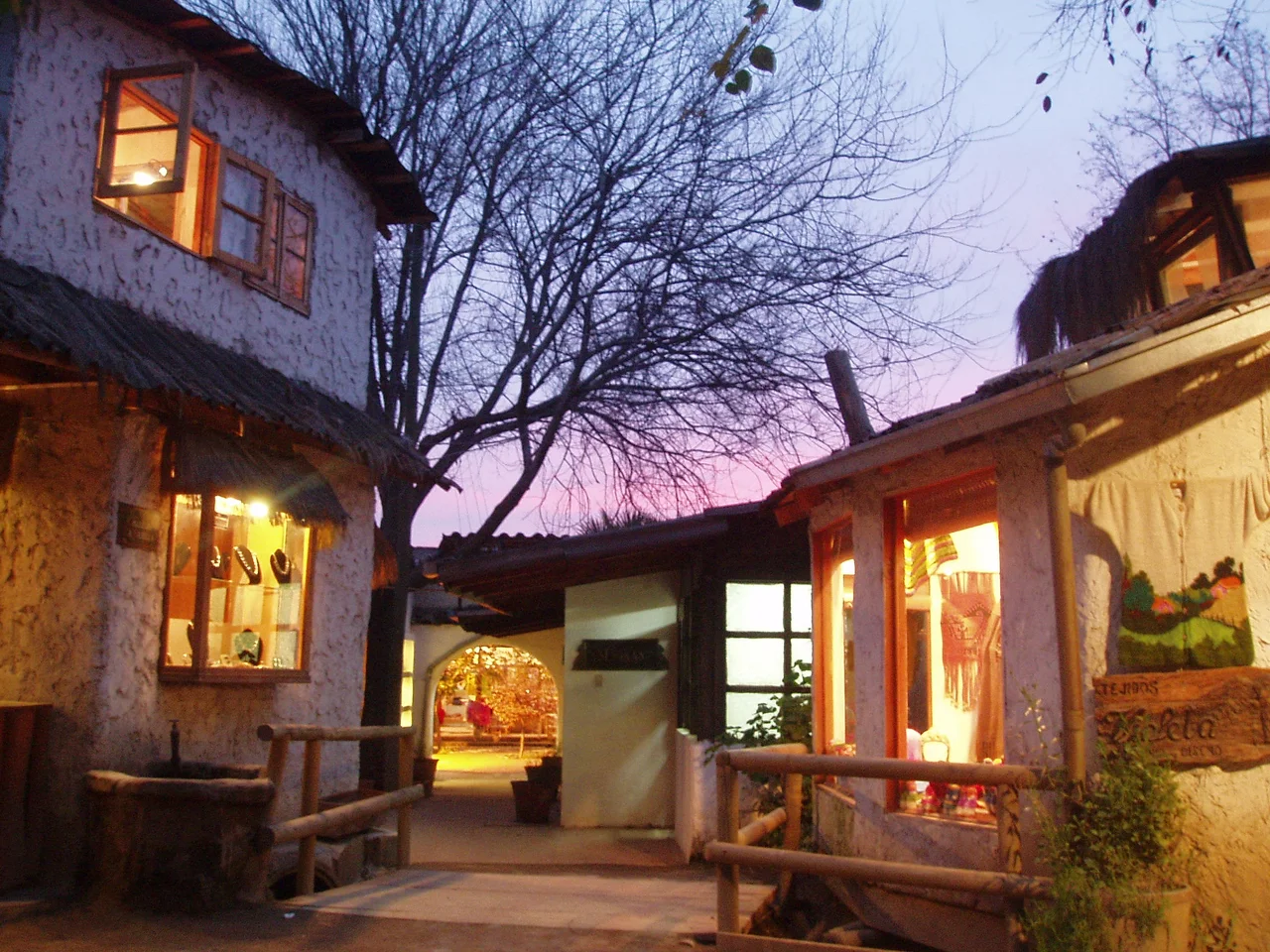

Los Dominicos Village
Two copper domes catch the Andean light at the end of Avenida Apoquindo, green-gold against the foothills where Santiago finally runs out of city. They sit atop the towers of San Vicente Ferrer Church, and a family added them in memory of two children who died young. Behind the church spreads a warren of low adobe shops, dirt-floored lanes, and the smell of leather and wood smoke. This is Pueblito Los Dominicos, where a working farm became a craft village without ever quite losing its rural ease.
A Conquistadora's Land
The ground here has changed hands for nearly five centuries. In 1544, Pedro de Valdivia, the governor who founded Santiago, granted these lands to Ines de Suarez, the Spanish conquistadora who had crossed the Atacama at his side and helped defend the young settlement against attack. From her the property passed through family after family, a quiet corner of the valley at the city's edge. During the Chilean War of Independence it served a more dangerous purpose: the guerrilla leader Manuel Rodriguez used it as a hiding place, and later figures such as the historian Diego Barros Arana and the future president Jose Manuel Balmaceda sheltered on the same grounds. Long before it sold pottery and empanadas, this was a place people came to disappear.
The Dominican Hill
The name comes from the Dominican order, which kept a monastery beside the church when the land belonged to the Cranisbro family, benefactors of the friars. The two copper-topped towers of San Vicente Ferrer remain the village's signature, and Chile declared the church a National Monument in 1983. The surrounding ground was protected soon after as a traditional heritage zone. Walk through it today and the religious quiet still lingers at the edges, in the shade of old trees and the thick adobe walls that hold the heat of the day. The sacred and the commercial share the same dust here, and neither seems to mind.
Old Stables, New Trades
The market as you see it was born in the late 1970s and early 1980s, when artists and artisans moved into the abandoned cellars and stables of the old fundo, the rural estate that once worked these fields. Rather than tear anything down, they built outward in the same colonial idiom, raising small shops of traditional adobe along the lanes, low walls and tiled roofs and shaded inner courtyards. The result is a village that looks far older than it is. Nearly two hundred stores now fill it, clustered so close that the paths between them feel like the streets of a tiny pueblo. The rustic look was not staged for tourists; it is simply what happens when craftspeople inherit a farm and decide to keep its bones rather than scrape them away.
What the Lanes Hold
The goods run from the practical to the beautiful and back again. Leather and wool, carved wood and stone sculpture, paintings, hammered copper cookware, and fine silver jewelry fill the stalls, much of it made by the same hands that sell it. Vendors offer flowers and medicinal herbs, native Chilean plants alongside imported bonsai, even pets, the lanes turning briefly into a garden, then a workshop, then a kitchen. When hunger arrives, so does the smell of Chilean empanadas baking and pastel de choclo, the sweet-and-savory corn pie that is comfort food across the country. On weekends the lanes fill with families, the air thick with charcoal smoke and the murmur of bargaining, and in spring the bright diamonds of volantines, the kites Chilean children fly, snap overhead in the foothill wind. It is one of the few places in modern Santiago where the city slows to the pace of someone deciding which handmade thing to take home.
From the Air
Pueblito Los Dominicos sits at 33.41 S, 70.54 W in Las Condes, at the eastern foot of the Andes where Santiago's grid surrenders to the mountains. From the air, look for the two green copper domes of San Vicente Ferrer Church at the end of Avenida Apoquindo, set against the abrupt rise of the cordillera. The closest field is Eulogio Sanchez (Tobalaba) Airport (ICAO: SCTB), a general-aviation strip in the eastern suburbs only a few miles away; Santiago's main gateway, Arturo Merino Benitez International (ICAO: SCEL), lies about 15 miles northwest in Pudahuel. Recommended viewing altitude is 2,000 to 3,000 feet AGL. Morning light is best before afternoon haze and Andean updrafts build over the foothills.
Nearby Stories
- Paine Memorial 21 km away
- 1947 BSAA Avro Lancastrian Star Dust accident 23 km away
- Battle of Chacabuco 31 km away
- La Campana National Park 36 km away
- Puente del Inca 44 km away
- Casa de Isla Negra 62 km away
- Santa Cruz, Chile 103 km away
- Pierre Auger Observatory 172 km away