
Loughmore
The village is officially Loughmoe, in Irish Luach Maigh, the reward-field. The reward refers either to medieval feudal arrangements - lands held free of rent in return for some special service - or to the legend of the Purcell ancestor who killed a giant boar to win a king's daughter and the castle and the surrounding land. Either way, Loughmoe is a name with a story attached. The English form, Loughmore, is the result of a nineteenth-century British Ordnance Survey error: the cartographers misread the older Irish name as Loch Mór, great lake, which is not what it ever meant. The castle - Loughmoe Castle - kept the right spelling. The village did not. Most local people use both interchangeably and pronounce neither one correctly to outsiders.
The Golden Vale
Loughmore sits on the banks of the River Suir, 5.5 kilometres south of Templemore and 10 kilometres north of Thurles, just east of the N62 road that connects them. This is the Golden Vale - one of the richest agricultural areas in Europe, a great rolling plain of limestone-based grassland that supports some of the most productive dairy farms anywhere in the world. The parish has always been farming country: cattle and milk, with some tillage on the lighter ground. The Avonmore creamery system that became Glanbia - now a global nutrition company - was assembled from village cooperatives like the ones that sat in Loughmore and the parishes around it. The land here is so good that it tends to make local farmers complacent; visitors from Mayo or West Cork raise their eyebrows when they see how easily it grows what is asked of it.
The Cormack brothers
On a night in 1858, John Ellis, a land agent from Kilrush near Templemore, was shot dead as he walked home along a country lane. His way had been blocked by uprooted bushes and branches; a hidden assailant fired once and Ellis died an hour later. Ellis had been hated for evicting tenants on behalf of the landlords who employed him - the kind of man whose death would be a relief to many in the parish. The police investigation, however, did not focus on the local landlord with whose sister Ellis had reportedly been having an affair. It focused instead on two local farmers, the brothers Daniel and William Cormack, who were arrested and tried at Nenagh Assizes in March 1858. The trial relied heavily on the evidence of an informer described in contemporary accounts as 'a villainous character' and widely believed to have been part of the murder plot. The presiding judge was William Keogh, notoriously harsh and politically partisan.
11 May 1858
On Thursday 11 May 1858, the Cormack brothers were hanged outside Nenagh Prison in front of a public crowd. Daniel Cormack spoke from the scaffold. Lord have mercy on me, he said, for you know, Jesus, that I neither had hand, act, nor part in that for which I am about to die. Good people, pray for me. His brother William, according to the contemporary report, made the same awful declaration; both were in the next moment launched into eternity. Two thousand three hundred and fifty seven people had signed a petition before the execution attesting to the brothers' innocence. The petition was ignored. Years later, a tenant named Michael Gleeson - one of the tenants Ellis had evicted - confessed to the murder on his deathbed. The Cormack brothers had been hanged for someone else's crime.
1910: the brothers come home
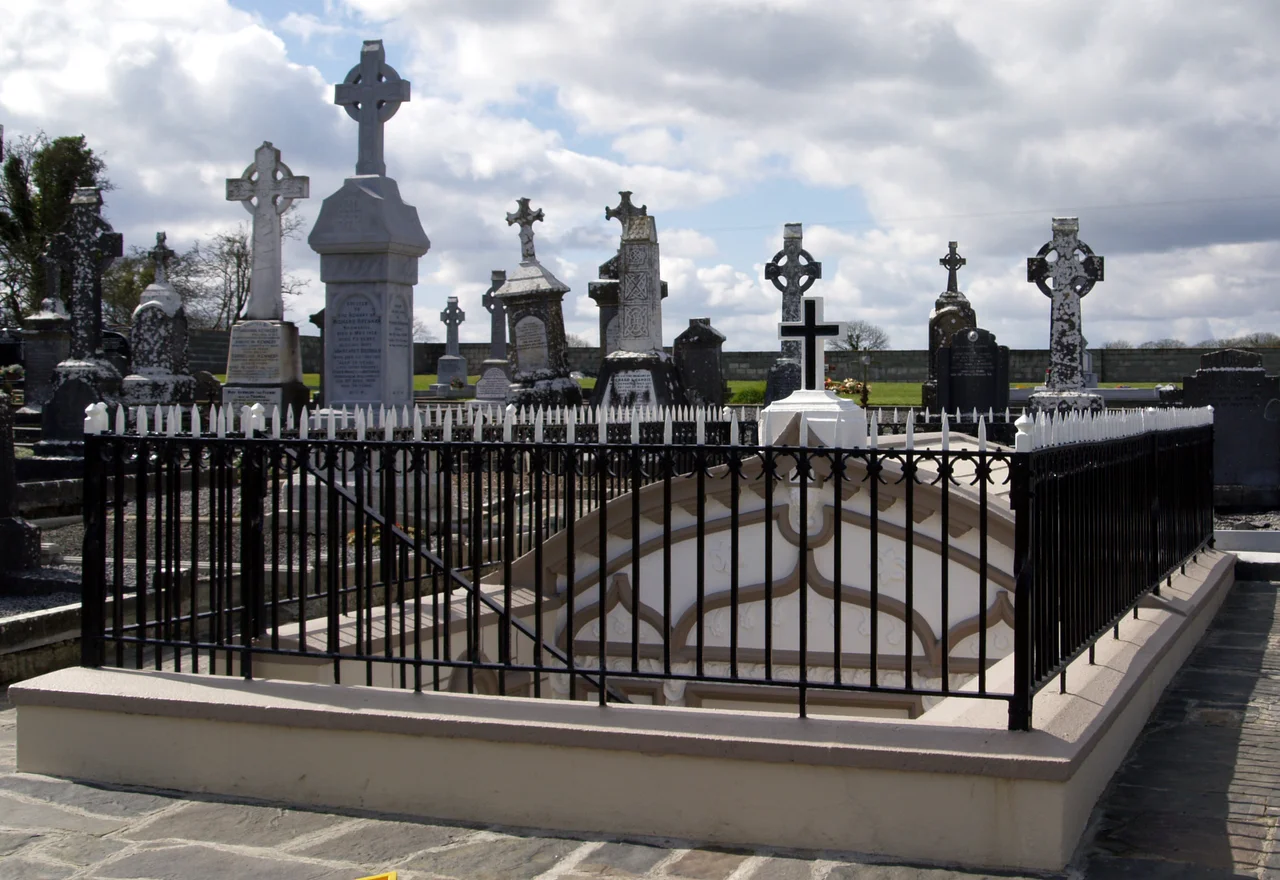
In 1910 a committee was formed in Loughmore to exhume the bodies of Daniel and William Cormack from the unmarked grave in Nenagh Gaol and return them to the village for proper burial. The exhumation was carried out; the original oak coffins were still recognisable. Two hearses drawn by plumed horses brought the brothers back to Loughmore, followed by a vast crowd through every village along the road. They were reburied in a mausoleum built in the churchyard, with an inscription on one side that proclaims their innocence to all who read it. People still go to see the mausoleum today; the original oak coffins are visible inside. It is one of the more remarkable acts of communal memory in nineteenth-century Ireland - a parish that knew, and kept knowing for half a century, that two of its own had been judicially murdered and brought them home when it could.
Hurling and football, both
Loughmore-Castleiney GAA is the local Gaelic Athletic Association club, and it is unusual in mid-Tipperary for one specific reason: it plays both Gaelic football and hurling at a serious level. The parish is known locally as a football island in a region where most of the surrounding clubs play hurling only. In 2013 Loughmore-Castleiney did something even more unusual - they won both the Tipperary Senior Hurling Championship and the Tipperary Senior Football Championship in the same year, the first such double in the county's history. Two of the brothers Noel and John McGrath, both born here, have played hurling for Tipperary at senior inter-county level; Noel McGrath is a two-time GAA GPA All Star. The club provided Jim Ryan and Bill Ryan to the Tipperary team that played in Croke Park on Bloody Sunday in November 1920, when British forces fired on the crowd and killed fifteen people including the Tipperary player Michael Hogan. Local memory in Loughmore is unusually long.
The fiddler and the suffragist
Kathleen Nesbitt of Loughmore was an award-winning traditional Irish fiddler in the twentieth century; her daughter Máiréad Nesbitt became the lead violinist of Celtic Woman, the global touring ensemble that has sold millions of records and headlined arenas across North America and Asia. Hanna Sheehy-Skeffington, the feminist, suffragist and political activist - widow of the pacifist Francis Sheehy-Skeffington who was murdered without trial by Captain John Bowen-Colthurst during the Easter Rising in 1916 - had family roots in Loughmore. After her husband's killing she became one of the most prominent campaigners for women's suffrage and Irish independence, lecturing extensively in the United States and serving on the Sinn Féin executive. The small village has produced, by its quiet means, both the music that fills Carnegie Hall and the voices that filled the meetings where Irish women demanded the vote.
From the Air
Loughmore is at 52.757°N, 7.827°W in mid-Tipperary in the Golden Vale, about 10 km north of Thurles and 6 km south of Templemore. Best cruise altitude 1,500-3,000 ft. The village sits along the N62 road; the Dublin-Cork railway runs through the parish; Loughmoe Castle is the most prominent landmark. The Devil's Bit mountains rise west of the area. The M7 and M8 motorways frame the region. Nearest airports: Shannon (EINN) ~75 km west, Cork (EICK) ~115 km south, Dublin (EIDW) ~140 km northeast.
Nearby Stories
- Birr, County Offaly 0.6 km away
- Killaloe 2.6 km away
- Sack of Cashel 4.5 km away
- Abbeyleix 10 km away
- 2003 Derrybrien Landslide 12 km away
- Knocktopher 14 km away
- Portarlington, County Laois 15 km away
- Croom Castle 20 km away