
Louis Blériot
At 4:41 on the morning of 25 July 1909, an underpowered French monoplane took off from a field near Les Baraques, between Calais and Sangatte, with a thirty-seven-year-old man at its controls who could not navigate by compass and was still in considerable pain from third-degree burns on his foot. He had no map. He flew at about 250 feet over the Channel and at roughly 40 miles per hour. He could see no boat below him, no horizon, no land. He had agreed to follow the destroyer Escopette toward Dover, but he overtook it. For ten minutes he was completely alone above the English Channel - 'isolated, lost in the midst of the immense sea,' he later wrote. Then the grey line of England appeared on his left, off to the east. The wind had blown him off course. He turned to follow the coast and looked for a man with a French flag.
Headlamps and Heartbreak
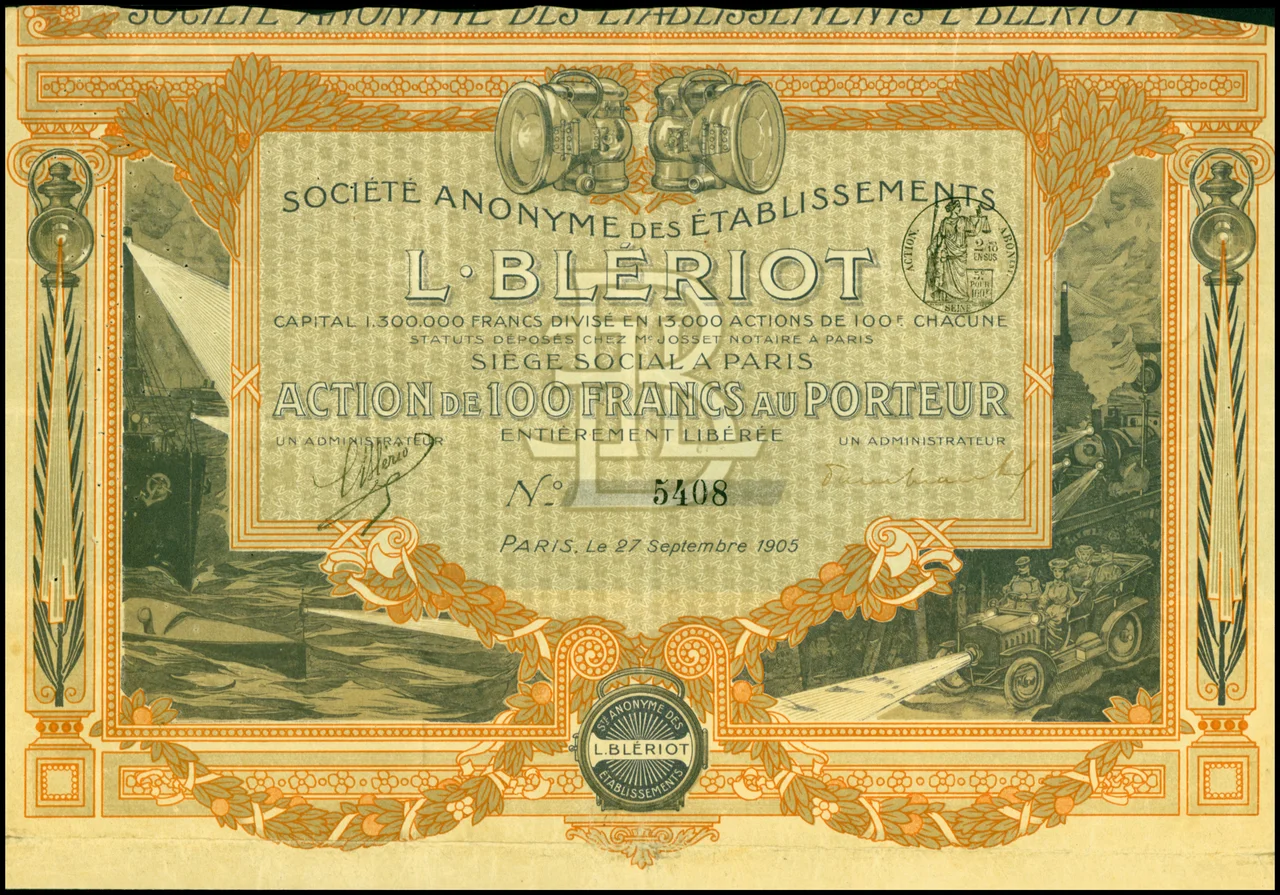
Louis Blériot was born in Cambrai in 1872, the oldest of five children. He went to the Institut Notre Dame at ten, the lycée at Amiens at fifteen, the Collège Sainte-Barbe in Paris to cram for the entrance exam to the École Centrale, and graduated 113th of 203 from one of France's most demanding engineering schools. After military service in the artillery, he took a job with an electrical engineering company - and left it to launch his own business. He had invented the world's first practical acetylene car headlamp. By 1897 he had a showroom on rue de Richlieu. By the turn of the century he was supplying Renault and Panhard-Levassor, two of the great French automobile makers. In October 1900 he saw a young woman dining in a restaurant near his showroom and told his mother that night: I will marry her, or I will marry no one. A bribed waiter produced her name - Alice Védères, daughter of a retired army officer. He courted her with the same determination he later brought to aviation. They were married in February 1901.
Crashes
Aviation was a series of expensive disasters. Blériot built ornithopters that never flew. He went into partnership with Gabriel Voisin in 1905; their first powered aircraft, the Blériot III and IV, failed. He left the partnership in 1906 and started his own company. The Blériot V crashed nose-first into the ground at 30 mph in April 1907; he was lucky the engine, mounted directly behind his seat, didn't crush him. The Blériot VI - tandem-wing, briefly successful - went into a spiralling nosedive at 25 metres altitude when the engine cut out. He climbed out of his seat and threw himself toward the tail; the aircraft partly pulled out and came down nearly horizontal. He walked away with cuts on his face from broken goggles. The Blériot VII flipped on landing. The Blériot VIII was destroyed in a taxiing accident. The Blériot IX and X never flew at all. By the time he started flying the Blériot XI in January 1909, he had spent at least 780,000 francs of his headlamp money on experimental aircraft - at a time when a skilled mechanic earned 250 francs a month.
A Burning Foot
In July 1909, at an aviation meet at Douai, Blériot was flying his Blériot XII when the asbestos insulation around the exhaust pipe worked loose after fifteen minutes in the air. Within half an hour, one of his shoes had burned through. He flew for another twenty minutes despite the pain, until engine failure forced him down. The burns were third-degree. The doctors said two months to heal. Three days later, he wrote to the London Daily Mail to announce his intention to compete for the thousand-pound prize the paper had offered for the first successful flight across the English Channel in a heavier-than-air machine. His main rival was Hubert Latham, a French-English aviator flying an Antoinette IV. Latham had already set up camp at Sangatte. Wilbur Wright had been asked to compete but declined - his brother Orville, recovering from injuries in America, had cabled telling him to wait. The Channel had been crossed by balloon many times since 1785. It had never been crossed by aeroplane.
The Crossing
Latham tried first, on 19 July. His Antoinette's engine failed six miles from Dover and he made the first landing of an aircraft on the sea. The destroyer Harpon picked him up. A replacement aircraft was being shipped from the Antoinette factory. The wind was too strong for several days. On Saturday night, 24 July, it began to drop. Alfred Leblanc, Blériot's friend and chief mechanic, woke at two in the morning, judged the weather perfect, and woke Blériot. At 4:15 he made a short trial flight in the Blériot XI. At 4:41, when the rising sun was confirmed by signal - the rules required flight between sunrise and sunset - he took off. The Type XI had a three-cylinder Anzani engine, originally built for motorcycles, and a laminated walnut propeller designed by Lucien Chauvière. He climbed to about 250 feet. The visibility worsened. After overtaking the Escopette, he lost sight of every reference point. Then the English coast appeared on his left, well east of his intended landing. He followed the line of cliffs about a mile offshore until he spotted Charles Fontaine, a journalist from Le Matin, waving an enormous French tricolour. Fontaine had picked a patch of gently sloping land called Northfall Meadow, close to Dover Castle on top of the cliffs, on the advice of Frederick Duckham, the engineer running the Dover harbour works. Blériot circled twice to lose height, cut his engine at about 20 metres, and made a heavy, gusty 'pancake' landing. The undercarriage broke. One blade of the propeller shattered. He was not hurt. The crossing had taken 36 minutes and 30 seconds.
The Outline in the Grass
Within hours he was celebrity. The Daily Mail correspondent put him in a motor car and drove him to the harbour, where Alice was waiting on the destroyer. They were taken to the Lord Warden Hotel at the foot of the Admiralty Pier. Orders began to come in for the Type XI - by year's end he had taken over a hundred at 10,000 francs each, finally repaying the headlamp investment. The Daily Mail prize was £1,000, worth about £152,000 in 2025 money. The outline of his aircraft was laid out in granite setts in the turf at Northfall Meadow, funded by the oil manufacturer Alexander Duckham and built by his brother Frederick Duckham, the engineer who had picked the landing site. The memorial is still there, half a kilometre from Dover Castle, in the grass. The Blériot XI itself is in the Musée des Arts et Métiers in Paris. Between 1909 and the start of the First World War in 1914, his company built about nine hundred aircraft, most of them variations of the Type XI. He bought the Société pour les Appareils Deperdussin in 1913 and renamed it SPAD - the company that produced the SPAD S.XIII fighter that helped win the air war. In 1927, retired from flying, he was at Le Bourget to greet Charles Lindbergh after his transatlantic flight. The two men, thirty years apart in age, had each crossed water that nobody before them had managed to cross by air. They posed for the cameras together. Blériot died of a heart attack in Paris on 1 August 1936 and was buried with military honours.
From the Air
The Blériot Memorial, marking the exact spot of the landing on 25 July 1909, sits at 51.131°N, 1.323°E in Northfall Meadow on the cliffs above Dover, about 500 metres east of Dover Castle. The outline of the Type XI aircraft is laid out in granite setts in the turf. From the air, look for the memorial as a small clearing in the grass on the chalk headland just east of the castle. The crossing route went from Les Baraques (50.95°N, 1.78°E) near Calais northwest across the Strait of Dover. Nearest airport is London Ashford (Lydd) (EGMD) about 35 km west. Best viewed at low altitude in clear visibility when both the French and English coasts are simultaneously in view.
Nearby Stories
- HMS Hermes (1898) 7.3 km away
- Herne Bay Museum and Gallery 8.5 km away
- Benenden School 9.2 km away
- Boulonnais 9.4 km away
- Priestfield Stadium 12 km away
- 1382 Dover Straits Earthquake 17 km away
- Royal Sovereign Lighthouse 21 km away
- Battle of Boulogne 28 km away