.jpg)
Manchester Arena bombing
Saffie-Rose Roussos was eight years old. She had just seen Ariana Grande perform her favourite songs, and she was walking out of Manchester Arena with her mother and sister, holding her mother's hand, when the bomb went off at 22:31 on 22 May 2017. She did not survive the night. Twenty-one others did not survive either: most of them young women, ten of them under the age of twenty, the oldest a fifty-one-year-old mother who had come to the arena to collect her children. They were not statistics. They were the reason the families were there at all, the daughters and sisters and cousins for whom Ariana Grande's tour had been a long-promised gift.
The Concert
Roughly 14,200 people were inside Manchester Arena that Monday night. The concert had begun at around 19:35 and drew toward its close shortly before 22:30, as the lights came up and the screaming softened into the buzz of people gathering coats and finding parents. The City Room foyer connecting the arena to Victoria Station was, by design, the main route home. It was where mothers and fathers stood holding signs and phones, waiting to catch sight of their children in the flood. Outside the security cordon, it was the easiest place in the venue to enter unchallenged carrying a thirty-kilo backpack. The attacker, who had been seen on the mezzanine for nearly an hour, descended at 22:30. A minute later, he detonated a nail-and-bolt device that the coroner would later say was strong enough to kill at twenty metres.
Those Who Were Lost
The twenty-two who were killed came from across Britain and beyond. Two were Polish nationals living in the UK; twenty were British. Among them was Martyn Hett, twenty-nine, a Coronation Street superfan who had been four metres from the blast and could only be identified by a tattoo of Deirdre Barlow on his leg. His mother Figen Murray would spend the next seven years campaigning for the venue security legislation that bears his name. Among them was Saffie. Among them was Nell Jones, fourteen, and Olivia Campbell-Hardy, fifteen, and Eilidh MacLeod, fourteen, and the off-duty police officer Elaine McIver, who had come to the concert with her partner. More than a thousand people were physically or psychologically injured. Twelve of those hospitalised were children under the age of sixteen. Many of the families in the foyer were waiting to take small children home from what was, for many of those children, their first concert.
The Response
Within a minute, a transport police constable was on the radio: 'We need more people at Victoria, we just had a loud bang.' Greater Manchester's emergency services moved at speed. The North West Ambulance Service sent sixty vehicles and carried fifty-nine people to hospitals, while off-duty consultant anaesthetist Michael Daley was later entered into the British Medical Journal's book of valour for the work he did at the scene. The Greater Manchester Fire and Rescue Service, by the Kerslake Report's later judgement, was 'brought to a point of paralysis' by a two-hour delay rooted in communication failures. Bystanders, taxi drivers, hotel staff at the Holiday Inn nearby, and parents who had been waiting for their children all carried the wounded, gave blood, opened their doors. Some of them are still in therapy. The Royal Manchester Children's Hospital, which Queen Elizabeth II visited three days later, was the place where many of those families learned whether their child had lived.
St Ann's Square
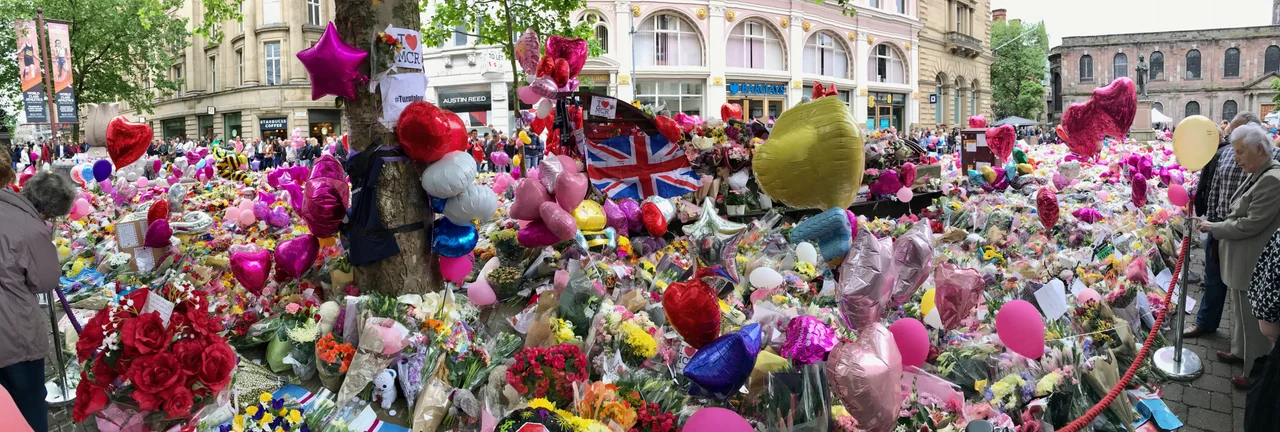
The vigil came the next day. Thousands gathered in Albert Square. Bishop David Walker of Manchester lit a candle. The Muslim Council of Britain condemned the attack. On 25 May the country observed a national minute's silence; in St Ann's Square, when the silence ended, somebody began to sing 'Don't Look Back in Anger' by Oasis, and the crowd joined in. That moment has become the city's image of itself in grief. Twelve days later, at Old Trafford Cricket Ground, Ariana Grande returned for the One Love Manchester benefit concert with Take That, Miley Cyrus, Pharrell Williams, Niall Horan, and Usher; she gave free tickets to those who had been at the arena. The concert raised millions for the We Love Manchester emergency fund, and on 14 June Grande was made the first honorary citizen of Manchester. She has spoken since about her own post-traumatic stress disorder from the attack.
The Glade of Light
The public inquiry, chaired by Sir John Saunders, concluded in June 2023 with the finding that 'more should have been done' to prevent the attack: by the venue, by the security contractor, by police, and by MI5, which admitted that intelligence which might have led to the bomber being investigated was not passed on. The bomber's younger brother, Hashem Abedi, was extradited from Libya and convicted in 2020 of 22 counts of murder; he was sentenced to a 55-year minimum term, the longest ever imposed by a British court. Across the river from Manchester Cathedral, near where the City Room used to be, a circular garden called The Glade of Light opened in 2022. Twenty-two engraved memorial stones sit among native wildflowers, one for each name. Saffie's. Nell's. Eilidh's. Martyn's. Each stone is small enough to kneel beside. That is the point.
From the Air
Manchester Arena and the adjoining Victoria Station sit at 53.4881°N, 2.243°W in the heart of Manchester city centre, immediately north of Manchester Cathedral. The Glade of Light memorial garden is steps from the Cathedral. Recommended viewing altitude 1,500-3,000 ft AGL. The arena's curved roof is visible alongside the Cathedral spire and the Pennine ridge to the east. Nearest ICAO airports: Manchester (EGCC) 8 nm south-southwest, Manchester Barton (EGCB) 6 nm west, Leeds Bradford (EGNM) 35 nm east-northeast. Greater Manchester sees frequent rain and low ceilings; the cathedral spire is a useful landmark when visibility allows.
Nearby Stories
- National Science and Media Museum 0.2 km away
- Jodrell Bank Observatory 3.2 km away
- Siege of Lathom House 5.6 km away
- Chester Zoo 6.2 km away
- Whalley Abbey 8.9 km away
- Haddon Hall 10 km away
- Wentworth Castle 16 km away
- Blackpool 16 km away