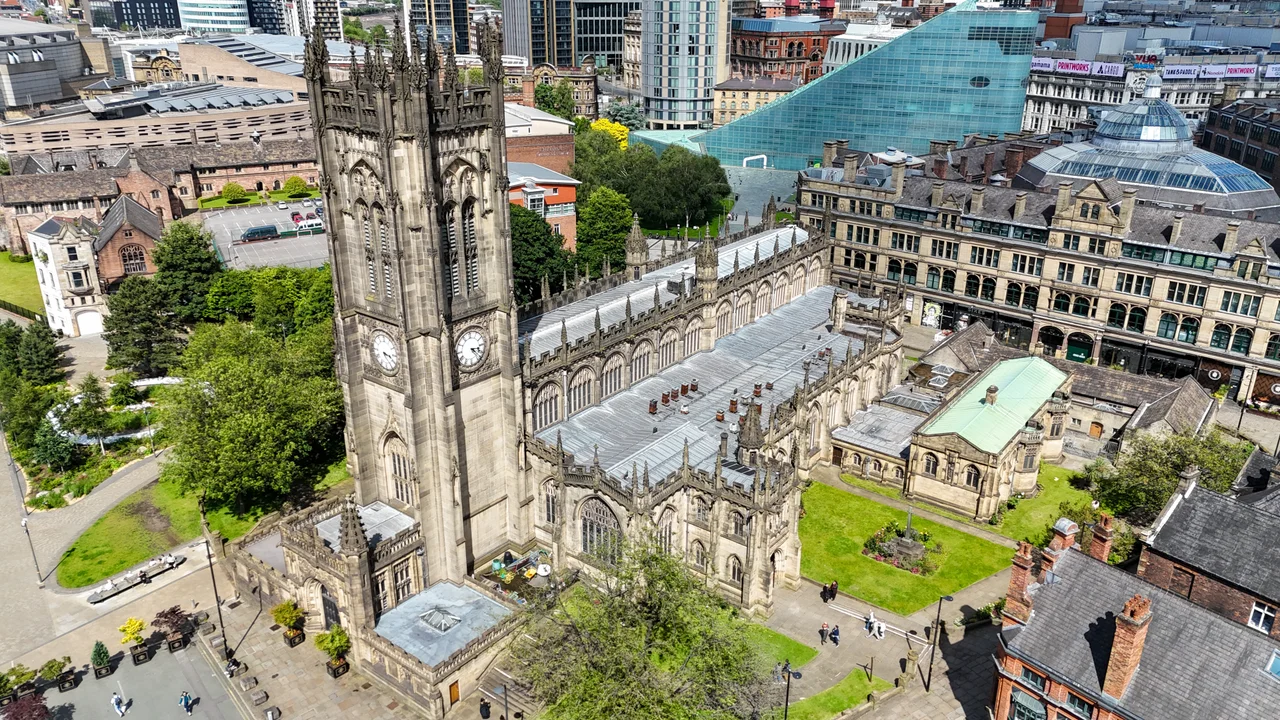

Manchester Cathedral
Inside the nave of Manchester Cathedral, fourteen carved angels hold instruments most worshippers in 1500 would never have heard inside a church: a lute, a hurdy-gurdy, a psaltery, two sets of bagpipes, a tabor. They were the gift of James Stanley II, warden of the Collegiate Church at the end of the 15th century, later Bishop of Ely, and they are perhaps the cheekiest piece of late-medieval theology in northern England. These were the instruments of street processions and mystery plays, of dances and weddings and folk songs. Stanley put them in the angels' hands and lifted them above the nave, as if to say that heaven sounded more like the marketplace than anyone had let on.
An Angel in the Wall
The cathedral's oldest surviving piece is the Angel Stone, a small carving with a Latin inscription that translates to 'into thy hands, O Lord, I commend my spirit.' Tradition once dated it to around 700 AD; the Corpus of Anglo-Saxon Sculpture now places it in the twelfth century. Either way, it was found buried in the wall of the south porch, evidence of an earlier church on a site that the Domesday Book of 1086 already knew. The collegiate body was founded in 1421 with the right to charge three shillings and sixpence for every marriage in its enormous parish, which is how it ended up with the eccentric Revd Joshua 'Jotty' Brookes presiding over a marriage production line. In 1821, Brookes solemnised 1,924 marriages, often a score at a time, and was known to plug a missing groom with any passer-by who happened to be loitering at the altar.
Stone That Weeps
The cathedral has been built three times over, in three different stones. The original walls were dark purple-brown Collyhurst sandstone from a Permian seam just north of the city, but Collyhurst weathers terribly and Mancunian rain accelerates the damage. In the early 19th century someone made the spectacular error of coating the nave with Roman cement; it sealed in damp and ate the stone underneath. Between 1850 and 1870 the architect J. S. Crowther replaced almost all of it with buff-grey Fletcher Bank Grit from Ramsbottom, copying the originals exactly. J. P. Holden heightened the west tower in 1868. Basil Champneys added the vestry, library and western porches in 1898. Percy Worthington added the choir-school wing later still. The result is a cathedral that looks Victorian and is medieval and has been rebuilt so often that the question of which it 'really' is no longer makes sense.
Two Bombs, One Church
The Christmas Blitz of 1940 destroyed all the Victorian stained glass and the great George Gilbert Scott organ that had stood over the pulpitum. For decades the windows were filled with plain glass and a single 1966 Fire Window by Margaret Traherne. Tony Hollaway then designed a sequence of five western windows between 1973 and 1995: St George, St Denys, St Mary, The Creation, The Apocalypse. They use abstract fields of red and blue and gold that catch Manchester's grey light at unexpected angles. On 15 June 1996, the largest IRA bomb ever detonated on the British mainland exploded a few hundred metres away on Corporation Street, injuring more than two hundred people and shattering the cathedral's east-end glass. The Healing Window by Linda Walton was installed in 2004 to commemorate the recovery. By then the cathedral had become practised at restoration.
Misericords
Beneath the choir stalls are thirty 16th-century misericords, the carved ledges medieval clergy leaned on through long offices. They are considered among the finest in Europe and were probably the work of the same school that carved Ripon Cathedral and Beverley Minster. One in particular, catalogued as N-08, contains the earliest known depiction of backgammon in the United Kingdom: a pair of players hunched over a board, scratching their heads, as alive in 1506 as anyone in a pub today. The choir itself was provided for in the 1421 statutes but had no dedicated school until Percy Worthington built one in 1934. War damage closed it. When Chetham's School of Music re-founded itself nearby in 1969, the cathedral struck a scholarship deal that has produced the choir ever since. In the 1970s it became the first statutory Church of England choir to admit girls' as well as boys' voices.
City's Parish Church
Manchester Cathedral is the city's parish church, the seat of the Bishop of Manchester, and the spiritual centre of an Anglican diocese created in 1847 to keep up with the explosive growth of the cotton city. Ten bells by Gillett and Johnston, cast in 1925 and tuned to D, hang in the tower for change ringing; the tenor weighs 1.3 tonnes. The Hanging Bridge, a 15th-century scheduled monument that was once the main approach to the church and was buried for more than a century, is now the highlight of the visitor centre that Queen Elizabeth II opened by the south porch. In 2025 the bells' centenary launched a fundraising campaign to rehang and augment them. After the Arena bombing of 2017, this was where Bishop David Walker lit a candle for the dead, and the Glade of Light memorial garden sits a short walk from its south porch, in the open ground between the cathedral and the river.
From the Air
Manchester Cathedral sits at 53.4853°N, 2.2447°W on Victoria Street at the northern edge of the city centre, between the River Irwell and Victoria Station. Recommended viewing altitude 1,500-3,000 ft AGL. The cathedral's Perpendicular Gothic tower is one of the most reliable landmarks in central Manchester, easily picked out alongside the curved roof of Manchester Arena just to its north. Nearest ICAO airports: Manchester (EGCC) 8 nm south-southwest, Manchester Barton (EGCB) 5 nm west, Leeds Bradford (EGNM) 35 nm east-northeast. Low cloud and drizzle are common; clear days offer good views down the Irwell corridor toward Salford.
Nearby Stories
- National Science and Media Museum 0.2 km away
- Jodrell Bank Observatory 3.2 km away
- Siege of Lathom House 5.6 km away
- Chester Zoo 6.2 km away
- Whalley Abbey 8.9 km away
- Haddon Hall 10 km away
- Wentworth Castle 16 km away
- Blackpool 16 km away