
Manchester Town Hall
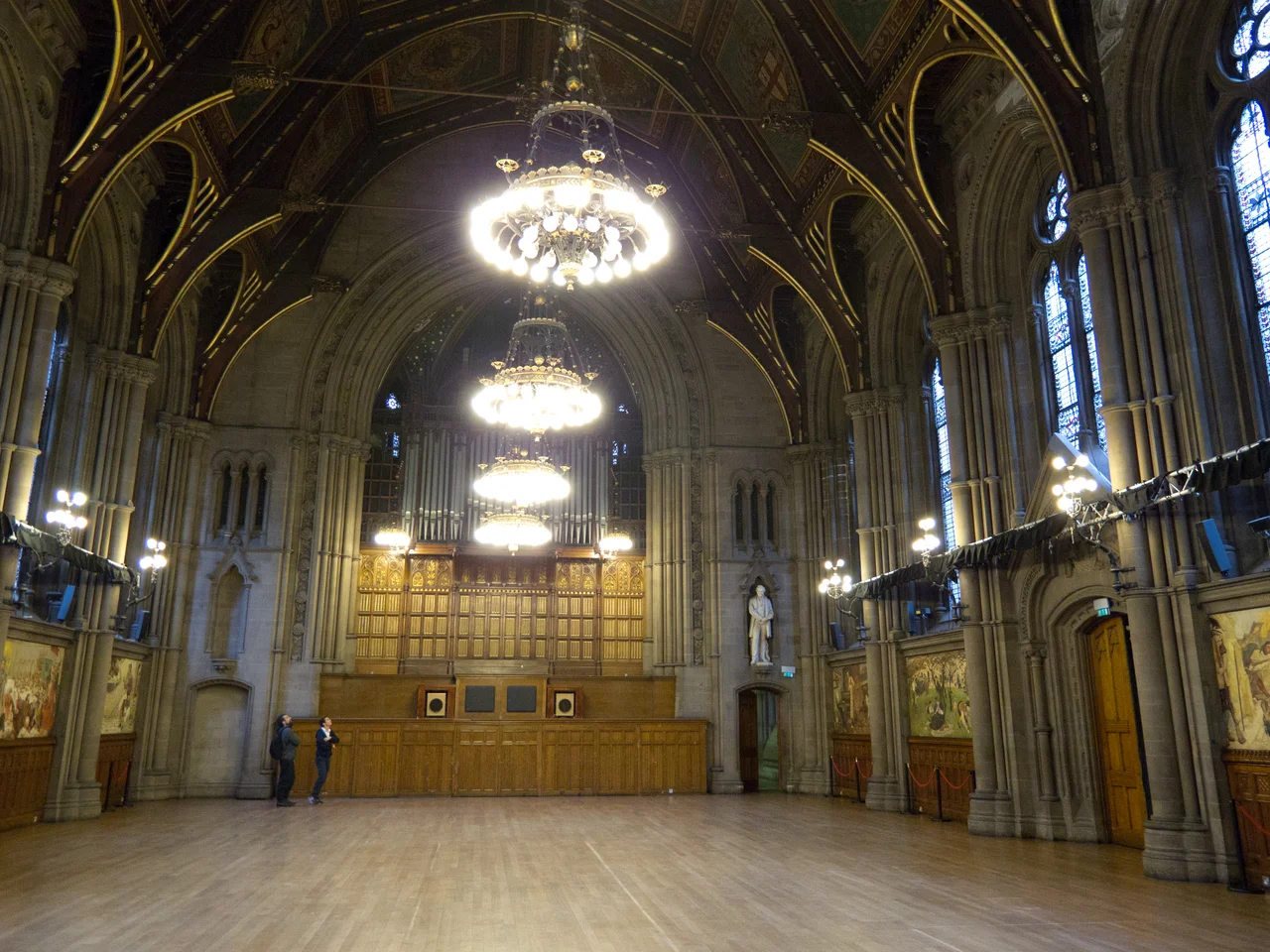
John Ruskin had complaints about most Victorian buildings, so when he called the Great Hall at Manchester Town Hall 'the most truly magnificent Gothic apartment in Europe' he had thought about it carefully. The room measures 100 feet by 50 feet, and the wagon-roof ceiling is divided into panels bearing the arms of countries and towns Manchester traded with at the height of its mercantile power. Twelve panels on the walls below tell the city's history in scenes painted by Ford Madox Brown using the Gambier Parry process. The room was finished in 1877 to host a city that had just doubled its population in fifty years and decided it deserved a building 'equal if not superior to any similar building in the country at any cost which may be reasonably required.' Manchester Corporation got its money's worth.
An Architect Placed Fourth
Alfred Waterhouse came fourth in the design competition. The judges thought Speakman & Charlesworth, Oldrid Scott, and Worthington had better drawings, but Waterhouse had the better building. His plan made remarkable sense of the triangular site bounded by Albert Square, Princess Street, Lloyd Street, and Cooper Street: a perimeter of working offices wrapping a core of ceremonial rooms with a Great Hall at its heart. He was appointed architect on 1 April 1868. The foundation stone was laid six months later by Mayor Robert Neill. Construction took nine years and used 14 million bricks. Waterhouse fretted endlessly about Manchester's atmospheric pollution; he refused to use the local Collyhurst sandstone, which dissolved in northern rain, and chose tough Spinkwell Stone from Bradford Dale instead. Even so, by 1900 the building was black with soot, and not until the 1960s did anyone scrub it back to its original honey colour.
Great Abel
The clock tower rises 280 feet over Albert Square. At its top hangs a carillon of 23 bells, twelve of which are hung for full-circle change ringing. The tenor, named Great Abel for Mayor Abel Heywood, weighs eight tons two and a half hundredweight. The clock bell first rang on New Year's Day 1879, cracked, was replaced in 1882, and was recast with all the others in 1937. The clock face carries the inscription Teach us to number our Days, from Psalm 90. Great Abel itself is inscribed with the line Ring out the false, ring in the true from Tennyson's Ring Out, Wild Bells. The clock was originally wound using hydraulic power piped through Manchester's now-vanished Hydraulic Power network, a Victorian municipal innovation that ran lifts and presses all over the city centre. As of 2017, change ringing is paused while the building is restored.
Bees and Cotton
Outside the Great Hall is the landing where the names of every Manchester mayor and lord mayor since the 1838 Charter of Corporation are inscribed on glass panes in a skylight. The mosaic floor underfoot is patterned with bees and cotton flowers, the city's two great symbols: industry and trade. Two grand staircases climb from the Albert Square entrance with risers low enough to accommodate Victorian dress. Three spiral staircases, in English, Scottish, and Irish granite, lead up from the other entrances. On the ground floor, the Sculpture Hall contains busts and statues of the city's makers - the Anti-Corn Law campaigners Richard Cobden and John Bright, the chemist John Dalton, the physicist James Joule, the conductor John Barbirolli, the first lord of the manor Thomas Grelley, and Humphrey Chetham, who endowed a school and a library that still bear his name.
Stand-in for Westminster
Because the building looks like a Gothic Revival cousin of the Palace of Westminster, film and television have long used it as a stand-in. The 1990 House of Cards filmed Westminster interiors here. So did State of Play, Ali G Indahouse, Sherlock Holmes (2008), The Iron Lady, Victor Frankenstein, and A Very English Scandal. The town hall also remains an actual place of business: a 24-hour police station reopened here in 2014 after a 77-year absence; weddings and civil partnerships happen in the Banqueting Room; the result of the 2016 EU Referendum was officially declared in the small hours of 24 June by the Chief Counting Officer, Jenny Watson. Council meetings are now held in E. Vincent Harris's 1938 Town Hall Extension, linked by glazed pedestrian bridges over Lloyd Street.
Behind the Hoardings
The town hall closed to the public in 2018 for the most ambitious municipal restoration project in Britain. The budget started at around £300 million and rose to £524.8 million as the work uncovered more damage and the heating, electrical, and stonework systems all needed replacing simultaneously. Over 500 timber windows are being restored. The Manchester Murals are being conserved. The opening is now scheduled for spring 2027, two decades after Ruskin's room last accommodated a public audience. When it reopens, the building should look more or less as Waterhouse left it: a Victorian secular masterpiece built to outlast a city's mood, and proof, in James Stevens Curl's phrase, of a style that could only be Victorian.
From the Air
Manchester Town Hall sits at 53.4792°N, 2.2442°W on Albert Square in the heart of Manchester city centre, facing St Peter's Square to the south. Recommended viewing altitude 1,500-3,000 ft AGL. The 280-foot Gothic clock tower is the easiest landmark in central Manchester, sitting roughly equidistant from Manchester Cathedral half a mile north and Oxford Road station to the south. Nearest ICAO airports: Manchester (EGCC) 7 nm south-southwest, Manchester Barton (EGCB) 5 nm west-northwest, Leeds Bradford (EGNM) 35 nm east-northeast. The city centre's compact Victorian core - cathedral, town hall, central library - is the cleanest visual signature when haze allows.
Nearby Stories
- National Science and Media Museum 0.2 km away
- Jodrell Bank Observatory 3.2 km away
- Siege of Lathom House 5.6 km away
- Chester Zoo 6.2 km away
- Whalley Abbey 8.9 km away
- Haddon Hall 10 km away
- Wentworth Castle 16 km away
- Blackpool 16 km away