
Mecca
Five times a day, roughly two billion people turn in the same direction. Whatever clock they are on, whatever hemisphere, whatever political circumstance, they orient themselves toward a single black-draped cubic structure at the center of a mosque in western Saudi Arabia. The Kaaba anchors the Islamic world geographically the way it anchors it spiritually. In Mecca itself, the crowds circling it during the Hajj can approach three million in a single week -- the largest regularly scheduled human gathering on Earth. Commercial flights may not pass over the city. No non-Muslim may enter. For fourteen centuries, this has been a place set apart from everything else.
Where the Prophet Was Born
Muhammad was born in Mecca in 570 CE, into a city already organized around pilgrimage and trade. According to Muslim tradition, the Kaaba had been built by the prophet Abraham and his son Ishmael around 2000 BCE. In 610, in a cave on Jabal al-Nour just outside the city, Muhammad received the first Quranic revelation through the angel Gabriel. For twelve years he preached against the polytheism of the Quraysh clan who ruled Mecca; in 622, facing assassination, he made the hijra to Yathrib, the city that would become Medina. He returned to Mecca in 629 on pilgrimage, and in 630, after the Quraysh broke their peace treaty, he marched back with his followers and the city surrendered almost without bloodshed. He cleansed the Kaaba of its idols and made Mecca the spiritual center of Islam. He would die two years later, but the direction of prayer he established has held for every generation since.
Centuries Under Distant Hands
For over a thousand years after Muhammad, Mecca was ruled by outsiders who mostly left it alone. The Hashemite Emirs governed as local religious-temporal leaders from the tenth century. The Ottomans controlled the Hejaz from 1517 with only brief interruptions, building fortresses, mosques, and a network of Ottoman urban fabric that would become beloved by pilgrims from across the Muslim world. When T.E. Lawrence helped organize the Arab Revolt against the Turks during the First World War, the Hashemites threw in with the British. After the war, instead of the independent Arab state they expected, they got the Saud family: in 1924 Ibn Saud conquered Mecca, and the modern Saudi kingdom would be built around control of Islam's two holiest cities.
1979: The Siege That Changed Everything
On 20 November 1979, at the first prayer of a new Islamic century, armed extremists seized the Grand Mosque and called for the overthrow of the Saudi royal family. The siege lasted two weeks and required French and Pakistani forces to help end it. The kingdom that emerged was different. The Saudi government, shaken by how close disaster had come, gave the religious establishment more power than it had held before. Female television presenters vanished from Saudi screens. Social restrictions tightened. Tourism became more regulated. An entire country's character shifted because of those two weeks in Mecca -- a consequence few outside the region fully grasped at the time, but one whose effects on Saudi women, Saudi culture, and the broader Muslim world would unfold for decades.
The City That Was
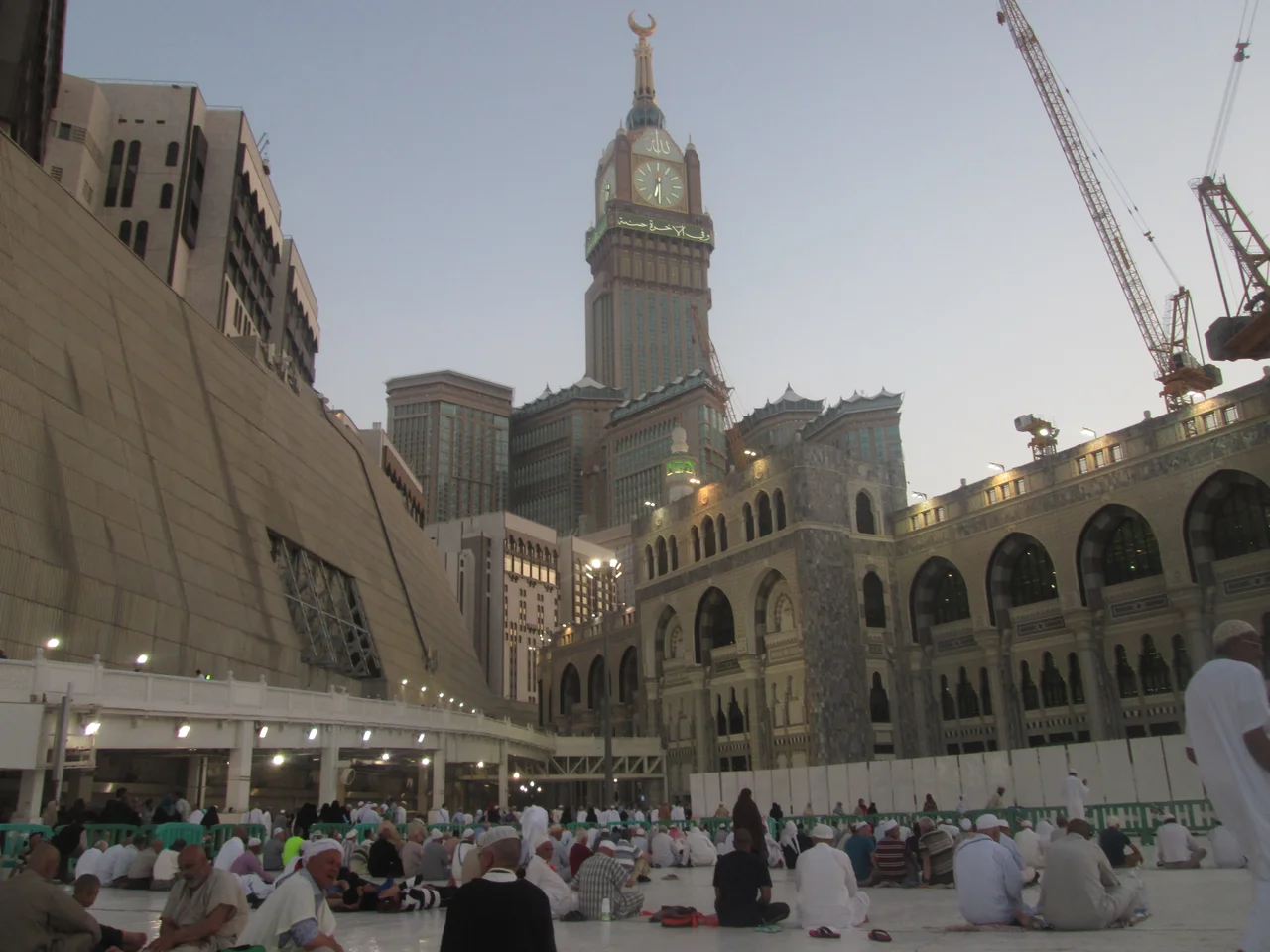
An estimated 95 percent of Mecca's historic buildings have been demolished by the Saudi government, most of them more than a thousand years old. The Ajyad Fortress, an Ottoman citadel overlooking the Grand Mosque, came down in 2002 to clear ground for the Abraj Al Bait, a 15-billion-dollar luxury hotel and clock tower complex that now looms above the Kaaba itself. The Turkish government pleaded against the demolition. So did international preservationists. The work proceeded. Defenders argue that accommodating the growing Hajj requires more hotels, more roads, more infrastructure. Critics call it cultural vandalism -- an attempt, intentional or not, to erase the physical traces of Islam's early history from the very city where that history began. The Prophet's birthplace has been paved over. The house of his first wife Khadijah was replaced by public toilets before eventually becoming a library. What pilgrims see today is mostly new.
The Crush of the Faithful
The modern Hajj moves millions of people through a choreography that is physically exhausting and sometimes dangerous. In September 2015, approximately 2,236 pilgrims were killed in a stampede at Mina -- the deadliest Hajj incident on record. Iran, which lost the most citizens, banned its nationals from attending the following year. Earlier that same year, a crawler crane had collapsed inside the Grand Mosque, killing 111. The Al Mashaaer Al Mugaddassah Metro, built by a Chinese firm in 2010 and regarded as possibly the highest-capacity rail line in the world, shuttles pilgrims between the holy sites at Arafat, Muzdalifah, and Mina; even it can be densely packed. Zamzam water, flowing from the well Muslims believe God provided to Hagar and Ishmael, is still served free to anyone who asks. Beyond the logistics, the Hajj is what it has always been: a journey that millions of people save their lives to make once, and that, for them, remakes what it means to be alive.
From the Air
Mecca lies at approximately 21.42 degrees north, 39.83 degrees east in western Saudi Arabia, about 70 km inland from the Red Sea coast at Jeddah. Important: Mecca airspace is restricted -- commercial aircraft may not overfly the city. The nearest major airport is King Abdulaziz International (OEJN) at Jeddah, a 60-minute drive. A secondary gateway is Ta'if (OETF) via Highway 15. The city is ringed by the barren Hejaz mountains; the sprawling Abraj Al Bait clock tower beside the Grand Mosque is a dominant daytime and nighttime visual feature when viewed from approach paths to Jeddah.
Nearby Stories
- Al-Balad, Jeddah 23 km away
- Jeddah Tower 33 km away
- Battle of Turubah 123 km away
- Red Sea Rift 143 km away
- Ghadir Khumm 159 km away
- Al-Baha 162 km away
- Thee Ain 206 km away
- Hejaz 214 km away