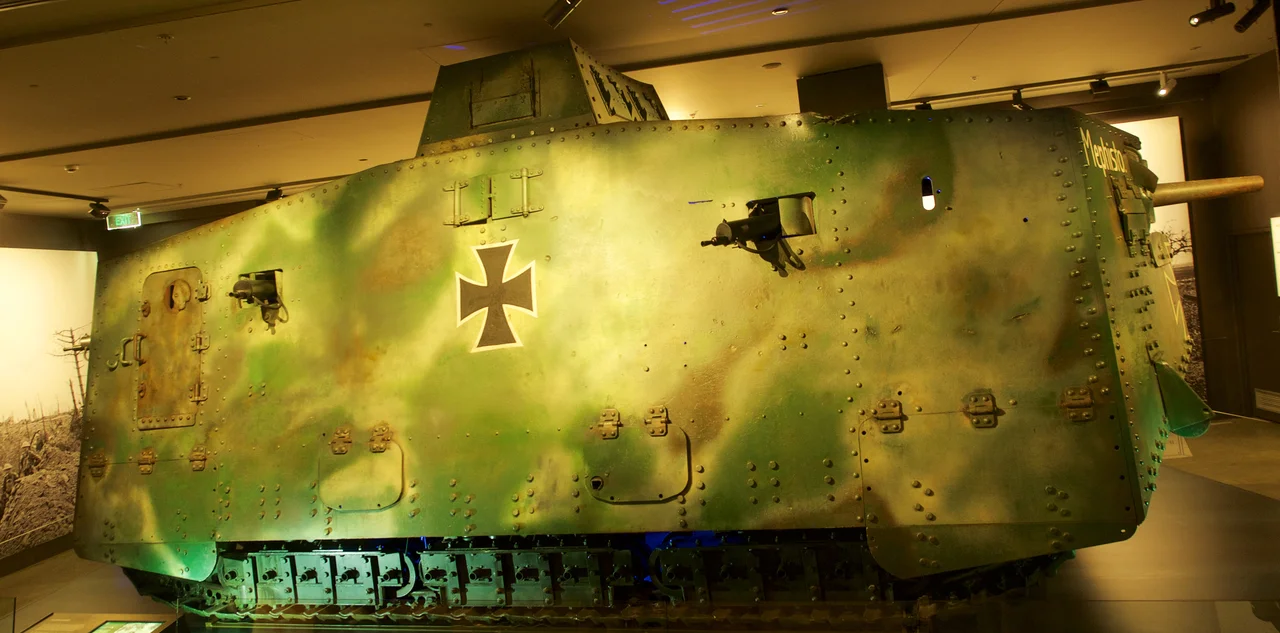

Mephisto (tank)
Germany built only about twenty of them, and today exactly one survives. It sits in the cool dark of the Queensland Museum's Anzac Legacy Gallery, a riveted steel box the size of a small house, its hull scarred and its name still legible: Mephisto, after the demon of German folklore. A red devil was once painted on its front armour, clutching a captured British tank under one arm, the idea lifted from a laundry-detergent poster. The A7V Sturmpanzerwagen was a monster of a machine, crewed by eighteen men in a roaring, fume-choked interior. This one, vehicle number 506, drove into a shell-hole near a French village in April 1918 and never drove out under its own power again. That it exists at all is the work of Australian soldiers who decided a wrecked enemy tank was worth dying to retrieve.
The Demon of Villers-Bretonneux
Mephisto was issued to the German army around the turn of 1918 and given the name by its commander, Lieutenant Heinz Theunissen, when it was fashionable to christen these machines after figures from German myth. On 24 April 1918, it joined a force of thirteen A7Vs in an attack on Villers-Bretonneux, the German high command hoping to take the town and the hill beyond, from which their guns could threaten the vital rail junction of Amiens. The day saw the first tank-versus-tank battle in history. Mephisto advanced with the railway line on its right, but a fuel blockage forced it to stop and fall behind. Chasing to catch the others, it pitched nose-first into a fresh shell crater and stuck fast. The crew had no choice but to climb out and abandon it.
Left in No Man's Land
The German attack succeeded; the town was taken, then lost again as Allied troops counterattacked through the night. By the morning of 26 April the lines had drifted back almost to where they began, and Mephisto sat marooned in an orchard at a place the Allies called Monument Farm, immobilised but intact, in ground the Germans still held. Two other A7Vs were gone, one overturned and captured, one blown up by its own side. For weeks Mephisto stayed where it had fallen, between two armies, as Australian units pushed the German line back outpost by outpost in the kind of small, sharp raids that gradually reclaimed the fields around it.
The Recovery
On 14 July 1918, men of the 26th Battalion AIF completed the occupation of Monument Wood and found the derelict tank in their lines. Lieutenant-Colonel James Robinson decided it should be taken as a trophy, and a recovery was planned with the precision of a raid. On the night of 22 July, two armoured vehicles of the British 1st Gun Carrier Company crept forward with twenty-three men, joined by thirteen from the 26th Battalion. To mask the engine noise, an aircraft flew low overhead and the artillery laid down sporadic fire. The Germans answered with a pre-planned bombardment of gas shells, and the men did their work in gas masks, hooking a steel cable to the hull and dragging the tank four kilometres back through the dark. They obscured the trail behind them and laid a false one to fool German aircraft. It was brutal, dangerous labour, carried out by ordinary soldiers in the worst conditions the war could offer, for the sake of a relic.
The Tank Boys
At the training ground where Mephisto was first brought, soldiers covered it in graffiti, in pride and irreverence both. One painted the British lion with its paw on a German tank; others added battalion badges, the words "Captured by 26th Batt, A.I.F.", and their own names scrawled across the hull. The weather and decades of repainting erased almost all of it. But thirteen names survive, hammered into the steel with a chisel or punch, too deep for time to wipe away. Under the words "Tank Boys" on the rear armour are six of them, men who appear in the Tank Corps records of late 1918. Several others belonged to civilian railway workers serving in France. They are not the names of the men who fought to recover the tank, but they are real soldiers, and their marks remain when their graffiti is gone, a roll of the dead and the living pressed permanently into the machine.
A Long Way Home
Mephisto sailed from England aboard the SS Armagh in April 1919, bound for Australia with more than fourteen hundred returning Anzac troops. Several cities wanted it; Brisbane won. On 22 August 1919, two steamrollers dragged the tank, riding on its own treads, from the river wharf to the museum, a journey of under two miles that took eleven hours. For decades it weathered outdoors, its sacred inscriptions slowly fading, until it was finally brought inside and sealed behind glass. The 2011 Brisbane floods half-submerged it, sending it away for years of restoration. In 2018 it returned to the Queensland Museum's Anzac Legacy Gallery. In 2023, its original compass, removed by an Australian officer while the tank sat at Tilbury Docks awaiting shipment to Australia, was quietly handed back and restored to the tank. The last A7V on Earth had recovered one more piece of itself.
From the Air
Mephisto resides indoors at the Queensland Museum in the South Bank cultural precinct, on the south bank of the Brisbane River at roughly 27.475 degrees south, 153.020 degrees east, directly across the river from the central business district. The river's distinctive bend at South Bank, with its parklands and the white spans of the nearby bridges, is the clearest landmark from the air. Brisbane Airport (ICAO YBBN) lies about 13 kilometres to the northeast; Archerfield Airport (YBAF) is roughly 11 kilometres to the southwest. The tank itself is housed inside and not visible from above, but the museum complex is best identified from 1,500 to 3,000 feet in clear weather by its position on the river opposite the CBD towers.
Nearby Stories
- Redcliffe Peninsula 2.7 km away
- Tamborine National Park 12 km away
- Cressbrook Homestead 27 km away
- Main Range National Park 31 km away
- 2010-2011 Queensland Floods 38 km away
- Cape Byron 96 km away
- Cape Byron Light 126 km away
- HMS Porpoise (1799) 588 km away