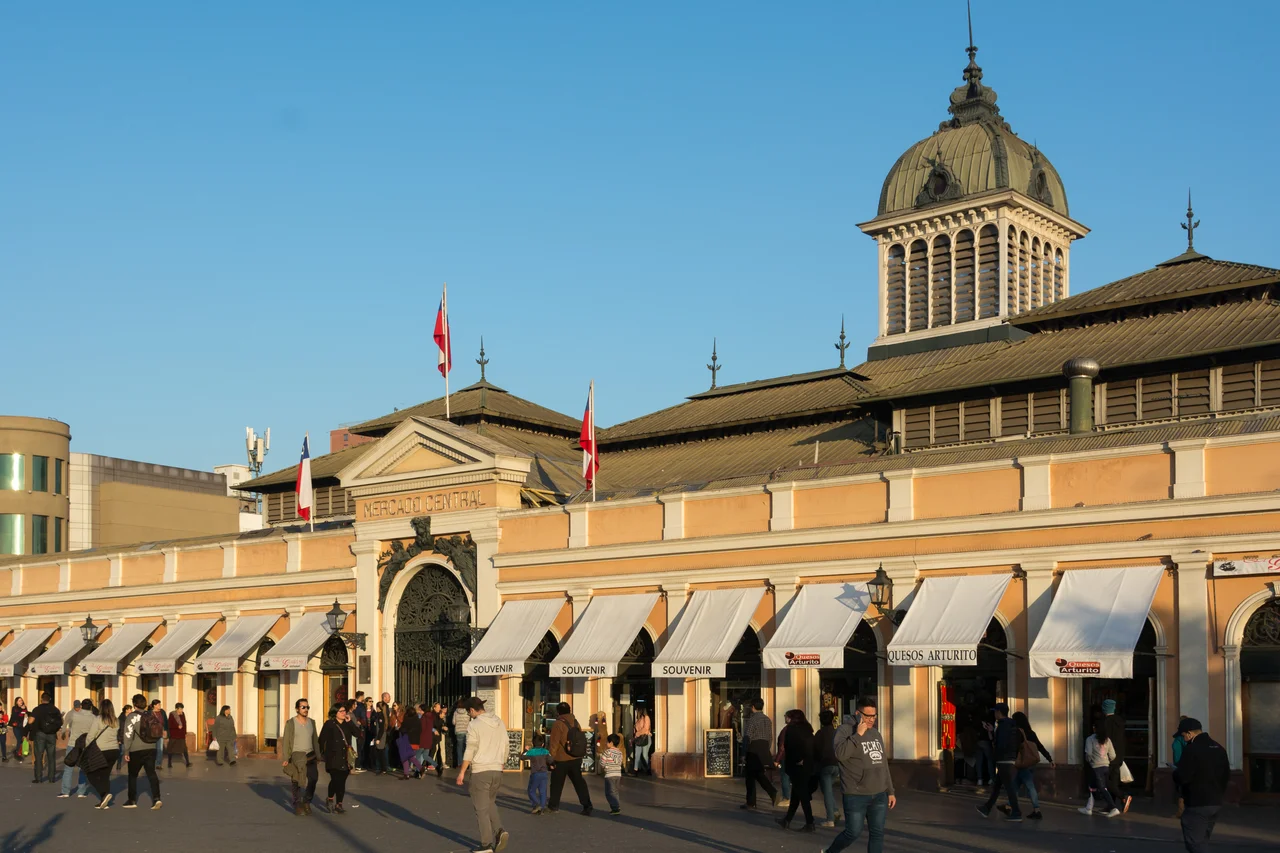

Mercado Central de Santiago
The fish arrive before dawn, and so does the shouting. Vendors heap silver-skinned congrio and reineta onto crushed ice, sea urchins split open orange and briny, and the cold floor runs slick with melt. Above all of it arches a roof that never belonged to this hemisphere: a lacework of cast iron, painted pale, fabricated in Glasgow and shipped in pieces around Cape Horn. The Mercado Central de Santiago has fed the city since 1872, and the contrast still startles, a slice of Victorian Scotland sheltering the catch of the Chilean coast.
Born From Fire
The market exists because its predecessor burned. The Plaza del Abasto, Santiago's old provisioning square, was destroyed by fire in 1864, and the city resolved to replace it with something that could not so easily be lost. The architect Fermin Vivaceta, a largely self-taught Chilean known for shaping the look of the nineteenth-century city, took charge of construction, and the new Mercado Central opened in 1872. Where the old square had been improvised and flammable, the new building was deliberate and permanent, its market trade enclosed at last in iron and masonry. Nearly a century and a half later, it is still doing the job it was built for, drawing both fishmongers and food critics, who have ranked it among the great markets of the world. That is a rare fate for any building, let alone a working market.
A Roof From Glasgow
The structure's glory is its ceiling. The cast-iron roof and the columns that hold it were fabricated by the Scottish firm R. Laidlaw & Sons of Glasgow, then a center of the Victorian iron trade, and the engineers Edward Woods and Charles Henry Driver took part in its design. The metalwork rises from a square base into a vaulted hall: a central pyramidal roof crowned by a domed tower, ringed by eight smaller two-tiered roofs, the whole frame wrapped in a masonry building. It is a piece of nineteenth-century industrial ambition, ordered from half a world away and bolted together beneath the Andes.
The Great Seafood Lunch
What the iron shelters is one of South America's most beloved meals. Chile's coastline runs thousands of miles down the edge of the Pacific, and much of its bounty ends up here: paila marina, the shellfish stew that arrives bubbling in an earthenware bowl; ceviche cured in lime; congrio frito, the firm white fish fried golden; and the spiny sea urchins, the erizos, that Chileans prize and many visitors approach with caution. Above all there is congrio itself, the eel-like fish that Pablo Neruda loved enough to write a poem in praise of its chowder. Restaurants crowd the central hall, the famous Donde Augusto among them, where flamboyant waiters compete for your table. Regulars know to drift toward the smaller stalls around the edges, where the cooking is plainer, cheaper, and often better. Either way, lunch here is an event, loud and long and unmistakably Santiago.
A City's Daily Theater
Beyond the food, the market is a stage. Tourists wander beneath the iron arches with cameras raised while the genuine business of the city carries on around them: chefs from across Santiago picking over the morning's catch, families filling bags for the week, fishmongers calling prices over the din and tossing fish from ice to scale. The hall holds both at once without strain. Musicians sometimes drift between the tables, and the smell of frying fish hangs in the cool air beneath the high vault. For a century and a half this has been the place where the sea meets the capital, where the cold Pacific is unloaded, weighed, argued over, and eaten, all under a roof that crossed an ocean to get here.
From the Air
The Mercado Central stands at 33.43 S, 70.65 W on the north edge of downtown Santiago, near the Mapocho River that separates the historic core from the Bellavista district. From the air it reads as a broad rectangular hall among denser blocks; the river and the green ribbon of Parque Forestal just south make useful references. Santiago's main gateway, Arturo Merino Benitez International (ICAO: SCEL), lies about 15 miles northwest in Pudahuel, with the general-aviation field at Eulogio Sanchez (Tobalaba, ICAO: SCTB) to the east. Recommended viewing altitude is 2,000 to 3,000 feet AGL. The Santiago basin traps haze, so visibility is best in the clearer air after a winter rain or on a windy spring afternoon.
Nearby Stories
- Paine Memorial 21 km away
- 1947 BSAA Avro Lancastrian Star Dust accident 23 km away
- Battle of Chacabuco 31 km away
- La Campana National Park 36 km away
- Puente del Inca 44 km away
- Casa de Isla Negra 62 km away
- Santa Cruz, Chile 103 km away
- Pierre Auger Observatory 172 km away