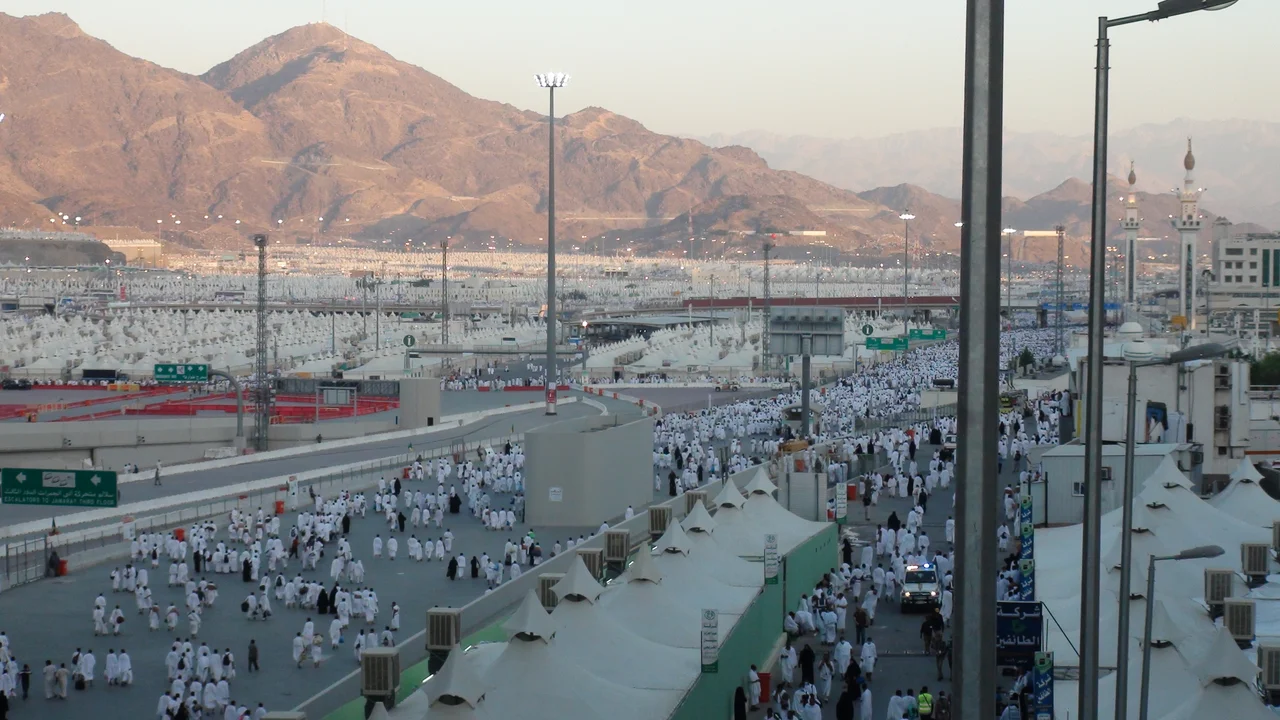

Mina, Saudi Arabia
Fly over the Mina valley in the Islamic month of Dhu al-Hijja and you will see what some maps still label the City of Tents. More than 100,000 white canvas tents, laid out in rigid rectangles 8 by 8 meters, stretch across a flat valley between mountains, cut by access roads and emergency exits and the bright-silver track of a metro line. The tents sleep roughly three million people. They have schools, clinics, dispensaries, a mosque, and a slaughterhouse district just outside. And for about five days each year they form the largest temporary settlement on Earth, before emptying again into silence.
Why Mina Exists
The Hajj is a place-specific pilgrimage. Certain rituals must happen in certain locations, on certain days, in a certain order. For the overnight before the day of Arafat and the three or four nights after, pilgrims are supposed to camp at Mina, about 8 kilometers southeast of Mecca. Islamic tradition ties the place to Ibrahim (the Abraham of the Hebrew Bible) and his attempt to sacrifice his son Ismail (Ishmael). Where the devil tried three times to dissuade him, Ibrahim threw stones to drive Shaytan away. Those three spots in Mina are now the three jamarat: the Jamarat al-Sughra, the Jamarat al-Wusta, and the largest, the Jamarat al-Kubra, also called the Jamarat al-Aqabah. Since 2003, the distance between the first two has been measured at 135 meters, and between the second and third at 225 meters. In the last days of Hajj, pilgrims throw seven small pebbles at each pillar, reenacting Ibrahim's rejection of temptation.
From Personal Tents to Permanent City
For most of the Hajj's long history, pilgrims brought their own tents to Mina, pitched them, lived in them for the required nights, and dismantled them when they left. The scene must have looked the same for centuries: a valley briefly filled with the canvas and carpets and cookpots of the world's Muslims, then scoured clean again by wind. In the 1990s, the Saudi government began installing permanent cotton tents, and a new problem emerged: cotton burns. On 15 April 1997, fires swept the Mina camp and killed more than 340 pilgrims, injuring around 1,500. In response, Saudi Arabia built the current 100,000-unit tent city of fireproof Teflon-coated fiberglass. The layout is grid-strict, the pathways wide enough for emergency vehicles, the tents air-conditioned in the most recent generation, and the whole complex monitored year-round even when it stands empty.
The Valley of Disasters
For more than three decades, the Mina valley and the adjacent Jamaraat Bridge have been the site of repeated tragedies. On 23 May 1994, a stampede at the bridge killed more than 270 pilgrims. On 5 March 2001, 35 more. On 1 February 2004, at least 251 killed and 244 injured. On 12 January 2006, at least 363 deaths and more than a thousand injuries. And then the worst: on 24 September 2015, a crush on streets 204 and 223 of the Mina camp killed at least 769 people according to official Saudi figures; independent counts, including those compiled by Reuters and the Associated Press from national repatriation records, put the toll between 1,100 and 2,431. These were elderly grandmothers from Java, laborers from Bangladesh, schoolteachers from Lagos. They had come to complete the pilgrimage that every able Muslim is expected to make once in a lifetime. Many were identifiable only by the pilgrim identification bracelets the Saudi authorities now require.
The Mashaer Metro
Mina sits bounded by the al-Aziziyah district of Mecca to the west, the 4th Ring Road to the north, Muzdalifah to the east, and the al-Jami'ah district to the south. Getting millions of people through these boundaries on schedule is a logistical feat that required engineering at the scale of a major city. The Mashaer Al-Muqaddassah Metro, currently the only complete metro line in Saudi Arabia, runs only during Hajj. It begins at Arafat, runs through Muzdalifah, then reaches three stations inside Mina: Station 1 near the Armed Forces Hospital, Station 2 near the al-Jisr Hospital, and Station 3 at the Jamarat al-Aqaba. Highway 40, one of the most important roads in the kingdom, passes within three kilometers of Mina. During the rest of the year, most of this infrastructure sits unused. Mina is a city built for five days a year.
The Masjid al-Khayf
In the center of the valley stands the Masjid al-Khayf, the largest mosque in Mina, covering about 20,000 square meters. Islamic tradition connects it to Muhammad, who is said to have led prayers there during his Farewell Pilgrimage in 632 CE, the only Hajj he performed. Like the rest of Mina's infrastructure, the mosque is active only during the Hajj season. For the other eleven months of the Islamic year the building stands closed, the tents stand empty, and the valley waits. On the last day of the Hajj, pilgrims cast their final pebbles at the jamarat, shave their heads or cut a lock of hair, and begin the journey home. Some will never return. For many, it was the defining experience of their lives. For a few thousand families each year, it was the last thing their loved one ever did.
From the Air
The Mina valley lies at 21.413°N, 39.893°E, about 8 km southeast of Mecca, at an elevation of approximately 400 m. Nearest airport is King Abdulaziz International Airport (OEJN) in Jeddah, 75-80 km west. Mecca airspace is restricted; the valley is closed to non-Muslims on the ground. From the air, the 100,000-tent camp is the dominant feature, visible as a bright grid against dark volcanic mountains. Recommended cruising altitude 10,000 ft or higher. During Hajj season (Dhu al-Hijja), expect heavy helicopter traffic supporting the pilgrimage.
Nearby Stories
- Al-Balad, Jeddah 23 km away
- Jeddah Tower 33 km away
- Battle of Turubah 123 km away
- Red Sea Rift 143 km away
- Ghadir Khumm 159 km away
- Al-Baha 162 km away
- Thee Ain 206 km away
- Hejaz 214 km away