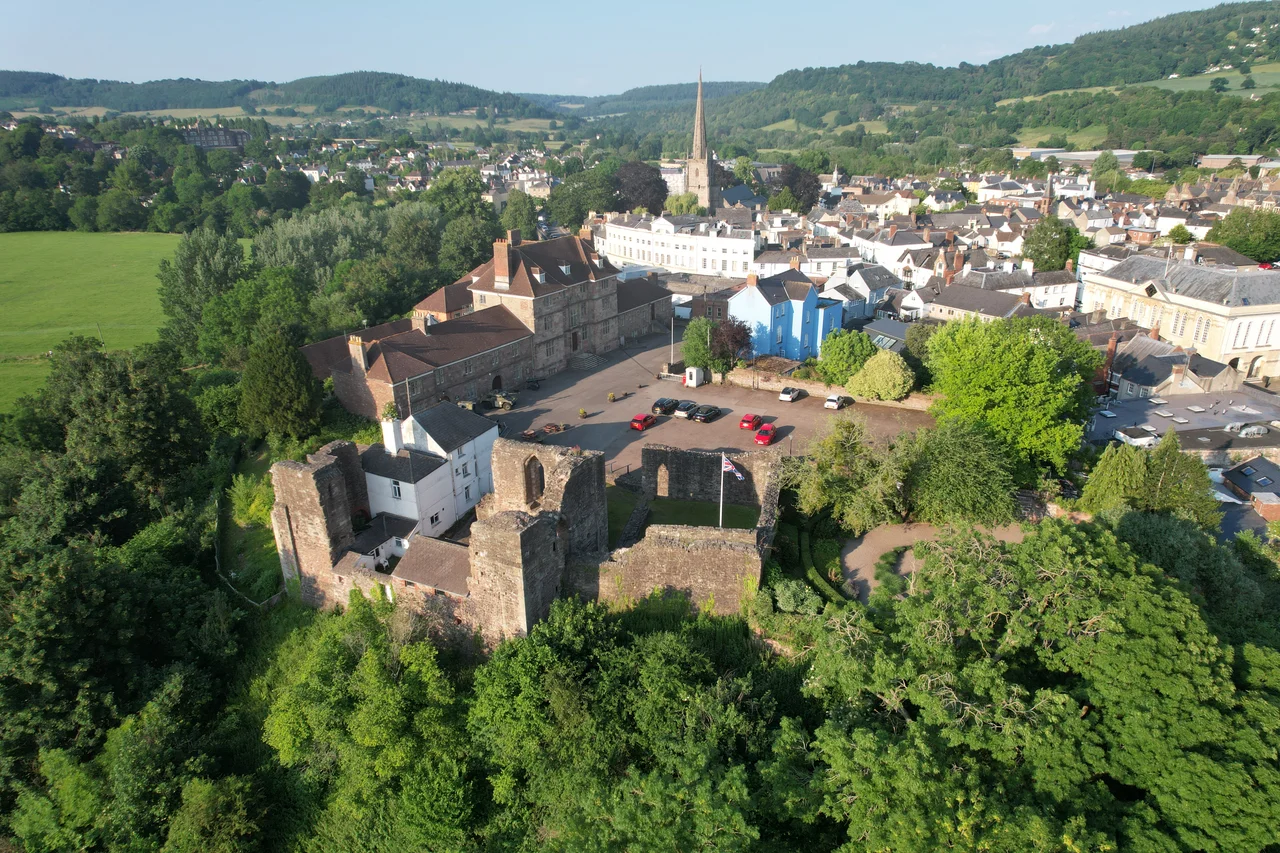

Monmouth Castle
Somewhere inside the Queen's Chamber above the gatehouse, in 1386, a young noblewoman named Mary de Bohun gave birth to a son while her husband was off hunting in the local forest. The husband would soon be king as Henry IV. The son, known then as Henry of Monmouth, would grow up to be Henry V, victor of Agincourt and the king Shakespeare made immortal. Today the Queen's Chamber is gone. So is most of the castle around it. What survives, perched above the confluence of the River Monnow and the River Wye, is the ragged Great Tower, fragments of the Hall, a few wall stubs, and an extraordinary later mansion called Great Castle House that sits squarely on top of the medieval ruin. Together they form one of the few British castles in continuous military occupation, still serving today as the headquarters of the Royal Monmouthshire Royal Engineers, the oldest regiment in the Army Reserve.
Border Stone
When William the Conqueror took England in 1066, he installed three of his most trusted lieutenants along the Welsh frontier: Hugh d'Avranches at Chester, Roger de Montgomery at Shrewsbury, and William FitzOsbern at Hereford. FitzOsbern's brief was to push west, and he built castles to anchor each gain. Between 1066 and 1069 he established Monmouth, a pairing for his other major fortress at Chepstow, set on high ground above the meeting of two rivers. Earth, timber, and a defended enclosure: a typical Norman ringwork of its day. By 1086 it was important enough to be named in the Domesday Book. Stone replaced wood before 1150. For two centuries it stood among the dense scatter of Marcher castles, Grosmont and Skenfrith and White Castle and Abergavenny, all jostling against the rebellious Welsh kingdoms to the west.
A Royal House
In 1267 the castle passed to Edmund Crouchback, son of Henry III and the first Earl of Lancaster, and the Lancastrian dynasty made it their own. Edmund built the Hall and chose Monmouth as his main residence in the region. His grandson, Henry of Grosmont, first Duke of Lancaster, improved it further in the early fourteenth century: large decorated windows were cut into the upper Great Tower, the roof was replaced, the castle began to look less like a fortress and more like a palace. Edward II was held here briefly in 1326, after his wife Isabella and her lover Roger Mortimer overthrew him; from Monmouth he was moved on to Berkeley Castle, where he was murdered. Henry Bolingbroke, the future Henry IV, kept Monmouth as a favourite residence, which is how his son came to be born here in 1386. The boy left with bowmen drawn from these same Welsh hills, and at Agincourt in 1415 he turned them on the French army with results that schoolchildren would memorise for centuries. The marketplace below the castle is still called Agincourt Square.
Demolition by Resolution
The English Civil War broke the castle. Monmouth changed hands three times between Royalists and Parliamentarians; in 1645 it fell finally to Parliament. Oliver Cromwell visited the town in 1646, and tradition holds that he ordered the demolition. On 1 March 1647 the House of Commons made it official: "That the Town and Castle of Monmouth be disgarisoned, and the Works slighted." Demolition began on the round tower at the end of that month. By 1647 much of the castle had collapsed under the engineers' picks, deliberately broken so that it could never be used as a stronghold again. But the destruction was selective. Within a generation the site was being rebuilt: Great Castle House went up between 1673 and 1675, a swaggering three-storey town mansion described by Pevsner as "a house of splendid swagger outside and in," set directly atop the medieval ruins. It became the seat of the Assize Court until 1725, when the courts moved to the new Shire Hall.
The Regiment That Stayed
In 1875 the Royal Monmouthshire Royal Engineers Militia, descended from a sixteenth-century county force first recorded in 1539, made the Great Castle House their headquarters. They have not left since. Today they are the senior regiment of the Army Reserve, the oldest in the British Army, and they still parade in the courtyard where Norman lords once held court. The regimental museum, tucked into the stable block, walks visitors through nearly five centuries of regimental history, from pike-and-shot militia to modern military engineering. The medieval fragments, the Great Tower with its bird's-mouth windows, the slumped foundations of the Hall, are looked after by Cadw, the Welsh heritage agency, and listed at Grade I as a scheduled monument. From the right angle in Agincourt Square, you can stand in front of the eighteenth-century statue of Henry V and see, behind him, the very stones in which he was born.
From the Air
Located at 51.81 degrees N, 2.72 degrees W in the south-east corner of Wales, just inside the border from Gloucestershire. The castle sits on raised ground above the confluence of the River Monnow and the River Wye, with the medieval Monnow gated bridge visible to the south-west. The site is small enough that the eighteenth-century Great Castle House dominates the view from above; look for the regimental flag flying over the courtyard. Nearest airports are Gloucestershire (EGBJ) 18 nm east-north-east, Cardiff (EGFF) 28 nm south-west, and Bristol (EGGD) 24 nm south-east.
Nearby Stories
- National Museum Cardiff 2.2 km away
- Kings Weston Roman Villa 2.2 km away
- Ebbw Vale Steelworks 2.6 km away
- Hereford Cathedral Library 6 km away
- Pershore Abbey 9.1 km away
- Chedworth Roman Villa 14 km away
- Windmill Hill, Avebury 18 km away
- Builth Castle 21 km away