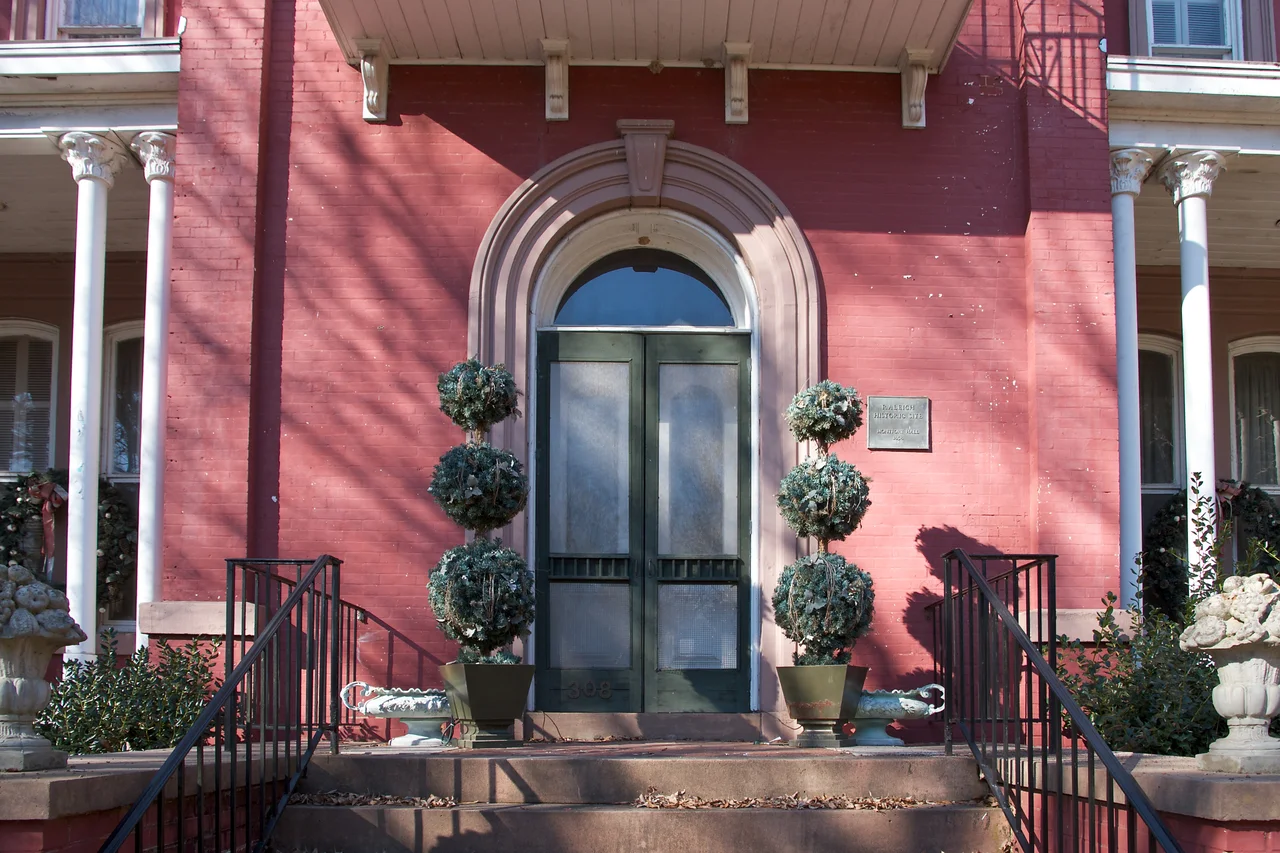

Montfort Hall
Sherman's troops burned plantation houses across the South in the spring of 1865, but they let Montfort Hall stand. The Italianate mansion at the western edge of Raleigh had been finished only seven years earlier, designed by an English architect with classical ambitions and a taste for rotundas. When the war ended, it was one of the few mansions in the state capital still on its feet. It has been many things since: family home, rooming house, supreme court justice's residence, Baptist church annex, and, since 2021, a boutique inn called Heights House. The rotunda is still there. So are the four Corinthian columns and the stained-glass skylight that once let sun into a Victorian drawing room.
An English Architect in 1850s Raleigh
William Percival arrived in Raleigh in 1857 from Richmond, Virginia to work on the First Baptist Church, completed in 1859. He stayed three years and drew plans for eleven different sites across North Carolina. His commissions included additions to the North Carolina State Capitol, the Caswell County Courthouse, and The Barracks at Tarboro. He lived during those years in Joel Lane's former house, the oldest dwelling in Raleigh. In 1855, William Boylan had deeded a hundred acres of his Wakefield property to his son William Montfort Boylan, and soon after, the younger Boylan hired Percival to design his residence. Montfort Hall was completed in 1858. Its interior centerpiece is a rotunda supported by four Corinthian columns and lit by a roof-mounted stained-glass window. Percival took his inspiration from the State Capitol rotunda he had just been working on, in miniature.
From Plantation to Subdivision
William Montfort Boylan died in 1899. His wife Mary Kinsey Boylan and their son William inherited the house. Mary hoped her son would keep it. He did not. In 1907 he sold the property to the Greater Raleigh Land Company, which subdivided the original estate into the Boylan Heights neighborhood, the planned residential suburb that still wraps the western edge of downtown Raleigh. The mansion and its immediate grounds were left as the only intact piece of what had been the Boylan plantation. The land that had supported tobacco, cotton, and the labor of enslaved people now supported tree-lined streets of bungalows. The big house itself entered a quieter phase, sometimes rented out to traveling salesmen and merchants through the 1910s.
Justice Brown, the Coburns, and a Church
In 1918, North Carolina Supreme Court Associate Justice George H. Brown sold the house to Rufus T. Coburn. The Coburn family lived in Montfort Hall for the next thirty-five years. Geraldine Coburn Cox, the justice's daughter, later remembered the 1920s house as largely intact from the Boylan era: rotunda, stained-glass dome, Corinthian columns, statue niches, early indoor plumbing. After the family moved out in 1953, the mansion was vacant and vandalized. In 1954 the Boylan Heights Baptist Church bought the property and adapted it for institutional use. Spaces were reconfigured for a church auditorium and other functional needs. The mansion changed character, but the bones held. It was listed on the National Register in 1978 as Montford Hall (the spelling was inconsistent in the records) and designated a Raleigh Historic Landmark in 1968 as the Boylan Mansion.
Heights House
In June 2018, Jeff and Sarah Shepherd bought Montfort Hall, with financial support from Keith Shepherd and Natalia Luckyanova, the founders of Imangi Studios. The multi-year renovation that followed stabilized the structure, upgraded utilities, and carefully preserved the signature features, the rotunda and stained-glass skylight chief among them. Spaces were adapted for hospitality without sacrificing historic character. Heights House opened in 2021 as a nine-room boutique inn and event venue at the edge of Boylan Heights, a few blocks from the Dorothea Dix Park sunflowers and a short walk from downtown Raleigh. It is now one of the few remaining antebellum mansions in the city, and the only surviving residence by William Percival in Raleigh.
From the Air
Montfort Hall stands at 35.776°N, 78.651°W in the Boylan Heights neighborhood, just west of downtown Raleigh and immediately north of Dorothea Dix Park. Raleigh-Durham International (KRDU) lies seven miles northwest. From 2,000 feet AGL on a clear day the white-trimmed brick mansion is visible against the canopy of mature trees that fills Boylan Heights. The downtown skyline rises immediately to the east.
Nearby Stories
- Sanford, North Carolina 7.6 km away
- Wilson, North Carolina 12 km away
- Cherry Hospital 13 km away
- Campbell University 19 km away
- North Carolina Tornado Outbreak of April 2014 21 km away
- Neuse River 23 km away
- Coal Glen Mine Disaster 26 km away
- Alamance County, North Carolina 27 km away