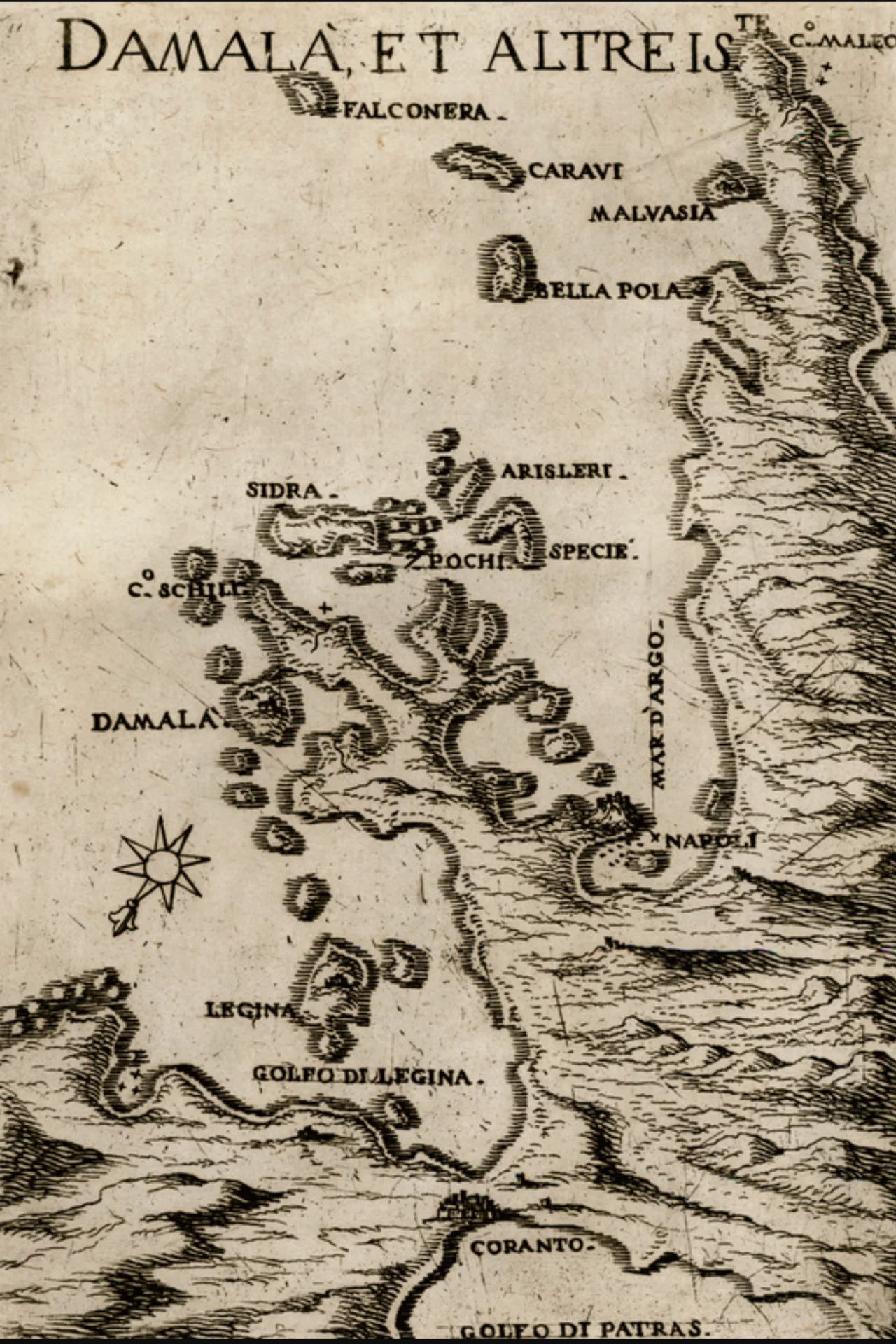

Morea
Hold a mulberry leaf up to the light and you can see the Peloponnese in it — the deep indentations, the three southern fingers pointing into the sea, the slightly lopsided bulk of the body. That resemblance, according to the most widely accepted theory, is why the great peninsula of southern Greece spent nearly a thousand years known not as the Peloponnese but as Morea. The name appears first in the 10th century, perhaps referring to a small bishopric in the western region of Elis, where mulberry cultivation was already ancient. The British Byzantinist Steven Runciman put it plainly: the name comes 'from the likeness of its shape to that of a mulberry leaf.' Whatever the precise origin, 'Morea' stuck — carried forward through centuries of conquest and reconquest, written into the names of principalities, despotates, eyalets, and kingdoms, each ruled by a different foreign power that nonetheless borrowed its terminology from the local Greek-speaking population it had come to govern.
A Name Smuggled from China
There is a second theory about Morea's name, less poetic but more historically tangled. Mulberry trees were known in the Peloponnese since antiquity, but they became economically transformative in the 6th century CE when silkworms — or more precisely, knowledge of how to raise them — were smuggled out of China into the Byzantine Empire. The story is remarkable: according to the historian Procopius, two monks concealed silkworm eggs inside hollow walking staffs and brought them to Constantinople around 552 CE, ending China's monopoly on raw silk production. The mulberry leaf, which is what silkworms eat, suddenly became strategically important. The Peloponnese, where mulberry cultivation thrived, gained new value as a silk-producing region. By the 10th century, when 'Morea' first appears in Byzantine chronicles, the mulberry tree was deeply embedded in the peninsula's economy and landscape. Whether the name derived from the shape of the leaf or from the ubiquity of the tree itself — or both — the mulberry gave the Peloponnese its medieval identity.
Crusaders and the Latin Principality
In 1204, the Fourth Crusade sacked Constantinople instead of fighting Muslims in the Holy Land — one of history's more spectacular mission failures. In the chaos that followed, 'Franks' (the Byzantine term for all Western Europeans) fanned out across Greece to claim territory. Two groups moved on the Peloponnese, eventually establishing the Principality of Achaea. They found 'Morea' already the local name and adopted it without hesitation.
The most consequential of the Frankish princes was Guillaume II de Villehardouin, who ruled from 1246 to 1278 and built a fortress and palace at Mystras, near the ruins of ancient Sparta, in 1249. His ambitions outran his luck: after losing the Battle of Pelagonia in 1259, he was captured by the Byzantine emperor Michael VIII Palaeologus and was forced to ransom himself by surrendering the fortresses of Mystras, Monemvasia, and Grand Magne. It was a fateful exchange. Mystras passed to Byzantine control and would become one of the great intellectual capitals of late medieval Greek civilization — a city of scholars, artists, and theologians — even as the Franks and Byzantines spent the next two centuries in grinding, inconclusive warfare across the rest of the peninsula.
The Despotate: Byzantium's Last Flowering
In the mid-14th century, the Byzantine emperor John VI Kantakouzenos reorganized Byzantine territory in the Morea into a Despotate — a semi-autonomous principality governed by a despot, typically a son of the emperor. The Despotate of the Morea, centered at Mystras, became something remarkable: while Byzantium shrank and Constantinople grew fragile, Mystras flourished. It was here that the philosopher Gemistos Plethon developed his neo-Platonic ideas in the early 15th century, influencing Renaissance thinkers in Florence. It was here that Byzantine art reached some of its finest late expressions.
The Despotate expanded steadily, incorporating the entire peninsula by 1430 as Frankish power waned. But the Ottoman Sultan Murad II breached the Hexamilion wall at the Isthmus of Corinth in 1446, exposing the peninsula to invasion. His successor, Mehmed II, captured Constantinople in 1453. The last Despots — brothers of the final Byzantine emperor — failed to coordinate a defense, invited Ottoman troops to suppress internal revolts, and ultimately fell. On 31 May 1460, Mystras surrendered. The last holdout, the castle at Salmeniko, fell in July 1461. The Despotate was gone.
Ottoman and Venetian Morea
Under Ottoman rule the peninsula became the Morea Eyalet, governed from a succession of capitals — Corinth, then Mystras, then Nauplion, then Patras. The Venetians clung to certain coastal fortresses for decades, but their possessions fell one by one during successive Ottoman-Venetian wars.
The Venetians did briefly reclaim the whole peninsula. Francesco Morosini captured it during the Morean War of 1684–99, and Venice established what it called the 'Kingdom of the Morea.' But Venetian rule proved unpopular — heavier in taxes and lighter in cultural sensitivity than the relatively tolerant Ottoman administration — and when the Ottomans invaded again in 1714, most local Greeks welcomed them back. The Ottoman reconquest was swift and complete, recognized by Venice in the Treaty of Passarowitz in 1718.
The decades after 1770 were particularly brutal. Albanian mercenaries hired during the failed Orlov revolt — a Russian-backed uprising — were not paid, and they turned on the civilian population, massacring Greeks and Turks indiscriminately. An estimated 20,000 Greeks were enslaved and sold. Around 50,000 fled the peninsula entirely. The survivors who remained in the mountains — the klephts, armed bands who waged guerrilla warfare against Ottoman authority — became the backbone of the Greek Revolution that broke out in 1821.
The Cradle of Revolution
The 14th-century Chronicle of the Morea, an anonymous text that survives in Greek, French, and other versions, records the feudal world the Franks built after the Fourth Crusade. Scholars debate which language the original was written in, though recent work favors the Greek manuscript in Copenhagen (MS Havniensis 57). The Chronicle is famous less for historical accuracy than for the vivid picture it paints of daily life in a multicultural, militarized world — a society where Greek, French, and Italian were all spoken, where Byzantine and Western law overlapped, and where the question of who actually owned the Morea shifted with every generation.
By 1821, the name 'Morea' had outlasted crusaders, despots, sultans, and doges. It was in the mountains of the Morea that the Greek War of Independence ignited. The Peloponnesian Senate, the first organizing body of the revolution, convened here. The armies that would eventually expel the Ottomans gathered here. The name 'Peloponnese' gradually reasserted itself in official usage through the 19th century, but in Greek vernacular, 'Morea' — Μωριάς — persists to this day.
From the Air
Morea — the medieval and Ottoman name for the Peloponnese — covers the entire peninsula of southern Greece, centered approximately at 37.35°N, 22.35°E. At cruising altitude the peninsula's distinctive mulberry-leaf shape (or hand with fingers pointing south) is recognizable from the three southern peninsulas — Mani, Cape Malea, and the Messenian — and the narrow Isthmus of Corinth connecting it to the mainland at the northeast. The Byzantine city of Mystras lies at 37.07°N, 22.37°E near Sparta, and is visible from lower altitudes as a hillside ruin below the Taygetus massif. Nearest major airport: Kalamata International (LGKL, 37.07°N, 22.02°E). Athens International (LGAV) provides the primary international gateway, about 220 km to the northeast.
Nearby Stories
- Battle of Maniaki 2.6 km away
- Brontochion Monastery 4.1 km away
- Argon Pedion 11 km away
- Lepreum 12 km away
- Battle of Lalas 12 km away
- Leonidio 21 km away
- The Slamat Disaster 29 km away
- Siege of Corinth (1463) 31 km away