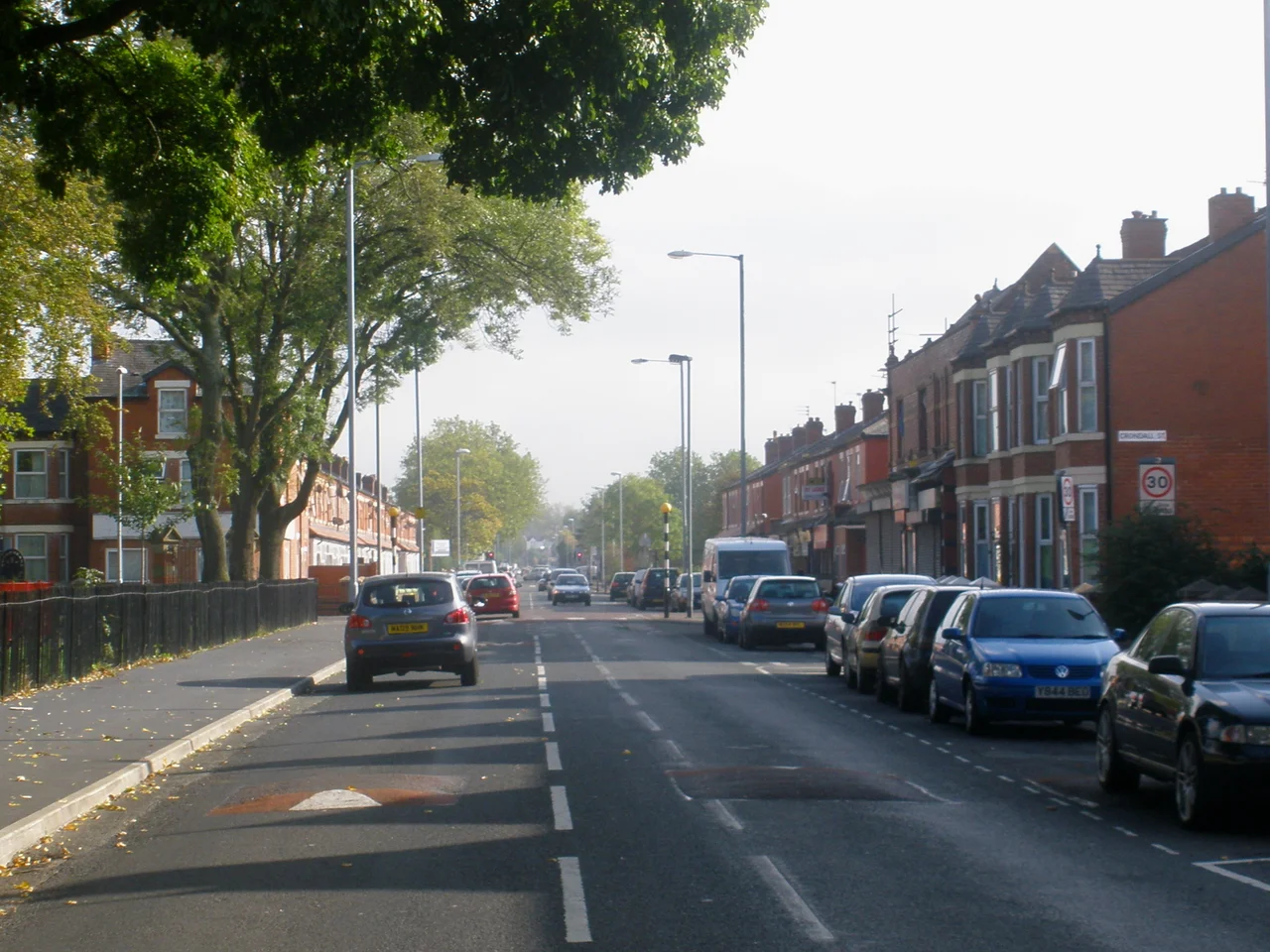

Moss Side
Elizabeth Gaskell opened Mary Barton, her great novel of industrial Manchester, in Moss Side. She described 'a deep clear pool' and an old timber-framed farmhouse in the middle of fields where workers walked to escape the smoke of the city. That was 1848. The farm was Pepperhill Farm, and within a generation the fields were terraces, and within another two generations the terraces were a port of arrival for Irish migrants, then for Black Caribbean and African families who built the cultural heart of Manchester's Carnival and the Curry Mile economy nearby. The pool is gone. Almost everything Gaskell describes is gone. What replaced it is a neighbourhood that has earned its complicated reputation honestly - and outlived almost every label outsiders have tried to fit on it.
From Moss to Mosside
The name comes from the great peat moss that once stretched from Rusholme to Chorlton-cum-Hardy. The first recorded mention of Moss Side appears in 1533, when it formed part of the Trafford estates; in 1801 the population was 151. By 1901 it was 26,677. The industrial expansion that ate the surrounding fields built block after block of red-brick terraced housing in the late 19th and early 20th centuries, and the houses filled with Irish workers, then with families from the Indian subcontinent and the Caribbean who arrived in the 1950s and 1960s. By the 1980s, Moss Side was the hub of Manchester's African-Caribbean community. The Manchester International Carnival, founded in 1972 and now drawing tens of thousands annually to Alexandra Park, grew out of this neighbourhood's claim to its own culture.
Maine Road
On 25 August 1923, Manchester City Football Club opened a new ground on Maine Road, having moved from Ardwick. It could hold 85,000 people on its opening day, one of the largest sports stadiums in the United Kingdom. For the next eighty years, on home matchdays, the streets of Moss Side filled with sky-blue scarves and chip shop queues. The roar from the Kippax stand could be heard across the south of the city. City moved to the new Etihad Stadium in East Manchester in 2003, and Maine Road was demolished. The site was rebuilt between 2011 and 2018 as Maine Place, a development of two, three, and four-bedroom houses around a new primary school named Divine Mercy. In 2011 it won the UK's Best Affordable Housing Scheme at the national Housing Excellence Awards. Some of the old terraces nearby still have City murals on their walls.
1981
In the summer of 1981, riots broke out in inner-city districts across England in response to police harassment, racial profiling, and unemployment that hit Black communities hardest. Moss Side rose with Brixton, Toxteth, and Handsworth. The disturbances ran for several nights in early July and produced sweeping inquiries that documented what the community had been saying for years. The 1970s had seeded Manchester's later 'Gunchester' nickname through the rise of gangs in the deprived south-central wards - Hulme, Longsight, Moss Side - where the underground economy supplied work that the formal economy did not. Turf wars in the 1990s and 2000s produced fatal shootings that filled the local news. Greater Manchester Police's Xcalibre task force, founded in 2004, and the multi-agency Integrated Gang Management Unit have brought gang-related shootings in the area down by about 90% in recent years. The work has been led, in large part, by the community itself.
The Streets That Stayed
Unlike neighbouring Hulme, Moss Side kept much of its Victorian and Edwardian housing stock. The 1960s and 1970s saw council demolitions on the western side, replaced with new estates around Alexandra Park. The bulk of the centre and east, however, was refurbished rather than razed. Streets like Great Western Street still feel like the city Engels would have recognised, only with new lives layered onto them. The Alexandra Park Estate has been renovated and its street pattern redesigned to reduce fear of crime. The Royal Brewery on Princess Road, which has stood on the same site since 1875 and has at various times brewed Kestrel, McEwan's, and Harp Lager, now produces Foster's for Heineken. The Moss Side Sports and Leisure Complex got an upgrade for the 2002 Commonwealth Games.
Erinma Bell and the Council Chamber
Among the three Labour councillors who currently represent Moss Side on Manchester City Council is Dr Erinma Bell, who co-founded the Carisma project in 2002 to address gun crime and violence through community work and won an MBE for her efforts before becoming a councillor. She is one of a long line of Moss Side residents who decided that the neighbourhood was theirs to define. The Guardian's 'Let's Move To' column in 2012 picked Moss Side as a place to move to, a milestone that surprised long-time residents less than it surprised the rest of Manchester. Whitworth Park sits at the edge of the ward. Manchester and Manchester Metropolitan universities are a fifteen-minute walk. The Curry Mile in Rusholme runs next door. The neighbourhood that journalists once parachuted into is now the one their younger colleagues are moving to.
From the Air
Moss Side sits at 53.456°N, 2.24°W about 1.9 miles south of Manchester city centre, bounded by Hulme to the north, Whalley Range to the south, and Old Trafford to the west. Recommended viewing altitude 1,500-3,000 ft AGL. From the air, look for the rectangular green space of Alexandra Park in the southwest and the cluster of new housing where Maine Road stadium used to stand. The A5103 (Princess Road) runs north-south through the area as the main route from the city centre toward Manchester Airport. Nearest ICAO airports: Manchester (EGCC) 6 nm south-southwest, Manchester Barton (EGCB) 5 nm west-northwest. Greater Manchester's low overcast is common; clearer flying weather typically comes in late spring or early autumn.
Nearby Stories
- National Science and Media Museum 0.2 km away
- Jodrell Bank Observatory 3.2 km away
- Siege of Lathom House 5.6 km away
- Chester Zoo 6.2 km away
- Whalley Abbey 8.9 km away
- Haddon Hall 10 km away
- Wentworth Castle 16 km away
- Blackpool 16 km away