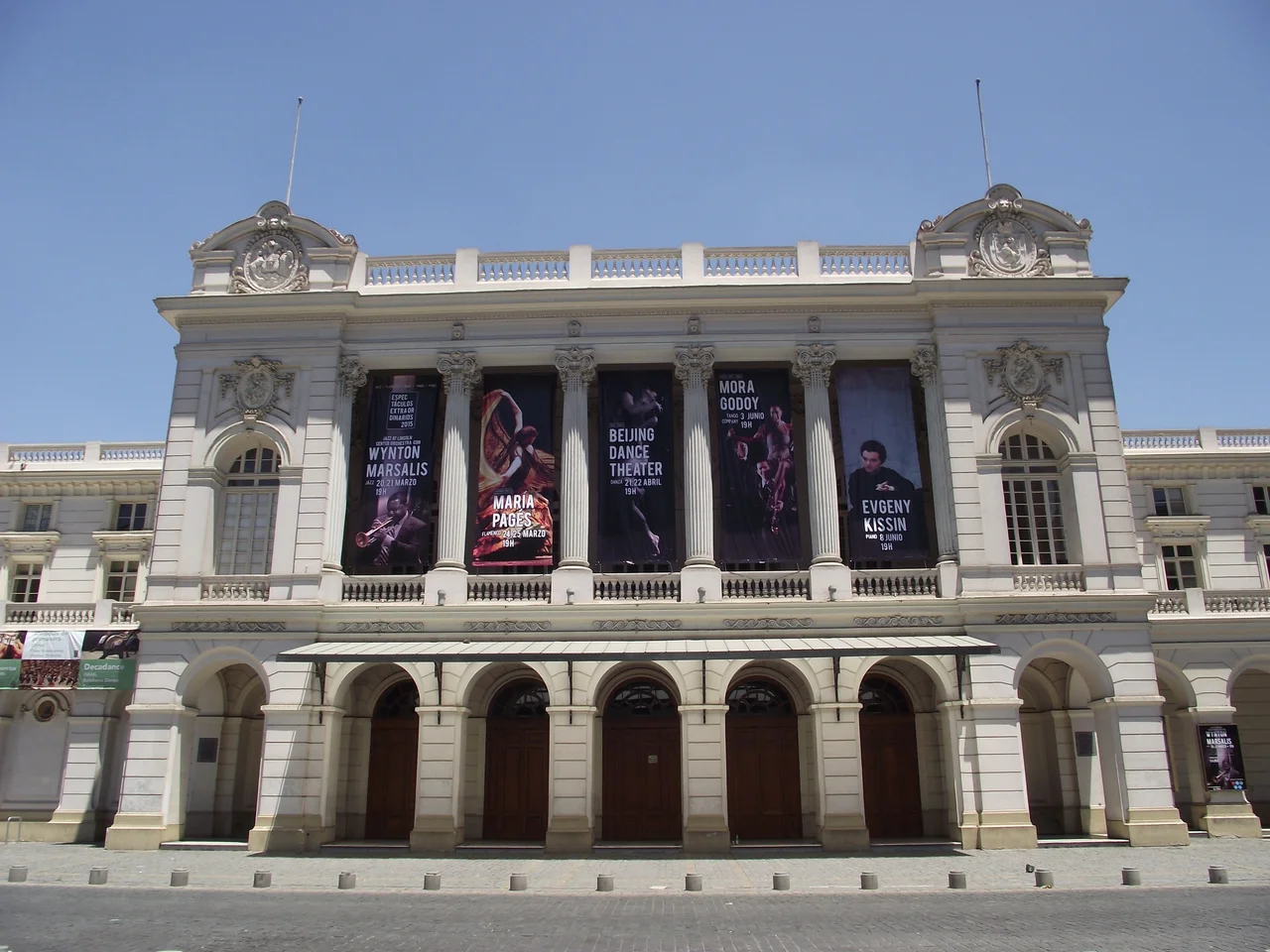

Municipal Theatre of Santiago
On the night of September 17, 1857, an Italian opera company raised the curtain on Verdi's Ernani before 1,800 spectators, and a young republic had its grand stage at last. The Teatro Municipal of Santiago had taken years and a French architect's vision to build, and it gleamed with a teardrop crystal chandelier under a neoclassical facade. What no one in that opening-night audience could have known was how many times the building would have to die and be reborn before the century was out.
A French Dream in a New Capital
The theater began as an act of civic ambition. In 1848 the Chilean government ceded a parcel of downtown land to the city, and an 1853 decree by President Manuel Montt set the construction in motion in a capital that was growing fast. The commission went to the French-Chilean architect Claudio Brunet des Baines, who designed a French neoclassical exterior in the European manner. His death in 1855 left the work to his countryman Lucien Henault and Henault's assistant Manuel Aldunate, and the project even drew on the counsel of Charles Garnier, the architect who would later design the Paris Opera. Chile was building itself a cultural capital, and it looked to France for the blueprint.
The Fire and the Fireman
Triumph turned to ash quickly. On December 8, 1870, a performance by the opera diva Carlotta Patti was followed by a fire that all but destroyed the building, leaving little more than the exterior walls standing. The blaze claimed the first fallen volunteer of the Santiago fire brigade, German Tenderini, who gave his life trying to save the theater; a street beside it still bears his name. Yet the city refused to let its opera house go. Local government and Chilean high society moved fast, Henault redesigned the interior, and the rebuilt theater reopened on July 16, 1873, to a performance of Verdi's La forza del destino. Out of the wreckage, the music resumed.
Shaken, Burned, and Rebuilt Again
The twentieth century tested the building further. The great earthquake of 1906 tore out most of the interior, and a second serious fire struck in 1927. Each time, the theater recovered, and each rebuilding made it more opulent even as the main hall shrank to 1,500 seats. Around it grew the institutions of a true opera house: the Santiago Philharmonic Orchestra in 1955, the Cultural Corporation of Santiago to administer the house in 1957, the Santiago Ballet in 1959, and the Teatro Municipal Chorus in 1962. Chile declared the theater a National Monument in 1974, and it later served as the stage for the OTI song festival in 1978 and again in 1986. When the historic stage curtain was finally replaced in 1995, the old one was cut into keepsakes for donors, so that even its retirement helped fund the future.
The Voices That Came South
For more than a century and a half, the world's greatest performers have made the long journey to this stage at the bottom of the Americas. The Chilean pianist Claudio Arrau, born in the southern town of Chillan and one of the supreme interpreters of his age, left his homeland in 1941 for a career of legend; when he returned for a visit in 1984, the theater inaugurated a salon in his honor, seating 250. The roster of guests reads like a history of twentieth-century performance. Singers Luciano Pavarotti, Placido Domingo, Kiri Te Kanawa, and Renee Fleming. Violinists Jascha Heifetz, Yehudi Menuhin, and Isaac Stern. Conductors Zubin Mehta, Daniel Barenboim, and Pierre Boulez. Dancers Mikhail Baryshnikov and the companies of the Bolshoi and the Mariinsky. A theater that began as a borrowed European idea became, against fire and earthquake, the place where the whole world came to sing for Chile.
From the Air
The Teatro Municipal stands at 33.44 S, 70.65 W in the historic heart of downtown Santiago, a few blocks east of the Plaza de Armas and near the financial district. From the air, the dense colonial grid and the open square of the Plaza de Armas to the northwest serve as the best references; the Andes rise sharply to the east. Santiago's principal gateway, Arturo Merino Benitez International (ICAO: SCEL), lies about 15 miles northwest in Pudahuel, with the general-aviation field at Eulogio Sanchez (Tobalaba, ICAO: SCTB) to the east. Recommended viewing altitude is 2,000 to 3,000 feet AGL. The central basin holds haze, so the clearest views come after rain or on a brisk, wind-scrubbed day.
Nearby Stories
- Paine Memorial 21 km away
- 1947 BSAA Avro Lancastrian Star Dust accident 23 km away
- Battle of Chacabuco 31 km away
- La Campana National Park 36 km away
- Puente del Inca 44 km away
- Casa de Isla Negra 62 km away
- Santa Cruz, Chile 103 km away
- Pierre Auger Observatory 172 km away