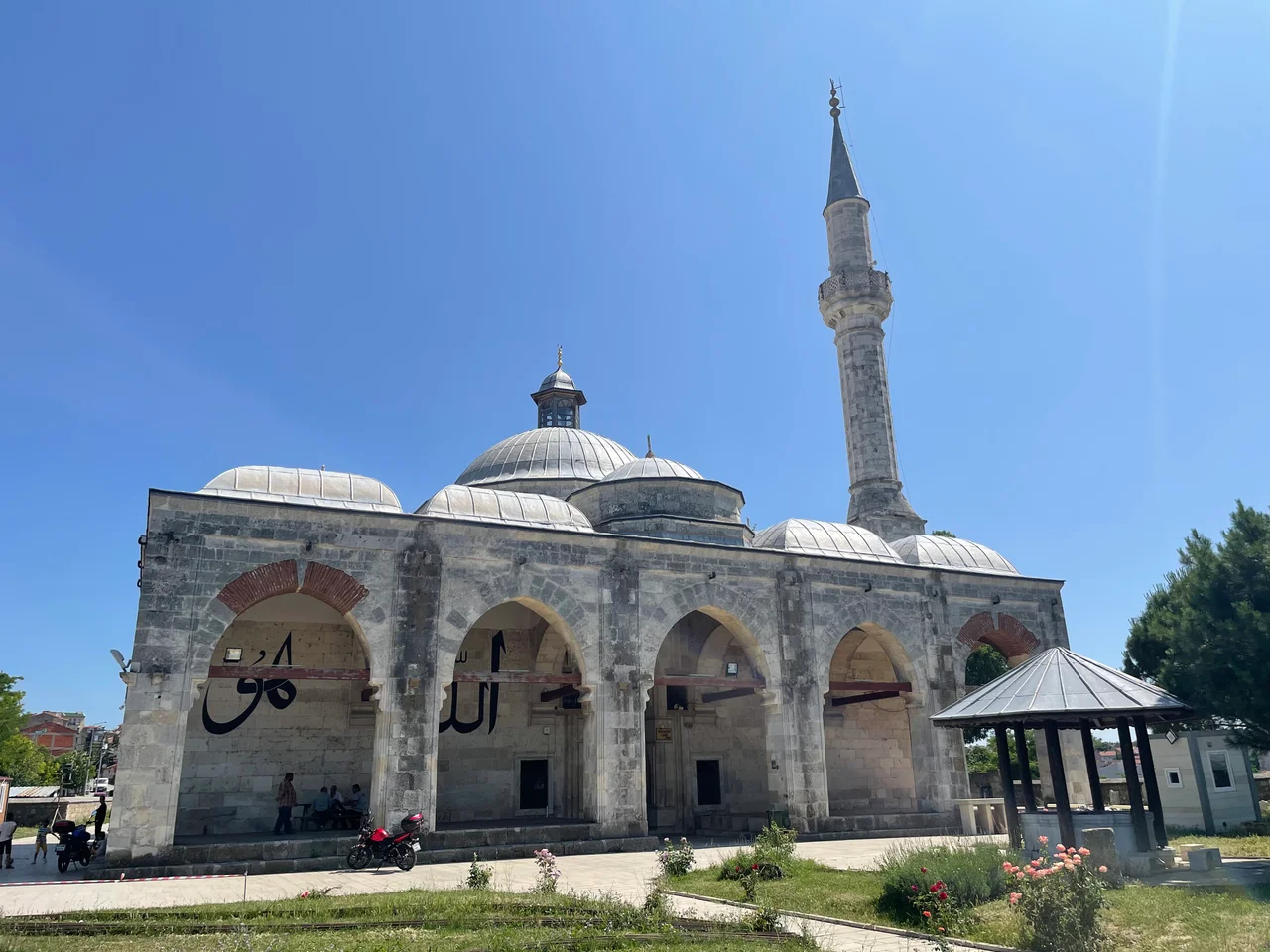

Muradiye Mosque, Edirne
Eight rows of cobalt blue hexagonal tiles, set on their points, wrap three walls of the prayer hall. Before the theft of 2001, there were 479 of them, in 53 different patterns, arranged with no obvious order: most designs appearing two or three times, the most common one repeated 54 times, fifteen patterns appearing exactly once. The disorder was deliberate, or at least it was original. It was also the first time anyone in the Ottoman Empire had produced underglaze painted tiles, and the small Muradiye Mosque in Edirne is where they ended up.
A Sultan's Side Project
Murad II commissioned the mosque, which was completed in 1435 or 1436 during his long reign over the early Ottoman state. He was the father of Mehmed the Conqueror, the sultan who would take Constantinople in 1453, but his own court remained in Edirne, the empire's European capital before the conquest. The building was originally not even a mosque. It began as part of a Mevlevi dervish complex, the order of whirling Sufis founded by the followers of Rumi, with a soup kitchen and an elementary school attached. The dervish complex was later converted to standard Sunni use, and the surrounding buildings vanished over the centuries. What survived is a small T-shaped prayer hall with a five-bay portico in front, an entrance hall with a domed room on either side, and a single stone minaret rebuilt several times after earthquake damage. The current minaret dates only to 1957.
The Frieze
The blue-and-white hexagonal tiles measure 22.5 centimeters across. Each one has a creamy white fritware body, a kind of ceramic made from a glassy frit rather than ordinary clay, with cobalt blue designs painted under a clear transparent glaze. The patterns drew directly on Chinese blue-and-white porcelain of the early 14th-century Yuan dynasty, which had reached Ottoman lands through trade. Plain turquoise glazed triangles fill the gaps between the hexagons, and a band of large blue-and-white moulded palmette tiles runs along the top of the frieze. These are the earliest underglaze painted tiles produced in Ottoman Turkey, and the earliest tiles with a frit body. They begin a tradition that would eventually produce the famous Iznik tiles of the next century, the cobalt and turquoise and tomato-red panels that line Istanbul's great imperial mosques. Everything started, in a sense, in this small room in Edirne.
Masters of Tabriz
The mihrab, the niche indicating the direction of Mecca, is unusually large for so small a building. It is built of moulded polychrome tiles in a technique called cuerda seca, dry cord, in which lines of greasy black resist separate areas of different colored glaze. The colors include yellow, apple green, turquoise, mauve, and cobalt blue. An inscription runs in raised white naskh script around the outer moulding, with a second inscription in yellow Kufic script running through the shafts of the naskh letters, the text from the Quran, verses 3:32 to 3:35. The style of this tilework is strikingly similar to the mihrab of the Yesil Mosque in Bursa, completed in 1421, where the craftsmen signed their work as the work of the masters of Tabriz. The same team almost certainly produced the Muradiye tiles, having traveled west from Tabriz in present-day Iran to work for the Ottomans, then continued on to produce panels at the Uc Serefeli Mosque in Edirne, completed in 1447.
The Misplaced Walls
The art historian John Carswell noticed something strange about the mosque. The painted decoration on the walls above the tile frieze runs behind the tiles rather than around them, suggesting the tiles were installed after the walls had been painted at least twice. The hexagonal frieze tiles are arranged with no coherent overall pattern. The two styles of rectangular border tiles do not match each other consistently. The mihrab is too large for the prayer hall. Carswell argued the tiles must have been moved here from somewhere else, most likely an imperial building in the Saray-i Cedid-i Amire, the New Imperial Palace Murad II built in 1450 on an island in the Tunca river just north of the city. That palace eventually housed between six and ten thousand people at its peak in the 17th century. By the early 19th century almost nothing remained of it. The tiles, salvaged from somewhere in that vanished complex, may be the only thing left of the palace that birthed them.
From the Air
Muradiye Mosque, Edirne: 41.6824 N, 26.5648 E, in the historic city of Edirne in northwestern Turkey, near the Bulgarian and Greek borders. Best viewed below 3500 feet. Identifiable as a small T-shaped Ottoman mosque with a single dome and a single stone minaret. The much larger Selimiye Mosque, a Sinan masterpiece with four tall minarets, dominates the Edirne skyline about 1 km southeast. Edirne airfield is small and not for general transit. Tekirdag Corlu (LTBU) is about 75 nm east; Plovdiv (LBPD) about 80 nm west. Class G airspace over most of Edirne; check NOTAMs for the nearby Greek and Bulgarian borders.
Nearby Stories
- Didymoteicho Fortress 16 km away
- 1928 Chirpan-Plovdiv Earthquakes 64 km away
- Ganos 85 km away
- Istanbul's Rural Outskirts 113 km away
- Great Basilica of Plovdiv 113 km away
- Samothrace temple complex 117 km away
- Buzludzha Monument 124 km away
- Varna Necropolis 149 km away