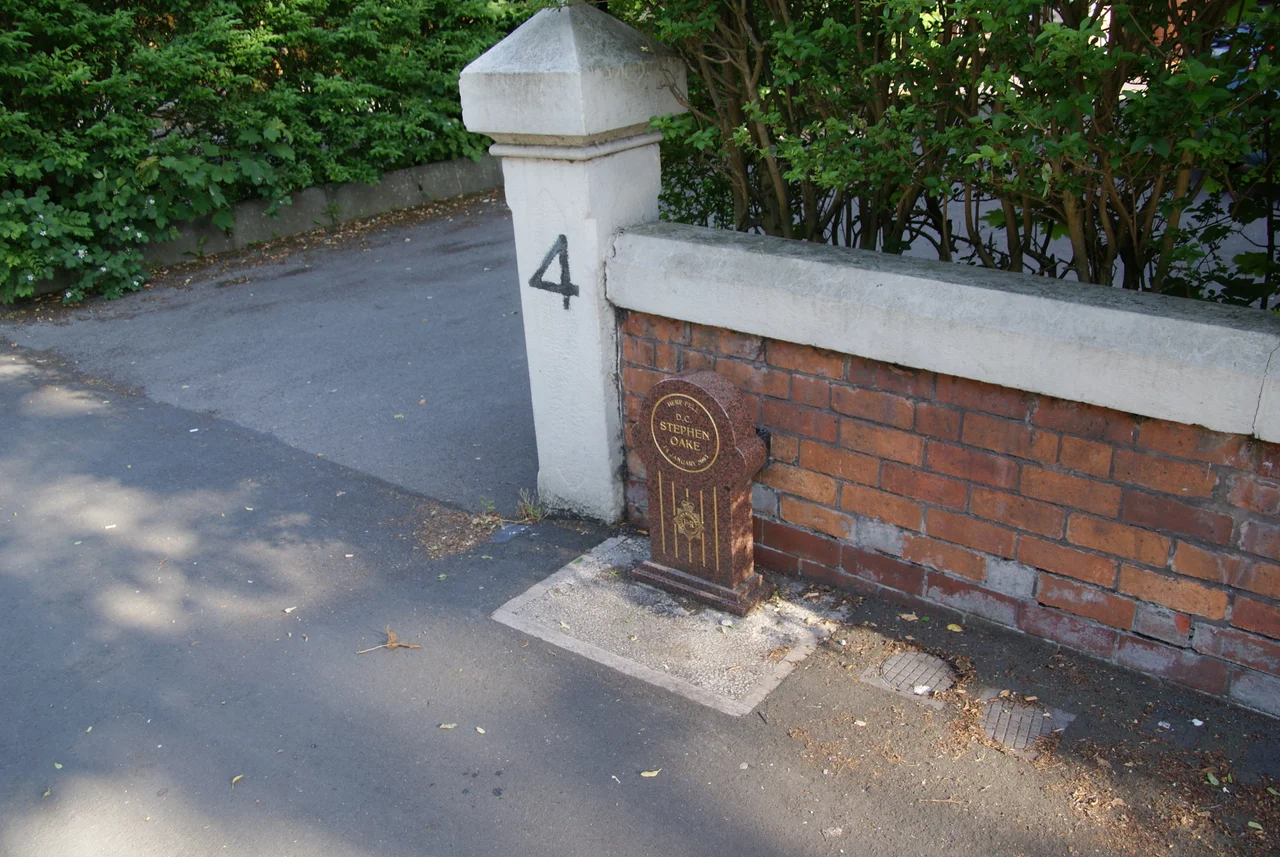

Murder of Stephen Oake
Stephen Oake came from a family that served. His father Robin had risen to become chief constable of the Isle of Man and a holder of the Queen's Police Medal. Stephen followed him into policing, spent nearly twenty years with Greater Manchester Police, and in 1999 moved into Special Branch as an anti-terrorism detective. He was 40, married, the father of three children, and known among colleagues for skills the force had formally commended only a year before he died. On 14 January 2003, in a flat in north Manchester, he went unarmed and without body armour to help restrain a man who had picked up a kitchen knife — and was stabbed eight times in the chest. He kept trying to help his colleagues subdue the suspect even as he was dying.
The Crumpsall Flat
The address was Flat 4, 4 Crumpsall Lane, a few miles north of Manchester city centre. The operation that morning was meant to be routine — an immigration matter, the resident not expected to be home. Instead the officers found three men inside, including an Algerian named Kamel Bourgass who had crossed into England in the back of a lorry three years before. He was wanted in London in connection with what the press would soon call the Wood Green ricin plot, a planned bioterrorism attack on the Underground, but the Manchester officers did not yet know who they had. He didn't seem dangerous. He wasn't handcuffed. Then Bourgass, believing he had been recognised, grabbed a knife and tried to run. Stephen Oake stepped in to stop him. Three other officers were wounded before Bourgass was finally pinned down. Oake died of his injuries at North Manchester General. He had been doing what every officer trains for: protecting colleagues, closing distance, not letting a violent man back out the door.
A Family's Loss
What the medals and the citations couldn't measure was a widow and three children losing a husband and father in the time it took a kitchen knife to be picked up and used. The Criminal Injuries Compensation Authority later paid Lesley Oake and each of the three children £13,000 — a figure the Greater Manchester Police Federation called an insult to the sacrifice. Stephen was buried in Manchester on 25 January 2003, a funeral that drew officers from across the country. His chief constable later pressed for him to receive the George Cross, Britain's highest civilian decoration for bravery; a civil service committee declined, judging that his actions, while heroic, had not quite met the threshold of bravery 'beyond the call of duty.' He received the Queen's Gallantry Medal posthumously instead. A street in north Manchester was renamed Stephen Oake Close, and a stone memorial set there. Vandals broke it in March 2007. Six months later it was replaced.
Forgiveness
Stephen Oake was an evangelical Christian, as his father is. In the weeks after the murder, Robin Oake stood up in public and forgave his son's killer. It was a statement so directly out of step with the national mood that it became one of the most-quoted moments of the case, and Robin Oake has spoken about it many times since — not as a denial of grief or of justice, but as something he felt his faith required of him. Kamel Bourgass was convicted at the Old Bailey in June 2004 and sentenced to life imprisonment with a minimum term of 22 years for the murder, plus a further 15 years for the attempted murder of two other officers; a second trial saw him convicted in the ricin plot and given another 17 years. He remains in custody. The debate Oake's death prompted — about whether English and Welsh police should handcuff suspects by default, regardless of apparent threat — quietly changed practice in police forces across the country.
Remembering DC Oake
Inside Greater Manchester Police, Stephen Oake is named alongside the small number of officers who died in service. His photograph is part of the force's roll of honour. Each January, on the anniversary, officers and family gather at the memorial in Crumpsall. Stephen Oake Close is an unremarkable suburban street — terraced houses, parked cars, the M60 a distant hum — and that is part of the point. The memorial doesn't try to make the day heroic. It marks a man who went to work expecting paperwork and never came home. The Police Memorial Trust, which paid for the stone, was founded for exactly this kind of remembering: ordinary streets where an ordinary morning turned, and someone stood up so that others could keep going.
From the Air
Located in Crumpsall, north Manchester, at 53.500°N, 2.246°W. The memorial sits on Stephen Oake Close, a small residential street roughly 4 km north of Manchester city centre, close to the A576 and the M60 ring road. Manchester Airport (EGCC) is about 18 km south; Manchester Barton (EGCB) is roughly 8 km west-southwest. Visible from low cruising altitudes on clear days as part of the dense red-brick fabric of north Manchester between Cheetham Hill and Heaton Park.
Nearby Stories
- National Science and Media Museum 0.2 km away
- Jodrell Bank Observatory 3.2 km away
- Siege of Lathom House 5.6 km away
- Chester Zoo 6.2 km away
- Whalley Abbey 8.9 km away
- Haddon Hall 10 km away
- Wentworth Castle 16 km away
- Blackpool 16 km away