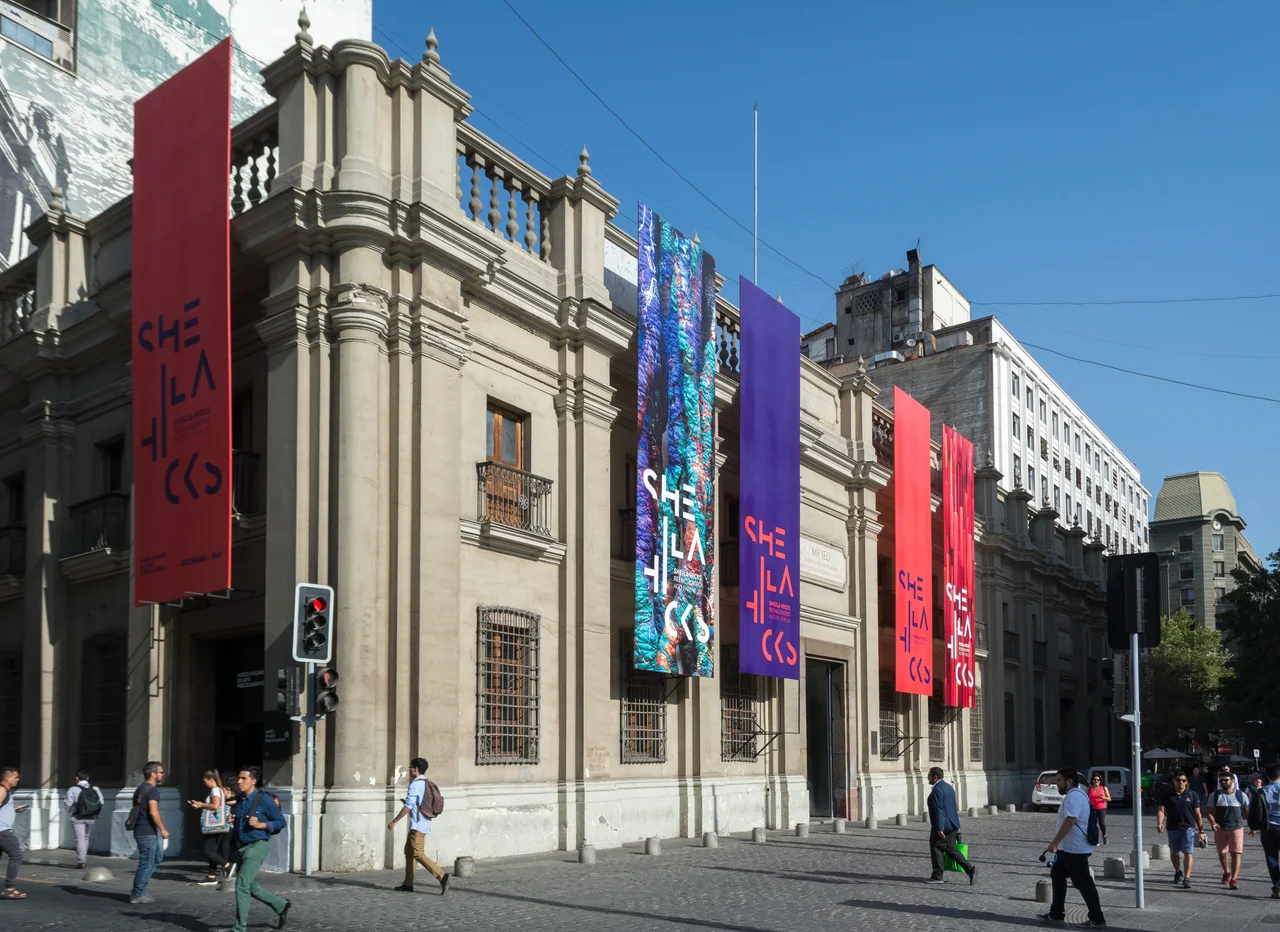

Museo Chileno de Arte Precolombino
A painted cloth hangs in a quiet gallery in central Santiago, its pigments still legible after nearly three thousand years. It was woven by the Chavin people of the Andes long before any European set foot in the Americas, and it is only one voice in a vast chorus. The Museo Chileno de Arte Precolombino holds more than three thousand works from nearly a hundred Indigenous cultures, spanning some ten thousand years of human creativity across two continents. This is not a museum of conquest. It is a museum of the makers who came first.
One Man's Half-Century
The collection began as a private obsession. The Chilean architect Sergio Larrain Garcia-Moreno spent nearly fifty years acquiring pre-Columbian art and artifacts, and in time he sought a permanent home where the pieces could be preserved and shown to the public. With the backing of Santiago's municipal government, he secured a building and established the curatorial institution that opened its doors in December 1981. What had been one collector's lifelong pursuit became a public trust. The objects had been chosen, by Larrain's own account, for their beauty rather than for archaeological context, and the museum carries that aesthetic eye to this day, presenting ancient work as art rather than specimen.
The Royal Customs House
The setting suits the contents. The museum occupies the Palacio de la Real Aduana, a colonial customs house built between 1805 and 1807, a block west of the Plaza de Armas and beside the old courts of justice and the former National Congress. In January 2014, a renovation by the acclaimed Chilean architect Smiljan Radic expanded the museum by some seventy percent, adding exhibition space, storage, and a conservation laboratory. The marriage is a fitting one: a building raised in the last years of Spanish rule now shelters the art of the peoples who long predated it, the colonial shell wrapped around far older treasures.
Four Worlds Under One Roof
The collection is organized into the great culture areas of the ancient Americas, and walking it is like crossing continents. The Mesoamerican galleries hold a statue of Xipe Totec, the flayed Aztec god of renewal, alongside an incense burner from Teotihuacan and a Mayan bas-relief. The Intermediate Area shows the pottery of the Valdivia, among the oldest ceramic traditions in the hemisphere, and gold from the Veraguas and Diquis peoples of Central America, with Capuli figures depicted in the act of chewing coca. The Central Andes gather Moche ceramics and that ancient Chavin textile, the oldest cloth in the museum. And the Southern Andes bring the story home to Chile and Argentina, with snuff trays from the San Pedro culture, ceramic urns of the Aguada, and an Inca quipu, the knotted cords that recorded a vast empire without writing. To move through these rooms is to grasp how deep and various human life in the Americas was long before 1492.
The Dignity of the Makers
Many of the museum's most striking objects come from burials, masks and copper figures recovered from graves across the Andes. Among the most affecting holdings is a mummy of the Chinchorro, the coastal people of northern Chile who preserved their dead thousands of years before the Egyptians did, in what may be the oldest deliberate mummification on Earth. These remains and artifacts are displayed today with a care that aims to honor rather than exhibit the dead, treating each piece as the work of people with their own cosmologies, craft, and grief. Behind every urn and textile stands a maker: a Chavin weaver, a Moche potter, an Inca accountant tying knots into memory, a Chinchorro family preparing a loved one for the long journey. The museum's quiet achievement is to let those hands speak directly to a modern visitor, across thousands of years, without the interruption of the empires that came after and tried to silence them.
From the Air
The museum sits at 33.44 S, 70.65 W in the historic core of Santiago, one block west of the Plaza de Armas. From the air, the open square of the Plaza de Armas and the cathedral beside it are the clearest landmarks; the dense colonial grid is hemmed by the Andes to the east. Santiago's main gateway, Arturo Merino Benitez International (ICAO: SCEL), lies roughly 15 miles northwest in Pudahuel, with the general-aviation field at Eulogio Sanchez (Tobalaba, ICAO: SCTB) to the east. Recommended viewing altitude is 2,000 to 3,000 feet AGL. The basin frequently holds smog, so the sharpest views of downtown come on clear days following rain or strong wind.
Nearby Stories
- Paine Memorial 21 km away
- 1947 BSAA Avro Lancastrian Star Dust accident 23 km away
- Battle of Chacabuco 31 km away
- La Campana National Park 36 km away
- Puente del Inca 44 km away
- Casa de Isla Negra 62 km away
- Santa Cruz, Chile 103 km away
- Pierre Auger Observatory 172 km away