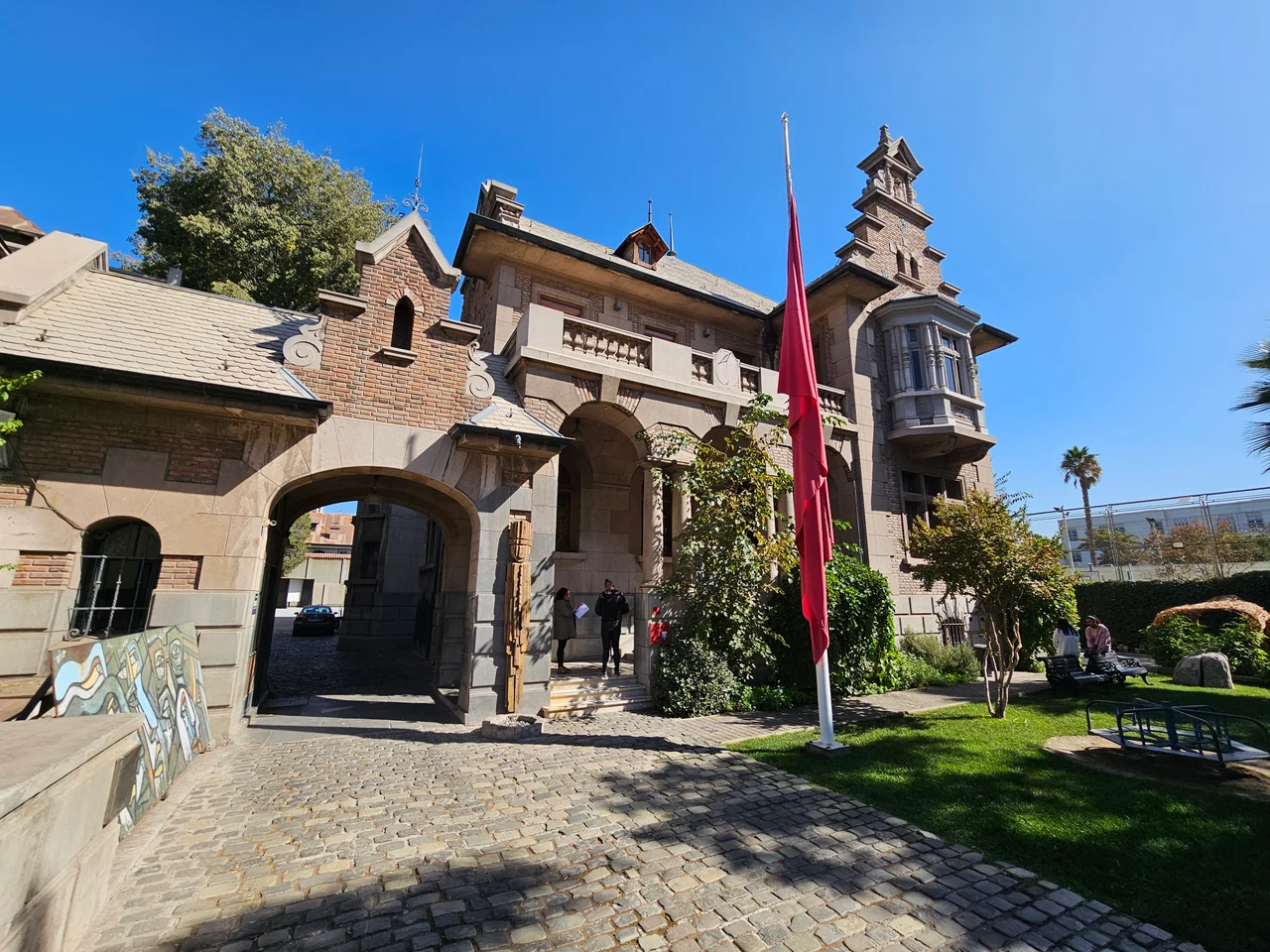

Museo de la Solidaridad Salvador Allende
Picasso and Miro and Matta did not send their work to Chile to be sold. In the early 1970s, painters and sculptors across the world were giving art away to a country most of them had never visited, because they believed in what was happening there. Salvador Allende, the elected socialist president, had asked the world's artists for a gesture of faith, and they answered: 650 works, freely given, to build a people's museum in Santiago. Then, on a September morning in 1973, the project died alongside the president it honored, and the surviving art had to flee the country it was meant to celebrate.
An Open Letter to the World
The idea came from the Spanish art critic Jose Maria Moreno Galvan in 1971, and Allende himself approved it. An international committee formed, drawing in figures like the Brazilian critic Mario Pedrosa and the Italian writer and painter Carlo Levi, and Allende issued an open letter inviting artists everywhere to contribute. The response was extraordinary. Between 1972 and 1973, works arrived from around the globe: paintings, prints, sculptures, drawings, tapestries, and photographs, 650 pieces in all. Joan Miro sent his. So did Roberto Matta, the great Chilean surrealist; the Brazilian Lygia Clark; the American Frank Stella. The premise was radical in its simplicity. Art would not be bought for the museum. It would be given, as an act of solidarity with a nation trying to remake itself.
The Eleventh of September
On September 11, 1973, the Chilean military overthrew Allende's government. The president died in the presidential palace as it was bombed and stormed, and the country fell under the dictatorship of Augusto Pinochet for the next seventeen years. The museum, barely born, was finished. Its organizers were forced into exile, and part of the collection simply vanished in the chaos. What could be saved was hidden away. Some works went into storage at the Santiago Museum of Contemporary Art; others were quietly absorbed into the National Museum of Fine Arts. The gift of the world's artists became contraband, scattered and concealed in the very city built to display it.
A Museum in Exile
The story does not end in defeat, which is what makes it remarkable. Driven from Chile, the people behind the museum kept its spirit alive abroad, gathering new works from artists who continued to give in protest against the dictatorship. The collection became a kind of traveling conscience. Only with the return of democracy did the work begin to come home. In 1990, the Salvador Allende Foundation started recovering the original collection, and in September 1991 the Museum of Solidarity reopened, at first within the National Museum of Fine Arts. Pieces lost for decades have continued to surface; recovered works have been repatriated from Spain in recent years. The museum that a coup tried to erase refused, across two continents and a generation, to disappear.
The House That Listened
There is a deep and deliberate irony in where the museum finally settled. Since 2004 it has occupied the Palacio Heiremans, a mansion built in 1925 for the Belgian entrepreneur Amadeo Heiremans Vaerman in the Republica neighborhood. During the dictatorship, this elegant house served the secret police, the DINA and its successor the CNI, as a detention center and a wiretapping station, among the largest in the country. People were held and tortured here. Part of that apparatus remains in the basement, the tangled telephone lines preserved as evidence. A building that the regime used to silence and surveil now shelters the art it could not destroy. Nothing about that placement is accidental.
Solidarity, Held
To walk through the Museo de la Solidaridad Salvador Allende today is to move through a kind of double exposure. The walls hold work given in hope by artists who believed a more just country was being born. The foundations hold the memory of the machinery that crushed that hope and the people who carried it. The museum does not separate these two histories; it lets them sit in the same rooms. That is its argument, quiet and unflinching: that solidarity outlasts repression, that the gift outlives the fist, and that a society which confronts its darkest spaces honestly is stronger for having done so.
From the Air
The museum stands in the Republica neighborhood just southwest of central Santiago, near 33.45°S, 70.67°W. From the air, look for the dense gridded blocks south of the Alameda and west of the downtown core. Santiago fills a broad basin around 520 meters elevation, with the Andes rising abruptly to the east and the lower coastal range to the west. Winter smog often softens the view over the city; clearer conditions follow rain. A viewing altitude of 3,500 to 5,000 feet AGL reads the neighborhood grid clearly against the larger sweep of the basin. Nearest airport is Comodoro Arturo Merino Benitez International (SCEL), roughly 10 nautical miles to the northwest.
Nearby Stories
- Paine Memorial 14 km away
- Viña del Mar International Song Festival 28 km away
- Battle of Chacabuco 29 km away
- Cerro El Plomo 30 km away
- Casa de Isla Negra 30 km away
- Paso Internacional Los Libertadores 49 km away
- Pichilemu 92 km away
- Uruguayan Air Force Flight 571 113 km away