
Museum of Transport, Greater Manchester
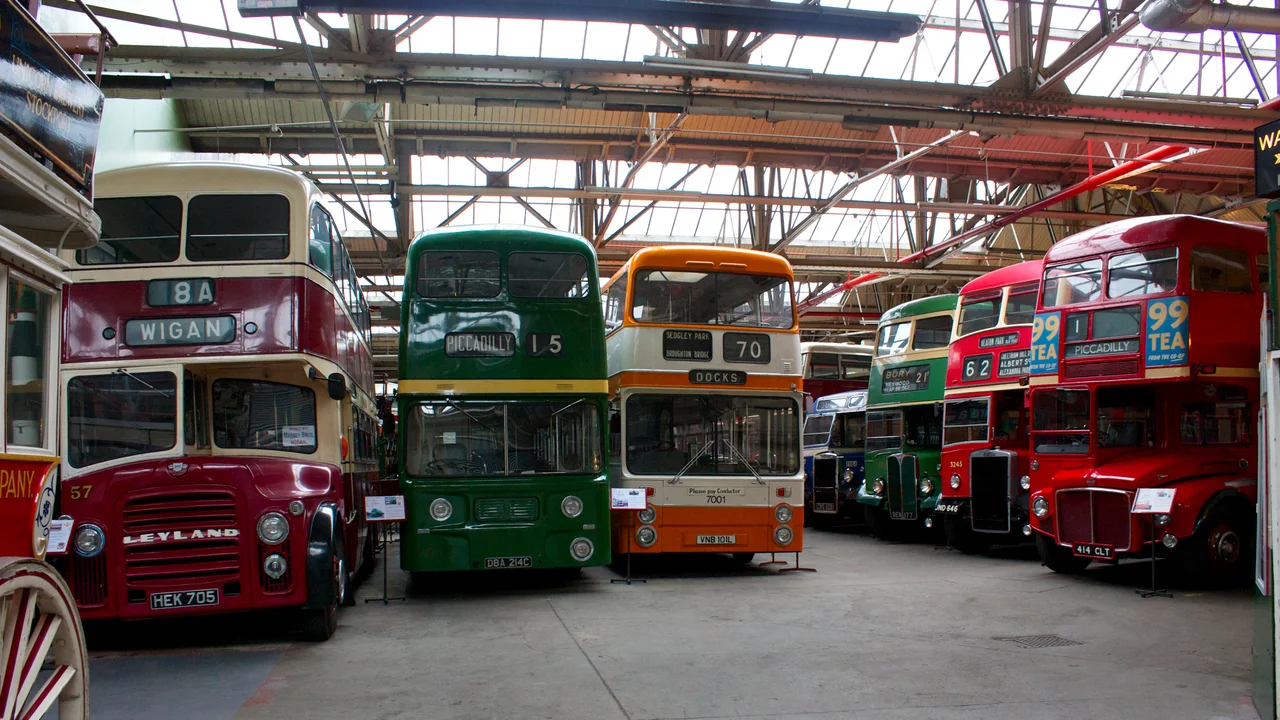
Walk into the entrance hall on Boyle Street and you smell it before you see it: that warm mineral smell of old diesel and floor polish and brass that any preserved-vehicle museum carries. Then your eyes adjust and there they are — seventy buses, in cream and crimson and green, parked in tight rows under steel trusses that have been holding up a roof since 1928. The Manchester Corporation logos still ride above the radiators. The destination blinds still read Belle Vue and Piccadilly and Levenshulme. This is one of the largest collections of preserved buses anywhere in Britain, kept alive by volunteers in the bus garage where many of these vehicles once clocked off shift.
A Garage That Became a Museum
The building's two halls were never meant to be a museum. The shed at the back, brick and iron and glass on Queens Road, was built in 1901 as an electric tram depot — back when Manchester ran one of the largest municipal tram networks in the country. The upper hall, a cathedral of riveted steel trusses, went up in 1928 as a Corporation Transport bus garage as the city pivoted from trams to motor buses. In 1935 they roofed over the open space between the two structures to create the lower hall. The block was Grade II listed in 1988 for its industrial significance. The collection itself was founded in 1977 by enthusiasts who feared the great fleets of Manchester and Salford Corporation buses would all end up scrapped; the museum opened to the public on 27 May 1979. The neighbouring tram shed is still doing its original job, operated today by Stagecoach Manchester as a working depot.
Eighty Buses and the Stories They Carry
The collection runs to about eighty vehicles, and roughly seventy of them are on site at any given time. There are trolleybuses from Manchester and Ashton-under-Lyne corporations — the silent electric workhorses that ran on overhead wires before the wires came down in the 1960s. There is the prototype body of a Manchester Metrolink tram, the city's reinvention of light rail after thirty years of buses-only. And tucked among the public-transport stalwarts are a handful of fittings used by Warner Bros. on the set of Harry Potter and the Prisoner of Azkaban — the Knight Bus and assorted props found a sympathetic home with people who appreciate the engineering joke. The archive holds tens of thousands of historic timetables, posters, uniforms, ticket machines and route maps. Conservators work in plain sight: on a good day you can watch a 1950s Daimler being slowly returned to its Corporation livery.
Heritage Bus Days
What sets this museum apart from a static collection is that the buses still run. On event days — usually one a month from spring through autumn, plus the December Christmas Cracker market — vehicles roll out of the garage and a heritage shuttle runs from Manchester Victoria station to Boyle Street every twenty minutes. Passengers ride for free on whatever happens to be in service that day: a 1950s Leyland Titan one weekend, a 1970s Atlantean the next. In February the Morris Minor club brings dozens of cars for an annual event. In 2023 the museum tried a Twilight Running Day, with the buses still circulating into the evening — the headlights of a 1960s Manchester Corporation single-decker sweeping along Cheetham Hill Road at dusk, exactly as they would have done sixty years earlier.
Where It Sits
Cheetham Hill is two miles north of Manchester city centre, on a slope above the River Irk. It is one of the city's most layered neighbourhoods — Georgian villas, Jewish heritage from the great late-Victorian migration, Pakistani and Bangladeshi communities from the postwar era, all stitched together by the A665. The museum sits at the north end of Boyle Street, tucked behind the Stagecoach Bee Network depot. The Queens Road tram stop is two hundred metres away — fittingly, you can arrive by Metrolink and step into a building that documents what Manchester's transport looked like before Metrolink. The 41, 135 and 151 buses stop nearby. Open Wednesdays, Saturdays, Sundays and bank holidays from 10:00 to 16:30, the museum charges modest admission and keeps the lights on through volunteers, donations and the membership of bus enthusiasts who clearly think this building is one of the most important in the city — because for the history of Manchester transport, it is.
From the Air
Located in Cheetham Hill, Manchester, at 53.503°N, 2.233°W, about 3 km north of Manchester city centre. The site sits beside the A6010 Queens Road and the Manchester Metrolink Bury line. Manchester Airport (EGCC) is roughly 18 km south; Manchester Barton (EGCB) is about 8 km west. From the air, identify the museum by the distinctive long shallow-pitched glass roof of the former 1901 tram shed alongside the heavier 1928 bus garage, just east of the M60 Junction 19 and the Manchester Fort retail park.
Nearby Stories
- National Science and Media Museum 0.2 km away
- Jodrell Bank Observatory 3.2 km away
- Siege of Lathom House 5.6 km away
- Chester Zoo 6.2 km away
- Whalley Abbey 8.9 km away
- Haddon Hall 10 km away
- Wentworth Castle 16 km away
- Blackpool 16 km away