.jpg)
National Football Museum
The very first rulebook of association football — six sheets of paper, hand-corrected, written in a room above a London tavern in October 1863 — sits in a climate-controlled case in Manchester city centre. Three floors up, the shirt Diego Maradona wore against England in 1986 hangs on a mannequin: the same blue-and-white stripes he was wearing when he punched the ball past Peter Shilton and called it the Hand of God. In between are about 140,000 other things, of which roughly 2,500 are on display at any one time. This is England's national museum of the game it invented, and after a bumpy start in Preston it found its permanent home in 2012 inside Manchester's strange glass wedge of a building, Urbis.
The Building Itself
Urbis was Ian Simpson's contribution to Manchester's millennium reconstruction after the 1996 IRA bomb levelled much of the centre. The shape is unforgettable: a slim glass shard rising in a single inclined plane from the corner of Cathedral Gardens, like a wedge of slate set down at a deliberate angle. It opened in 2002 as a museum of cities, struggled to find an audience, and closed in 2010. The National Football Museum moved in two years later. The four-floor layout works for the collection in a way it never quite did for urban exhibits — the inclined glass façade pulls daylight into the Pitch Gallery, where the Hall of Fame display sits, and you can ride a lift to the top and look down through the building's transparent skin at the cathedral, Chetham's, and the Printworks tracking out below.
From Preston to Manchester
Football's national museum was originally Preston's. The idea came together in 1994 when Baxi Partnership acquired Preston North End and started rebuilding Deepdale — the oldest continuously used professional football ground in the world. A chance conversation introduced PNE chairman Bryan Gray to Harry Langton, who had spent thirty years amassing what became the FIFA Museum Collection. FIFA saw the connection: house the collection at a heritage stadium. A £7.5 million Heritage Lottery grant in 1997 made it real, and the Duke of Kent opened the museum at Deepdale on 21 June 2001. Visitors came — about 100,000 a year — and the praise was genuine; Bobby Charlton said he could not think of a better football museum anywhere in the world. But the books would not balance. In 2009 Manchester City Council offered £2 million a year to bring it east. Preston countered with £400,000. The trustees chose Manchester.
The Collections
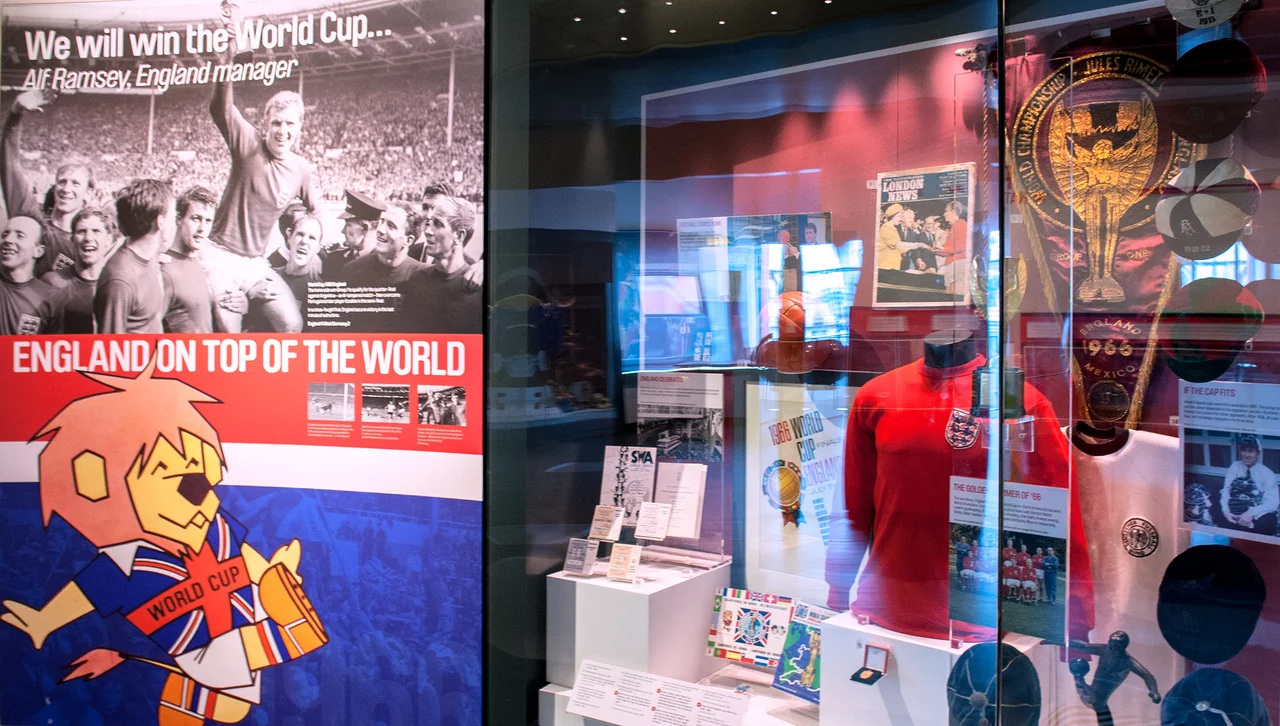
What sits inside is staggering when you stop to think about it. The original 1863 Laws of the Game, written on the night football diverged from rugby at the Freemasons' Tavern in London. The two balls used in the 1930 World Cup Final, the first such match — Argentina chose one for the first half, Uruguay chose the other for the second half, and Uruguay won. The world's oldest surviving women's football kit, from the 1890s. The match ball from England's 1966 World Cup victory at Wembley. Maradona's shirt. The original 1896 FA Cup trophy, used through 1910. L. S. Lowry's painting Going to the Match, which the museum acquired in 2022 after a £7.8 million campaign — the matchstick crowds streaming into a Bolton Wanderers ground, painted in 1953 by an artist who lived in nearby Pendlebury and went to Burnden Park most Saturdays. The kind of objects, in other words, where every label is a small history of the modern world.
Why Manchester
There is a fair argument that no city has a stronger claim to be the spiritual home of English football than Manchester. United and City sit on opposite sides of town, the museum sits between them, and the two clubs together have shaped the post-war story of the game as much as any pair of rivals anywhere. The first ever rule book is here, but so is the modern Premier League — every season's match programmes, the team sheets, the ephemera. The museum became free for Manchester residents when it began charging in 2019, a small piece of civic accounting that keeps the institution tied to the city that funds it. Half a million people walk through every year. They come to see the trophies and the shirts, but the thing they tend to remember is something smaller — a child's autograph book, a 1950s rosette, a turnstile from the old Wembley still smelling faintly of axle grease.
From the Air
Located in Manchester city centre at 53.486°N, 2.242°W, at the north end of Corporation Street next to Manchester Cathedral and the Printworks. Manchester Airport (EGCC) is about 14 km south; Manchester Barton (EGCB) is roughly 7 km west. From the air the Urbis building is unmistakeable — a wedge-shaped glass shard rising in a single inclined plane between the cathedral and Victoria station, distinct from any of its neighbours in the Manchester skyline.
Nearby Stories
- National Science and Media Museum 0.2 km away
- Jodrell Bank Observatory 3.2 km away
- Siege of Lathom House 5.6 km away
- Chester Zoo 6.2 km away
- Whalley Abbey 8.9 km away
- Haddon Hall 10 km away
- Wentworth Castle 16 km away
- Blackpool 16 km away