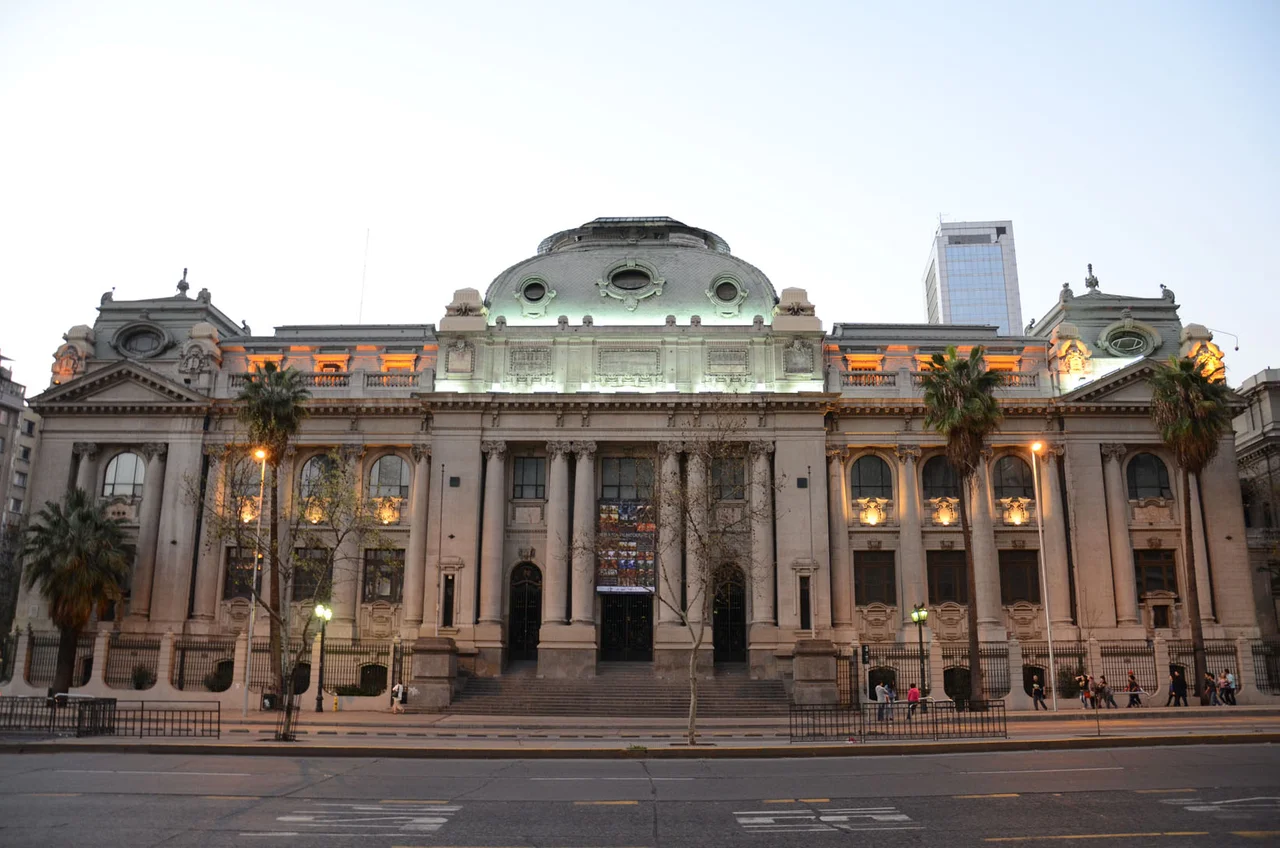

National Library of Chile
Before Chile was a country, it had a library. On August 19, 1813, while the war for independence still hung undecided, revolutionaries published a Proclamation of Foundation in the newspaper El Monitor Araucano and made an extraordinary request: that every citizen donate their books to build one great public collection. A nation that did not yet fully exist was already gathering its memory. Two centuries later, that gamble fills a colossal Beaux-Arts palace on the Alameda, holding millions of volumes and the documentary soul of an entire republic.
A Library Born in Wartime
The timing was audacious. The Biblioteca Nacional was created during the Patria Vieja, the fragile first stirring of Chilean self-rule, alongside a handful of other founding institutions. Then the war turned. After the Disaster of Rancagua in 1814, royalist armies crushed the patriot cause, and the young library closed along with the other republican experiments. It might have ended there. But the patriots won the Battle of Chacabuco in 1817, and the government reopened the library and began feeding it important collections. Bernardo O'Higgins, Chile's Supreme Director and the man whose name now graces the avenue outside, appointed the scholar Manuel de Salas as its first director. The friar Camilo Henríquez, who had edited Chile's first newspaper, followed as the second head librarian in 1822.
The Palace on the Alameda
For its first century the library moved between borrowed homes, including the square where the Teatro Municipal now stands. Then, for the centennial of independence, Chile decided to give its books a monument worthy of them. Construction of the present building began in 1913, one of several grand public works marking a hundred years of nationhood, and finished in 1925. The façade is unmistakably French in spirit, a procession of columns and arches in pronounced neoclassical style. Inside, carved marble staircases climb past sculptures and canvases by classic Chilean painters such as Alfredo Helsby and Arturo Gordon. The building shares its walls with the National Archive of Chile, so the country's printed memory and its official records sit under one roof.
The Memory of a Nation
For its first decades the library was a dependency of the colonial-era Universidad de San Felipe and its successor, the Universidad de Chile, gaining its independence only in 1852. In 1929 it was folded into the Dirección de Bibliotecas, Archivos y Museos, the national body overseeing Chile's cultural institutions. Today the Biblioteca Nacional ranks among the oldest and largest libraries in Latin America, its shelves holding millions of books and manuscripts along with maps, newspapers, photographs, and recordings. Many of its treasures arrived exactly as the 1813 proclamation imagined, donated or sold by Chileans who understood that a private collection becomes priceless when it joins a public one. Among the holdings is a copy of the Aurora de Chile, the country's first newspaper. To walk the reading rooms is to move through two hundred years of a nation arguing with itself, dreaming aloud, and writing it all down. The library that began as a wartime act of faith has become precisely the great public treasury its founders refused to wait for peace to start building.
A Hill at the Door
Step outside and the city presses close. The Santa Lucía metro station sits directly alongside the building, and just to the east rises Cerro Santa Lucía, the rocky outcrop where Pedro de Valdivia's expedition camped before founding Santiago in 1541. There is a quiet symmetry to it: the place where the city began, watching over the place where the city keeps its memory. Generations of students, researchers, and the simply curious have climbed the marble stairs, requested a volume, and joined a conversation that started before Chile had a flag of its own.
From the Air
The National Library sits in central Santiago at 33.4423°S, 70.6457°W, fronting the broad Avenida Libertador General Bernardo O'Higgins (the Alameda). From the air the long neoclassical block reads clearly against the green wedge of Cerro Santa Lucía immediately to the east, a reliable visual anchor for the historic core. The nearest general-aviation field is Eulogio Sánchez (Tobalaba) Airport, ICAO SCTB, about 9 km east in La Reina; the main gateway is Comodoro Arturo Merino Benítez International, ICAO SCEL, roughly 15 km northwest in Pudahuel. Santiago's downtown sits in a basin ringed by the Andes, so clear morning light before the afternoon haze offers the best viewing.
Nearby Stories
- Paine Memorial 21 km away
- 1947 BSAA Avro Lancastrian Star Dust accident 23 km away
- Battle of Chacabuco 31 km away
- La Campana National Park 36 km away
- Puente del Inca 44 km away
- Casa de Isla Negra 62 km away
- Santa Cruz, Chile 103 km away
- Pierre Auger Observatory 172 km away