
Newstead House, Brisbane
Every other building from Brisbane's first decade is gone. The convict barracks, the early stores, the timber cottages of the men who carved a town out of the bush at a bend in the river - nearly all of it has been demolished, burned, or replaced. One house remained. On a green rise above the spot where Breakfast Creek slides into the Brisbane River, Newstead House has kept its footing since 1846, watching the swamp at its feet become a suburb and the muddy colonial outpost below become a city of millions. Walk up to it now and the white verandahs, the French doors thrown open to the breeze, the long lawns running down toward the water - it all looks settled, permanent, as if it had always meant to last. It very nearly didn't.
Older Than the City Below It
This was Turrbal country long before it was anyone's estate. For thousands of years, families camped along this stretch of the river - which they knew as Maiwar - and at the mouth of the creek, fishing its tidal flats and gathering at the water's edge. Brisbane itself was Meanjin, said to mean the place of the blue water lilies. The dispossession was not abstract: in 1858, two Aboriginal men from the Breakfast Creek area, Dalinkua and Dalpie, were moved to write to the local newspaper protesting the treatment of their people. Newstead House rose in the middle of all this in 1846, built for the Scottish pastoralist Patrick Leslie by Andrew Petrie, the colony's first builder and architect. It began as a modest cottage in the plain Colonial-Georgian style - nothing like the late-Victorian showpiece it would become.
A House That Kept Changing Hands
Leslie barely settled in. By 1847 he had sold the place to his brother-in-law, Captain John Clements Wickham - a man with a remarkable past, for he had sailed as first lieutenant aboard HMS Beagle on the voyage that carried Charles Darwin around the world. As Brisbane's police magistrate, Wickham expanded the cottage into something grander, adding the wide verandahs and French doors built for entertaining in the subtropical heat. After him, the house passed through a long line of tenants and owners - leased to an attorney-general, then to the merchant and politician George Harris, who lived here with his wife Jane for twenty-seven years. For a few years in the 1890s it was home to the businessman Lewis Flegeltaub and his large family. Each occupant left a mark, and the house grew layer by layer into the elegant residence visitors tour today.
Saved by a Failed Factory
In March 1898, Newstead House came within a whisker of erasure. The Lysaght brothers bought the property meaning to knock the house flat and raise a factory in its place - a works churning out iron and rabbit-proof fencing wire for the surrounding farms. Then the agricultural economy slumped, the factory plans collapsed, and the wrecking never came. The reprieve was permanent. Eventually the property was vested in a public trust, and the building that had outlasted every other survivor of early Brisbane was secured for good. It was listed on the Queensland Heritage Register in 1992, by which time its rarity was beyond dispute.
American Voices on the Verandah
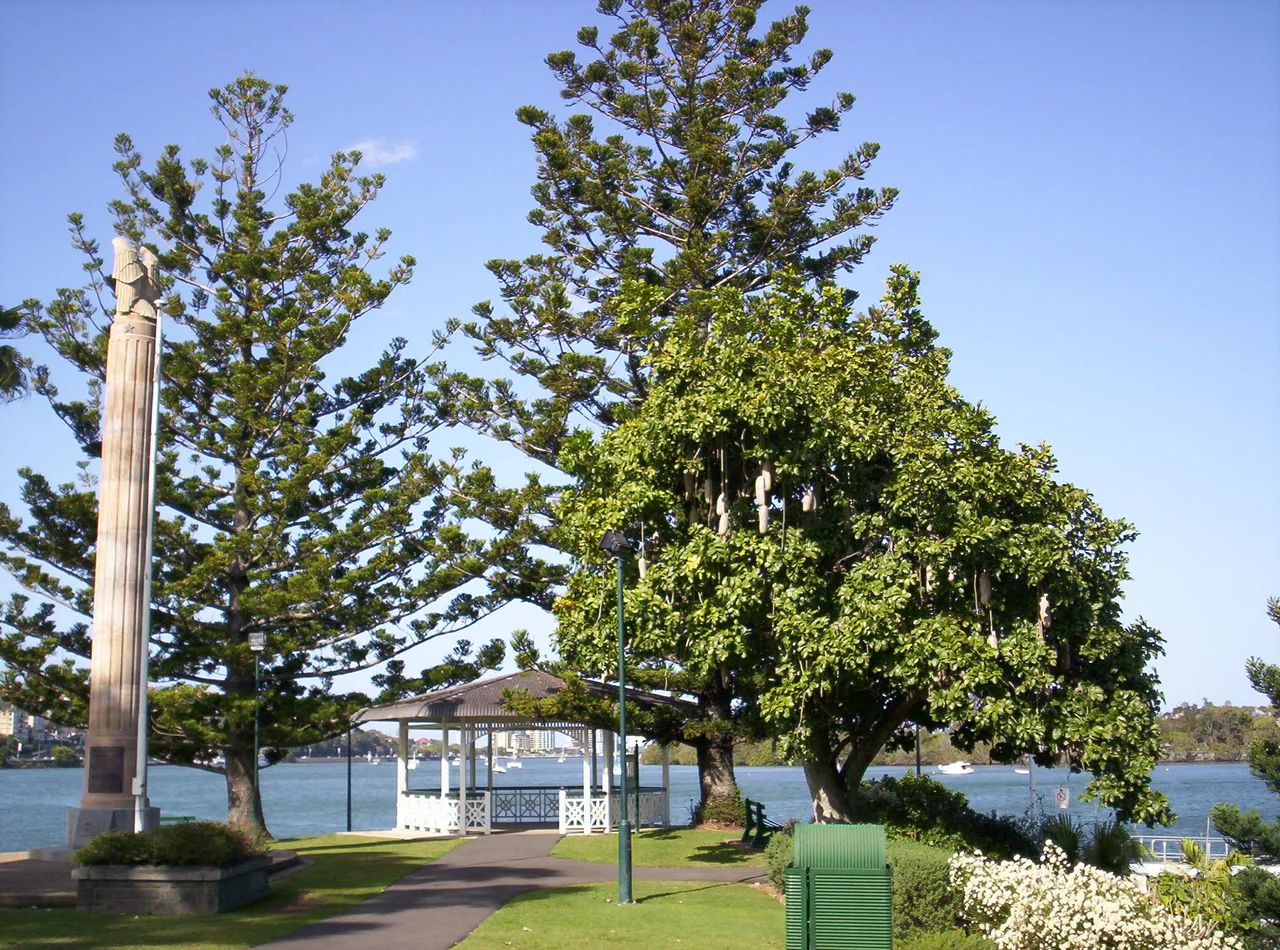
During the Second World War, the house took on a new role. With Brisbane transformed into a forward base for the Allied campaign in the Pacific, American servicemen occupied Newstead House, and the old colonial rooms filled with foreign accents and wartime urgency. That chapter is remembered in the grounds by the Australian-American War Memorial, dedicated on 3 May 1952 by the Queensland Governor, Sir John Lavarack, in tribute to the US servicemen and women who helped defend Australia. Today the house is a museum, painted and furnished in the rich late-Victorian style of its heyday, open to visitors and hosting concerts on its lawns. Below the windows, the river still bends past, doing exactly what it did when this was the only house on the hill.
From the Air
Newstead House sits at roughly 27.44 degrees south, 153.05 degrees east, on a low headland above the Brisbane River where Breakfast Creek joins it, in the inner-northern suburb of Newstead. From the air, look for the green expanse of Newstead Park breaking the dense riverside development, with the white-roofed house and its verandahs near the water's edge; the curve of Breakfast Creek and the Brisbane River makes the most reliable visual anchor. Brisbane Airport (YBBN) lies about 7 km to the northeast, so the area sits beneath busy approach and departure paths - expect controlled airspace and traffic. Archerfield (YBAF), Brisbane's general-aviation field, is roughly 13 km to the southwest. Best viewed in clear, calm subtropical conditions; afternoon sea breezes off Moreton Bay are common.
Nearby Stories
- Redcliffe Peninsula 2.7 km away
- Tamborine National Park 12 km away
- Cressbrook Homestead 27 km away
- Main Range National Park 31 km away
- 2010-2011 Queensland Floods 38 km away
- Cape Byron 96 km away
- Cape Byron Light 126 km away
- HMS Porpoise (1799) 588 km away