
North Carolina Museum of History
Fred Olds liked stories more than objects. In the late nineteenth century, the newspaperman traveled to every one of North Carolina's hundred counties, at least once each, collecting whatever pieces of the past people would give him, and writing down what those people said about them. He came home with a studded shoe buckle once owned by founding father James Iredell, the death mask of Confederate General Robert Hoke, and the philosophy that still runs the museum today: the artifact is only the door, the story is the room. On December 5, 1902, Olds merged his private collection with what the state already had on display, opened the doors as the Hall of History, and never really retired.
Thirty-Seven Cases and the Father of the Museum
The Hall of History opened with thirty-seven display cases inside a corner of the State Museum, which has since grown into the modern North Carolina Museum of Natural Sciences. Olds's collection mixed the grand and the strange. There were tools and weapons, photographs and clothes, oddities from every county he had visited. The North Carolina Historical Commission took over the hall in 1914 and moved it across Union Square to the Ruffin Building, but the collection outgrew that space almost immediately. A 1939 move to the Education Building gave it a purpose-built area for artifacts and exhibits. The Hall was renamed the North Carolina Museum of History on July 1, 1965, and moved again in 1968 into the new Archives and History/State Library Building. A metal statue of Olds now greets visitors at the museum's current entrance, flanked by statues of free Black craftsman Thomas Day and a representative Sauratown woman.
A Twenty-Nine-Million-Dollar Home on Edenton Street
On June 16, 1988, the state broke ground for a dedicated museum building at 5 East Edenton Street, in the block between the State Capitol and the Legislative Building. The new museum opened in 1994. It cost over twenty-nine million dollars and gave the collection 55,000 square feet of exhibit space across four floors, plus a research library, conservation labs, classrooms, a 315-seat auditorium, and proper artifact storage. The Civil War-era cannon in front, the 1902 Wright Glider model hanging in the entrance, and the recreated 1920s drugstore inside have become photographs in a generation of school field-trip albums. The museum is a Smithsonian Affiliate, part of the Division of State History Museums under the North Carolina Department of Natural and Cultural Resources, and admission is free.
Tar Heel Junior Historians
In 1953 the North Carolina General Assembly authorized the Tar Heel Junior Historian Association. Seven decades later, it is still one of the largest history-focused youth networks in the country. Free clubs operate in public, private, and home schools across the state, in 4-H groups, scouting programs, and historical societies. Members run from fourth through twelfth grade. Some clubs have a single student and one adviser; others have hundreds. Museum staff support the network with curriculum resources and a semiannual magazine. The model is simple: get kids researching, writing, and presenting actual North Carolina history, and they will remember it. It is the same philosophy Fred Olds used in 1902. The artifact opens the door. The story stays.
The North Carolina Sports Hall of Fame
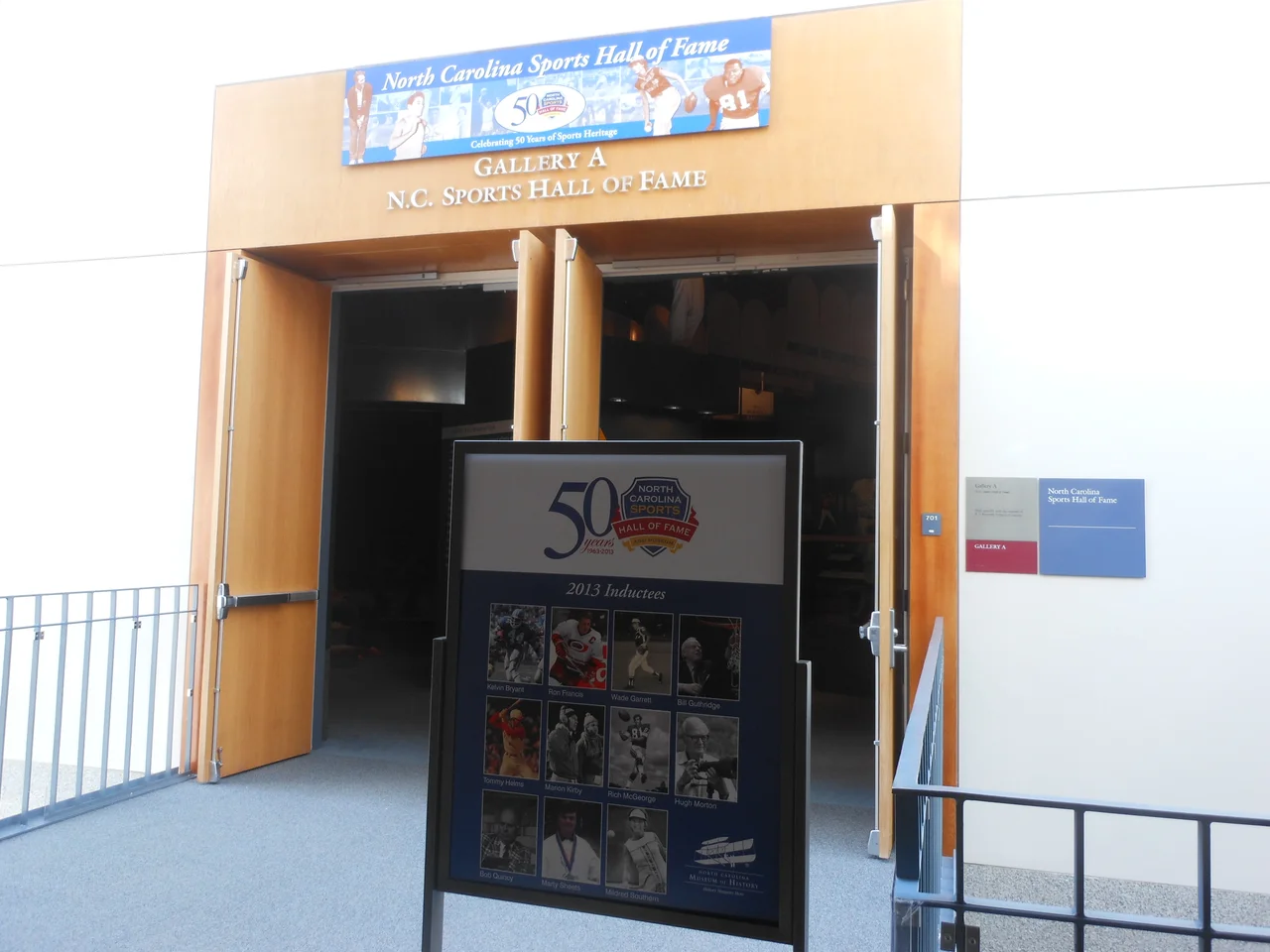
On the third floor, 4,000 square feet are devoted to the North Carolina Sports Hall of Fame, founded in February 1963 by the Charlotte Chamber of Commerce. Inductees donate mementos. The gallery now holds Richard Petty's race car, Dale Earnhardt's fire suit, Arnold Palmer's Ryder Cup golf bag, Meadowlark Lemon's Harlem Globetrotters uniform, Jim Valvano's warm-up suit from NC State, Kay Yow's Olympic basketball, Charlie "Choo Choo" Justice's UNC football jersey, and the Carolina Hurricanes captain Rod Brind'Amour's game-worn jersey from Game 7 of the 2006 Stanley Cup Finals. Michael Jordan, the Wilmington native who became the most famous athlete from North Carolina, was missing for years because he had been "unable" to attend the required induction banquet. In 2010 they finally inducted him at halftime of a Charlotte Bobcats game, the NBA team he then owned. Some stories really do tell themselves.
From the Air
The North Carolina Museum of History stands at 35.782°N, 78.638°W in downtown Raleigh on East Edenton Street, between the State Capitol and the Legislative Building. Raleigh-Durham International (KRDU) lies ten miles northwest. From 2,000 feet AGL the museum is one corner of the cluster of state government buildings around Union Square, with the State Capitol's white dome immediately to the west and the modern Legislative Building to the north.
Nearby Stories
- Sanford, North Carolina 7.6 km away
- Wilson, North Carolina 12 km away
- Cherry Hospital 13 km away
- Campbell University 19 km away
- North Carolina Tornado Outbreak of April 2014 21 km away
- Neuse River 23 km away
- Coal Glen Mine Disaster 26 km away
- Alamance County, North Carolina 27 km away