
North Carolina Museum of Natural Sciences
Two dinosaurs lie tangled together in a Montana hillside, possibly mid-fight when something killed them both 67 million years ago. They were dug up in 2006, then haggled over for fourteen years as buyers, sellers, and mineral-rights lawyers fought their own slow combat. In 2024, the Dueling Dinosaurs finally went on public display in Raleigh, inside a purpose-built wing of the largest natural history museum in the Southeastern United States. They are, in every sense, the centerpiece. But this museum on Jones Street has been collecting wonders since 1879, long before anyone knew what a Nanotyrannus was.
From Two Cabinets to Four Floors
The North Carolina State Museum began in 1879 as a merger of two state-owned collections — one of rocks, one of agricultural curiosities. For sixty years afterward, a single man, Herbert Brimley, shepherded its growth from cabinet of curiosities to credible scientific institution. The museum outgrew the Briggs Building on Fayetteville Street, added an annex in 1899, and moved into a purpose-built home in 1924. Then it kept growing. Universities donated their collections in the 1950s and again in the 1990s. Today the museum occupies two buildings connected by a breezeway: the original Nature Exploration Center and, across the street, the four-story Nature Research Center that opened in 2012 to crowds of 70,000 in its first 24 hours.
Bones and Whales and Emeralds
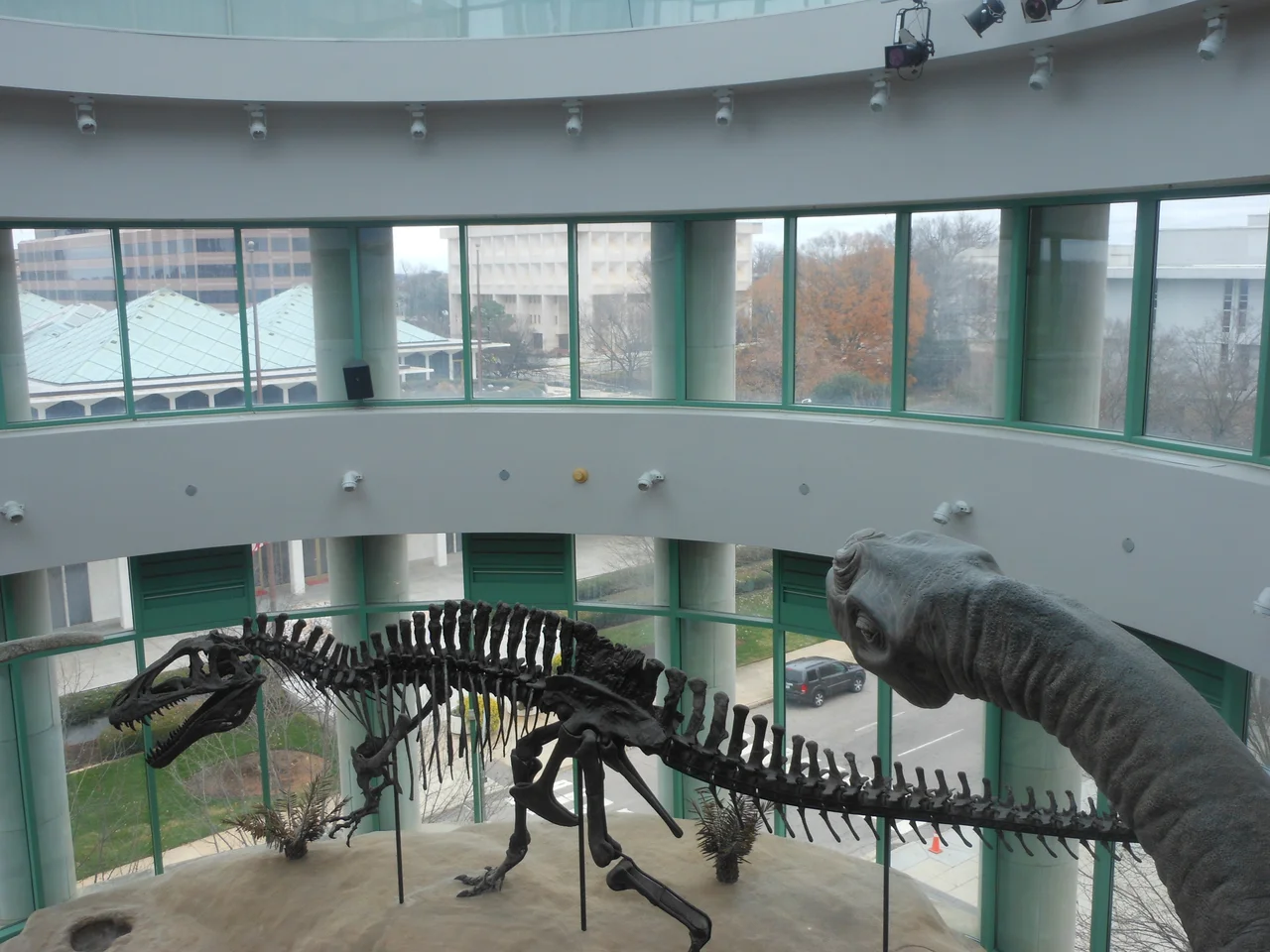
The North Atlantic right whale called Mayflower was collected in 1874 and has been on display somewhere in Raleigh ever since — over a century of children craning their necks at her ribs. Down the hall hangs Acro, formally known as NCSM 14345, the largest and most complete Acrocanthosaurus skeleton known. Underground North Carolina shows off the 64.8-carat Carolina Emperor, the largest cut emerald in North America. Natural Treasures keeps a Carolina parakeet specimen, a small green ghost of an extinct species the state once flocked with. Nothing here is in a hurry. The museum collects on a geological timescale and shows its work.
Scientists Behind Glass
What sets the Nature Research Center apart is that the laboratories are visible. Walk to the second floor and a window opens onto veterinary staff performing real procedures on reptiles, birds, and small mammals, with two-way audio so visitors can ask questions. Upstairs, astronomers analyze the chemistry of gas clouds around forming stars. Genomicists track DNA relationships among primates. Paleontologists study the morphology of theropods — the lineage that links Tyrannosaurus rex to every robin and sparrow alive today. The work is real, and the public watches it happen.
The Whales That Changed the Law
Inside the SECU Daily Planet Theater — a globe three stories tall — visitors meet Stumpy, a North Atlantic right whale killed by a cargo ship in 2004. His death helped force a federal rule requiring slower ship speeds along whale migration routes. The skeleton is touchable. So is the lesson: this is what happens when a 70-ton animal hits a steel hull at full speed. The museum pairs hard truths with hands-on access, and the combination is the point.
Beyond Downtown
Six miles from Jones Street, the 45-acre Prairie Ridge Ecostation offers Piedmont prairie, forest, and ponds threaded with sustainable-building demonstrations. A satellite branch in Whiteville, formerly the Museum of Forestry, celebrates North Carolina's forests through an outdoor Tree Trail and a Fossil Dig Pit. BugFest and Astronomy Days bring scientists, telescopes, and tens of thousands of visitors together each year. Even with the Dueling Dinosaurs as its newest crown jewel, the museum keeps insisting that natural history is something you participate in, not something you watch from a distance.
From the Air
Centered at 35.78N, 78.64W in downtown Raleigh. The museum sits on Jones Street next to the State Legislative Building. Nearest airport is Raleigh-Durham International (KRDU), 12 miles northwest. The downtown Raleigh skyline is the visual reference; the museum complex sits at its northern edge near the State Capitol.
Nearby Stories
- Sanford, North Carolina 7.6 km away
- Wilson, North Carolina 12 km away
- Cherry Hospital 13 km away
- Campbell University 19 km away
- North Carolina Tornado Outbreak of April 2014 21 km away
- Neuse River 23 km away
- Coal Glen Mine Disaster 26 km away
- Alamance County, North Carolina 27 km away