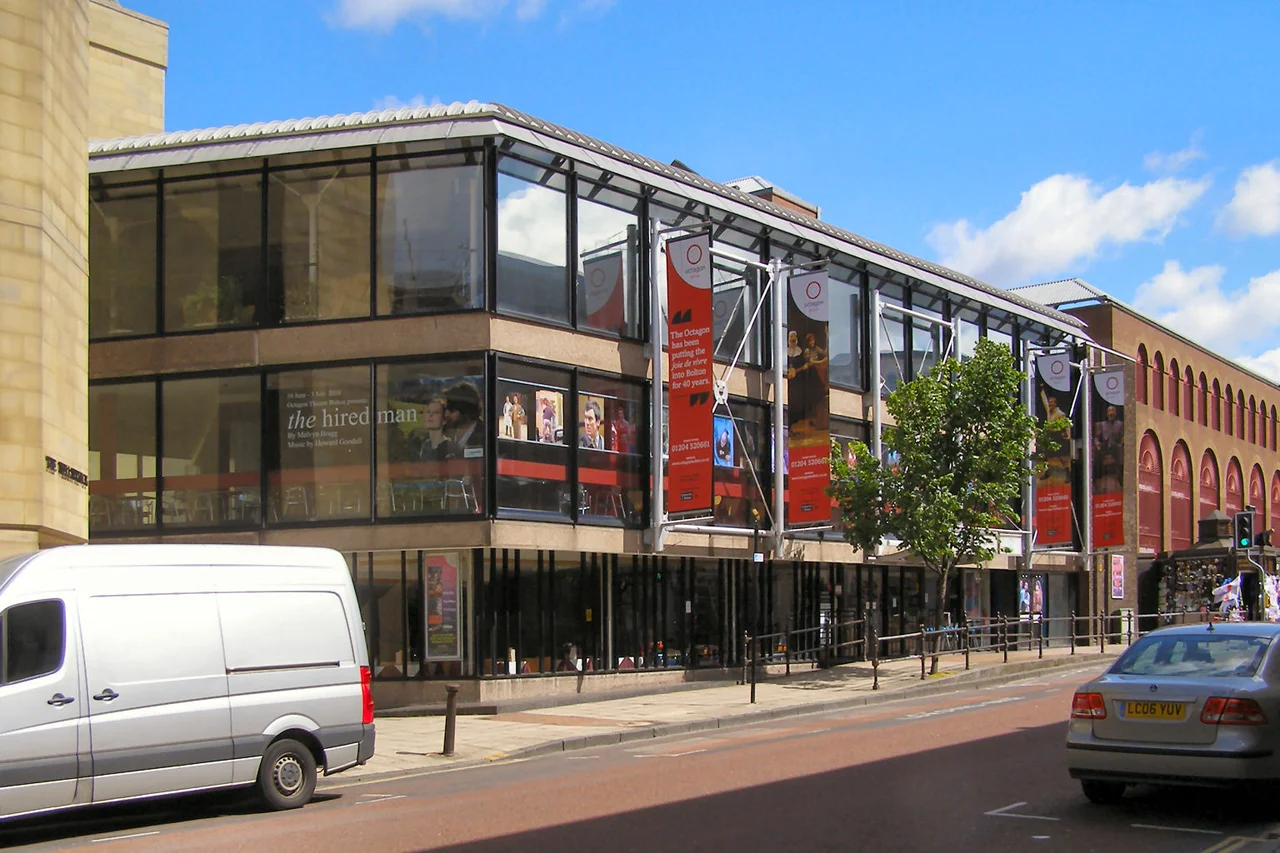

Octagon Theatre, Bolton
The building is hexagonal, but it is called the Octagon. Reading already had a Hexagon Theatre when Bolton was looking for a name in 1967, so the new venue picked the nearest unclaimed regular polygon and got on with it. That sort of stubborn practicality runs through the whole story of this theatre. When Princess Margaret arrived on 27 November 1967 to open the place, the council had been told the royal party would need no comfort facility — so naturally they installed a lavish lavatory with gold-plated fittings just in case. It was never used officially, was tested by the plumbers, and was then ripped out and converted into office space. Bolton built a £95,000 theatre on public donations and immediately treated it like a working tool.
First Professional House After the War
The Octagon was the first professional theatre to be built in North West England after the Second World War — a fact that sounds modest until you remember what the war had done to civic culture across Britain's industrial heartlands. Bolton in the 1960s was still a cotton town in long decline, and the proposal to build a producing theatre rather than a cinema or a bingo hall took a particular kind of municipal nerve. Geoffrey H. Brooks, Bolton's Director of Architecture, designed the main auditorium as a flexible space that could shift between in-the-round, thrust and end-stage configurations — a piece of theatre engineering that was still unusual at the time, and which gave the company technical freedom most regional theatres did not have. The opening production was Annie and Fanny by Bolton-born playwright Bill Naughton, whose Alfie had become a film the year before.
Almost Lost, Then Saved
By the late 1990s the Octagon was in real trouble. A 1998 refurbishment funded by the Arts Council had improved the seats and the bar, but in 1999 a financial crisis threatened to force the theatre to abandon producing its own work and become a receiving house for touring shows — a fate that would have made it just another venue rather than a creative engine. Bolton's response is the Bolton bit of the story. Local people founded the Support Campaign for the Octagon Theatre under the slogan 'Keep theatre made in Bolton', collected 12,000 signatures, marched through the town centre, and put on two benefit concerts. Funders blinked first. The Octagon's status as a producing theatre was preserved. A decade and a half later, in 2018, the theatre closed for a major redevelopment and reopened in May 2021, refreshed and at last fully accessible, with new lighting, acoustics and front-of-house spaces.
The People Who Worked Here
What gives a regional producing theatre its strength is the rotating cast of writers and performers who come through it before they become famous, and the Octagon's roll-call is genuinely long. Peter Kay worked in the ticket office before he was Peter Kay. Freddie Mercury played one of his earliest live gigs here in 1969, two years before he renamed himself and joined Queen. Dominic Monaghan acted here before he went off to be Merry in Middle-earth. Sir Ian McKellen recited lines from a Victorian melodrama on the stage for a 2017 episode of Who Do You Think You Are? Bolton-born playwright Jim Cartwright was writer-in-residence in the late 1980s and premiered Two and Bed here; David Thacker, an artistic director with a long Arthur Miller connection, revived Two in 2016 and staged its sequel Two 2 the same year. Susannah York played Blanche DuBois in A Streetcar Named Desire in 1989. Sue Johnston fundraises for the place and acts in it.
What It Stages
The Octagon now produces eight or nine in-house shows a year, with an unusual leaning toward American drama — Miller, Williams, August Wilson — alongside classic adaptations and new writing. The main auditorium seats between 300 and 400 depending on configuration, which means an Arthur Miller play on a thrust stage one month can become a Christmas family show in the round the next. The smaller Bill Naughton Studio Theatre, named for the local playwright who opened the venue, seats a hundred and gives new work and youth productions a room of their own. When you watch a show here you watch it close: in-the-round configuration in particular puts the front row about two metres from the actors. It is a theatre built to feel like a town meeting hall that happens to be producing professional drama, and that is exactly what its supporters fought to keep it being.
From the Air
Located in central Bolton at 53.577°N, 2.431°W, on Howell Croft South, a short walk from Bolton Town Hall and Victoria Square. Manchester Airport (EGCC) is about 30 km south-east; Manchester Barton (EGCB) is roughly 18 km south-east; Blackpool (EGNH) lies about 55 km to the north-west. From a low cruise the theatre sits in the dense Victorian town-centre block north-east of the railway station, identifiable by its low hexagonal footprint among the surrounding rectangular civic buildings.
Nearby Stories
- National Science and Media Museum 0.2 km away
- Jodrell Bank Observatory 3.2 km away
- Siege of Lathom House 5.6 km away
- Chester Zoo 6.2 km away
- Whalley Abbey 8.9 km away
- Haddon Hall 10 km away
- Wentworth Castle 16 km away
- Blackpool 16 km away