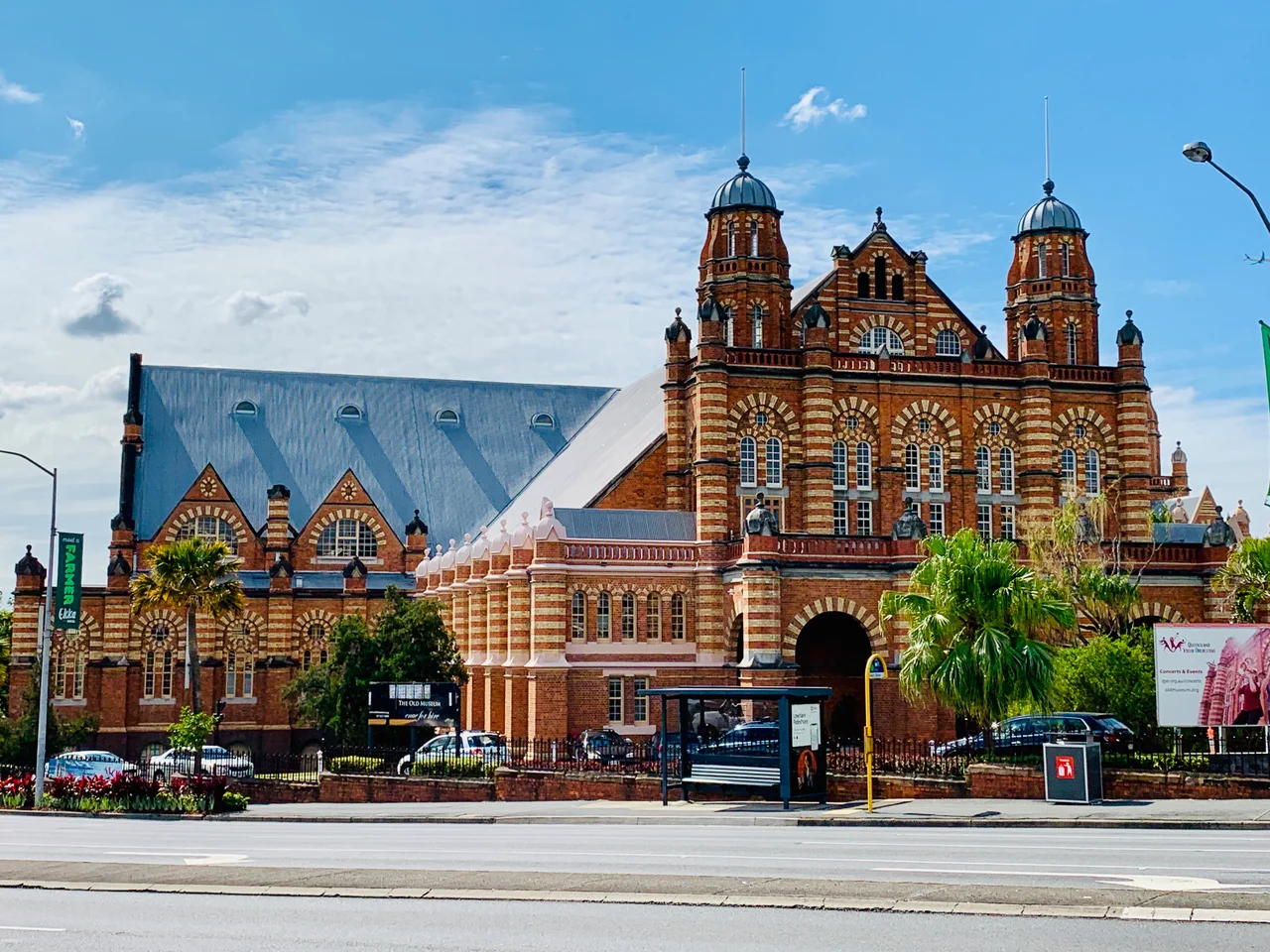

Old Museum Building, Brisbane
Fire made this building possible. On a winter night in June 1888, Brisbane's first exhibition hall - by then doing duty as a roller-skating rink - burned to the ground at Bowen Hills. From its ashes the city resolved to build something far grander, and three years later it had: a vast confection of red brick crowned with towers and horseshoe arches, the kind of building that looks like it was imported from Lahore rather than raised on a Queensland hillside. Its architect, George Henry Male Addison, reached for a style sometimes called Indo-Saracenic, all domes and terracotta detail, and his masons laid an astonishing 1.3 million bricks to realise it. Locals know it simply as the Old Museum, though it has been many things - exhibition palace, concert hall, art gallery, and for the better part of a century, the home of the Queensland Museum.
Three Hundred Hands, Twelve Months
The new Exhibition Building and Concert Hall rose with remarkable speed. The foundation stone went down on 25 April 1891, laid by the acting Governor Sir Arthur Hunter Palmer, who sealed beneath it a bottle containing copies of each of Brisbane's leading newspapers - a time capsule still waiting under the stone. More than three hundred workers laboured over the building, and by August 1891, just twelve months later, it was complete. It had been built for the Queensland National Agricultural and Industrial Association, the body behind the colony's great annual show. The site already carried history: the Queensland Acclimatisation Society had worked the grounds through the 1860s and 70s, trialling which foreign plants and animals might thrive in the subtropics.
When Melba Sang
For decades the great hall was where Brisbane came to hear music. From the 1890s into the 1930s, the Exhibition Concert Hall was the city's principal venue, and the voices that filled it belonged to some of the most celebrated performers of the age. Dame Nellie Melba - the Australian soprano whose name still attaches to a peach dessert and a slice of toast - sang here. So did Ignacy Jan Paderewski, the Polish pianist who would later become prime minister of his country. To sit in that brick auditorium and hear a Melba aria rise into the arches was, for a young colonial city, a brush with the wider cultural world. Generations later, the building still hums with music as home to the Queensland Youth Orchestras.
The Museum Moves In
The grand show association did not last. The economic depression of the 1890s forced it into liquidation, and in 1897 the Queensland Government took over the building and grounds. Two years later, in 1899, the Queensland Museum moved in - and stayed. For eighty-six years the collections filled these halls, from natural-history specimens to relics of the colony's past, while other parts of the building carried on as concert hall and art gallery. The museum's tenancy ran so long, and so defined the place, that when it finally departed for the new Queensland Cultural Centre across the river in 1986, the name had already stuck. The Exhibition Building had become, permanently, the Old Museum.
A Survivor in Brick
Few buildings of its kind remain. The Old Museum is one of only two nineteenth-century exhibition buildings still standing in Australia - the other being Melbourne's Royal Exhibition Building - which makes Addison's brick palace genuinely rare. Its later life has been varied and slightly improbable: in the 1980s it served as a filming location for an Australian-made revival of the television series Mission: Impossible, and since 2016 its halls have hosted the flower and garden displays of the Ekka, Brisbane's beloved annual exhibition. Listed on the Queensland Heritage Register in 1992 and named one of the state's Q150 Icons in 2009 for its engineering, the building endures - a reminder of the night a skating rink burned and a city decided to build something extraordinary in its place.
From the Air
The Old Museum Building stands at roughly 27.45 degrees south, 153.03 degrees east, at Bowen Hills on the northern edge of inner Brisbane, on the corner of Gregory Terrace and Bowen Bridge Road beside the Brisbane Showgrounds (the Exhibition Grounds). From the air, look for the dark red-brick mass with its corner towers and arched portico, set against the open expanse of the showgrounds - the large cleared show arena is the easiest landmark, with the inner-city towers a couple of kilometres to the south. The site lies within Brisbane's controlled airspace; Brisbane Airport (YBBN) is about 11 km to the north-northeast and Archerfield (YBAF) roughly 11 km to the southwest. Best viewed in clear daylight; the brick and terracotta glow warm under low afternoon sun.
Nearby Stories
- Redcliffe Peninsula 2.7 km away
- Tamborine National Park 12 km away
- Cressbrook Homestead 27 km away
- Main Range National Park 31 km away
- 2010-2011 Queensland Floods 38 km away
- Cape Byron 96 km away
- Cape Byron Light 126 km away
- HMS Porpoise (1799) 588 km away