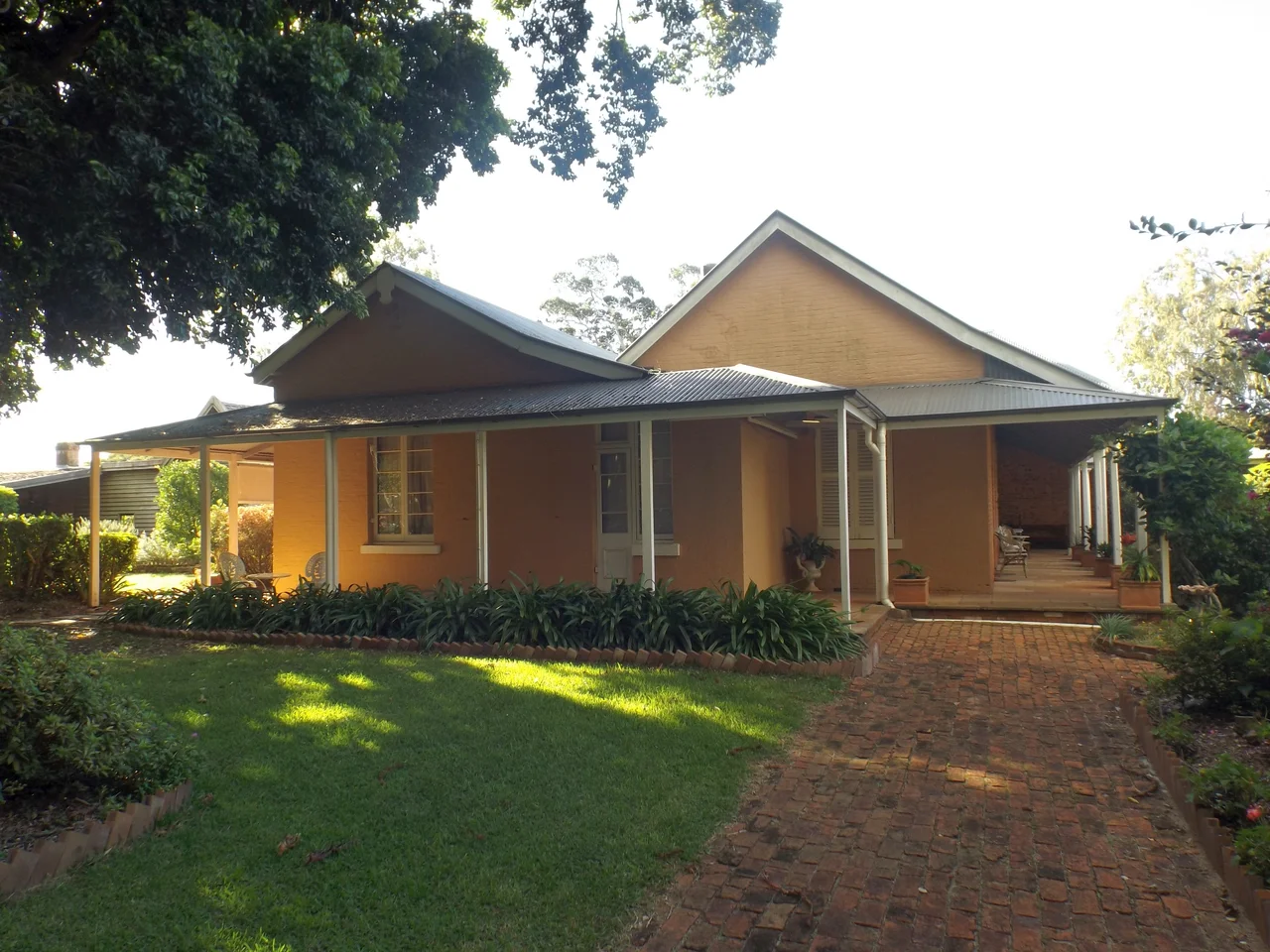

Ormiston House Estate
In September 1864, beside a tidal creek on the shore of Raby Bay, the first commercial sugar in Queensland's history poured from a crushing mill. The man who owned it was Louis Hope - a Scottish aristocrat, a member of the colony's Legislative Council, and the figure history would crown as the founder of the Queensland sugar industry. He is remembered in a stone cairn raised in his honour and in the gracious brick house that still overlooks the bay, its wide verandahs ringed with Tuscan columns turned, the story goes, from cypress pine he shipped to England and back. But the cairn and the columns tell only part of the story. The sugar that made Ormiston famous was cut, from 1867, by South Sea Islander labourers - Pacific people whose work built the industry and whose presence the monuments long left unspoken.
The House Hope Built
Ormiston House grew in stages between about 1858 and 1865, named for a Hope family place back in Scotland. Hope had reached New South Wales in 1843 and thrown himself into the economic life of the young Moreton Bay region, accumulating land across what would become Queensland - a share in Kilcoy Station, Shafston House at Kangaroo Point, and these acres above Raby Bay. He began with cotton, then turned to sugar cane, and as the plantation prospered he raised a substantial brick residence in 1864-65. It was, for its time and place, astonishingly modern: gas lighting (very likely a by-product of the sugar-making next door), hot water, and indoor cisterns, in a corner of the colony where most settlers still drew water from a well. Bricks were fired on the property; timber was felled and milled on site.
Where Queensland Sugar Began
The mill was the heart of it. In 1864 Hope erected Queensland's first sugar-crushing mill on the bank of Hilliards Creek, the machinery shipped out from Cook and Company of Glasgow, and that September it produced the colony's first commercially milled sugar. Within a year the Ormiston plantation was the largest in Queensland. By the late 1860s the mill and an attached distillery were running hard, Hope buying cane from smaller neighbouring growers and crushing it on shares as a central mill. What happened on this shore rippled outward: sugar would become one of Queensland's defining industries, transforming whole stretches of the tropical coast. It all traces back to a creek mouth at Ormiston and a single season's crop in 1864.
The Islanders in the Canefields
From September 1867, the cane at Ormiston was harvested by South Sea Islander workers - men brought from the islands of Melanesia, in the western Pacific, who lived in separate quarters on the estate. They were part of a vast and brutal traffic: across roughly four decades, some 62,000 Islanders were carried to Queensland and New South Wales to labour on the sugar plantations. Many were recruited through deception or outright kidnapping, a practice known by the ugly, accurate name of blackbirding. The wider context is not incidental to Hope: he came from a family whose fortune had roots in West Indian slavery. These Islander labourers were not a footnote to the Queensland sugar story - they were its foundation, real people far from home whose work the industry depended on and whose descendants, the Australian South Sea Islander community, carry that history still.
What Remains on Raby Bay
Hope's sugar empire did not last. A bitter lawsuit with a neighbour ended with the mill machinery sold off, and Hope leased out much of the land before sailing for England with his family in 1882. He died in 1894, and the house passed from the family in 1912 to the grazier John Arthur Macartney. In 1959 the Carmelite Nuns acquired the property and built a monastery in its grounds; with their blessing, Ormiston House today is a house museum, lovingly maintained by a restoration association formed in the 1960s. Visitors walk its high-ceilinged rooms, admire the cedar joinery and pressed-metal ceilings, and stand on verandahs that look across Raby Bay much as they did in Hope's day. An avenue of bunya pines still marks the grounds. The 1935 cairn still honours the sugar pioneer - and a fuller telling now insists on honouring, too, the Islander hands that made his sugar.
From the Air
Ormiston House Estate lies at about 27.50 degrees south, 153.26 degrees east, on the western shore of Raby Bay at Ormiston, in Redland City southeast of Brisbane, with its grounds running down to the mangrove-fringed foreshore of Moreton Bay. From the air, look for the green estate and the dark roof of the historic house and adjacent monastery set against the canal estate and marina of modern Raby Bay, with the broad waters of Moreton Bay and North Stradbroke Island beyond to the east - the bay shoreline and canal network are the clearest landmarks. Redcliffe and the bay islands frame the wider view. The nearest major field is Brisbane Airport (YBBN), about 25 km to the north-northwest; Archerfield (YBAF) lies roughly 23 km to the west-northwest. Best viewed on clear mornings when low sun lights the bay; watch for sea breezes off Moreton Bay.
Nearby Stories
- Redcliffe Peninsula 2.7 km away
- Tamborine National Park 12 km away
- Cressbrook Homestead 27 km away
- Main Range National Park 31 km away
- 2010-2011 Queensland Floods 38 km away
- Cape Byron 96 km away
- Cape Byron Light 126 km away
- HMS Porpoise (1799) 588 km away