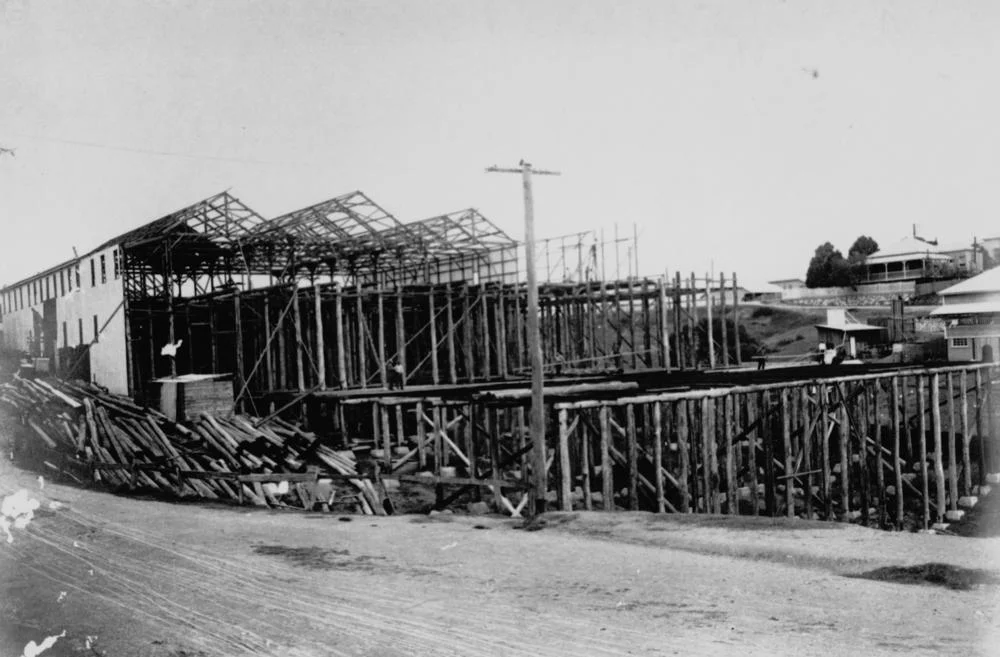

Paddington tram depot fire
It started, residents thought, as sparks - flickers drifting up from beneath the great timber shed on Latrobe Terrace, where Paddington slopes down its hill. Around half past seven on the evening of 28 September 1962, neighbours raised the alarm, and depot staff rushed to save what they could: first the cash, locked away in the depotmaster's car, then the trams themselves. They managed to drive three out before the fire severed the power and the rest were trapped. What followed was one of the largest fires in Brisbane's history. By morning the depot was a smoking skeleton and dozens of trams were gone - and though no one quite realised it yet, so was the future of the trams that still rattled through the rest of the city.
A Shed Built to Burn
The depot had stood since 1915, raised by the Brisbane Tramways Company to service the routes threading the western suburbs. It was built almost entirely of timber and corrugated iron, and it clung to the side of a hill. At the front it met Latrobe Terrace at street level, but the slope fell away so steeply behind that the rear of the building stood on a forest of timber posts, some more than fifty feet tall. Beneath the floor, in the cavern those posts created, the tramways stored tyres, oil and grease. It was, in hindsight, a fire waiting for a spark - a vast wooden structure perched over its own kindling. When the blaze took hold in that underfloor storage, the cause never definitively established, it found everything it needed.
The Night the Sky Glowed
The fight was lost almost before it began. Water pressure on the hill was feeble, and the flames climbed fast through the timber. As the fire ate into the structure, burning trams broke loose and crashed through the weakening floor to the ground below, one after another. When it became clear the depot could not be saved, the firefighters changed their goal entirely - no longer to rescue the building, but simply to keep the fire from leaping to the homes crowded around it. Fed by rubber and oil, the blaze threw a glow that could be seen from suburbs right across Brisbane. By the end, the depot was destroyed and sixty-seven trams were lost - close to a fifth of the city's entire fleet. The council later admitted that neither the trams nor the depot had been insured.
The Excuse the City Needed
The loss strained the council's transport department badly, but it also handed one side of a long-running argument exactly what it wanted. Trams versus buses had been debated in Brisbane for years. Now, with the fleet suddenly short, the council brought in buses to fill the gap - even hiring some from the New South Wales government, a move critics called a stunt, since the Courier-Mail reported the council had buses of its own in storage. The Lord Mayor, Clem Jones, argued that the very ease of plugging the hole with buses proved their greater flexibility. In December 1962, four tram routes were converted to diesel buses, the first major closures the system had seen. The logic hardened into policy: in 1967 the council resolved to abandon the trams entirely, and on 13 April 1969 Brisbane's last tram ran.
Risen from the Ashes
From the wreckage came one defiant gesture. Salvaging trucks, wheels and other components from the burnt-out trams, the workshops used them to build eight new ones. These were painted a distinctive pale blue and marked, beneath the driver's window, with a small image of a phoenix - the mythical bird reborn from fire - and Brisbane fondly called them the phoenix cars. They were a brave emblem for a system already dying. Where the depot once stood, a shopping centre rose; redeveloped in the late 1980s, its rooflines were shaped to echo the pitched gables of the lost tram shed, so that even the building that replaced it carries the memory of what burned. The phoenix, in the end, marked not a rebirth but a long farewell.
From the Air
The site of the Paddington tram depot fire is at roughly 27.46 degrees south, 153.00 degrees east, on Latrobe Terrace in the inner-western Brisbane suburb of Paddington - now occupied by the Paddington Central shopping precinct on its sloping hillside block. From the air, look for the dense pattern of timber 'Queenslander' houses on the steep ridges west of the city centre, with the Latrobe Terrace shopping strip running along the hill; the Brisbane CBD towers stand a couple of kilometres to the east as the main reference. The location sits beneath Brisbane's controlled airspace - Brisbane Airport (YBBN) is about 12 km to the northeast, and Archerfield (YBAF) roughly 9 km to the south-southwest. Best viewed in clear daylight; the hilly terrain and tree cover make the precise block easiest to find by following Latrobe Terrace along the ridgeline.
Nearby Stories
- Redcliffe Peninsula 2.7 km away
- Tamborine National Park 12 km away
- Cressbrook Homestead 27 km away
- Main Range National Park 31 km away
- 2010-2011 Queensland Floods 38 km away
- Cape Byron 96 km away
- Cape Byron Light 126 km away
- HMS Porpoise (1799) 588 km away