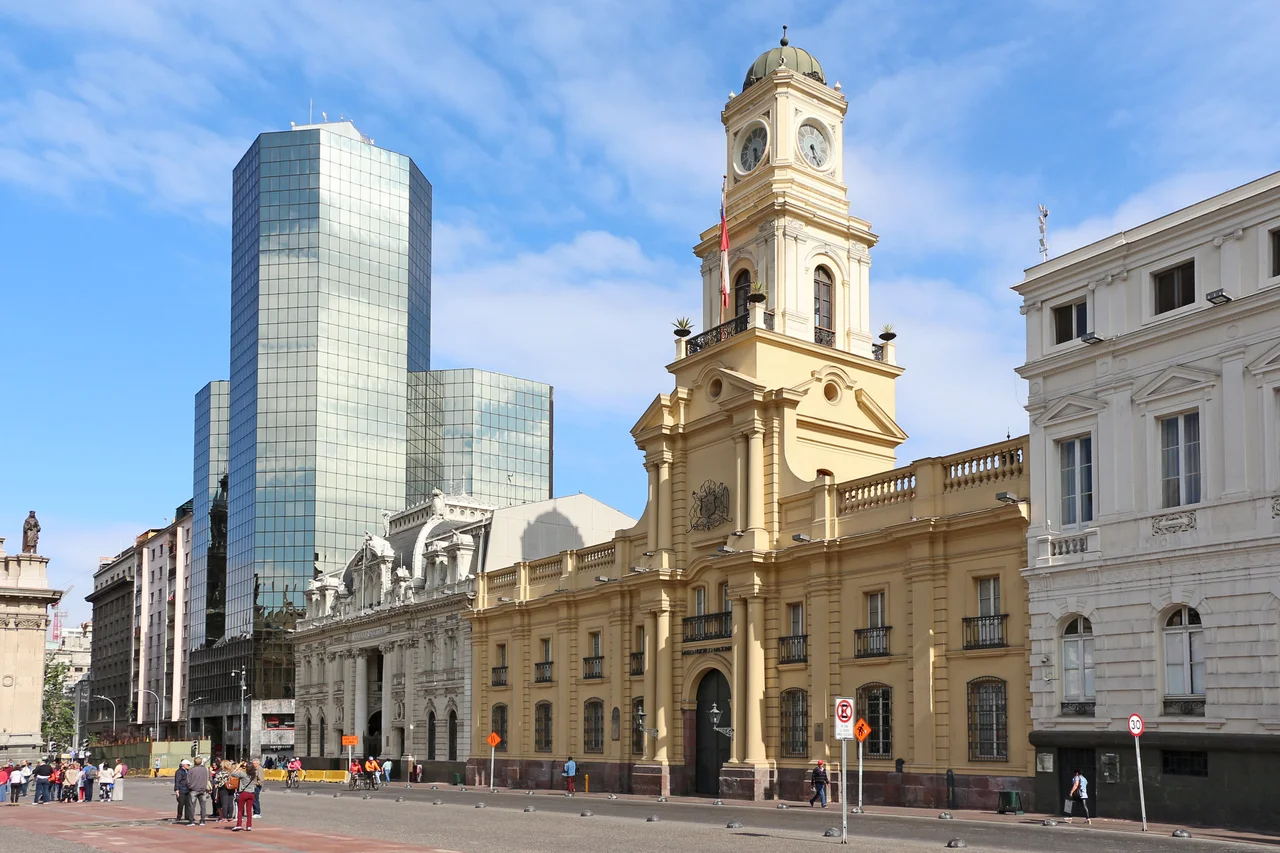

Palacio de la Real Audiencia de Santiago
Spain finished this building to house its judges, and Chileans promptly used it to dismantle Spanish rule. The Palacio de la Real Audiencia rose on the Plaza de Armas between 1804 and 1807 as the home of the royal courts of justice, the highest instrument of the king's law in the colony. It served that purpose for barely two years. In 1810, Chile's first governing junta gathered here to replace the Spanish governor, and the seat of imperial authority became the cradle of a republic. Few buildings have switched sides quite so completely.
A Toesca Pupil's Work
The palace was designed by Juan Goycolea, a pupil of the Italian-born architect Joaquín Toesca. That lineage matters in Santiago, because Toesca had shaped the look of the colonial capital, designing the nearby La Moneda Palace and the main façade of the Cathedral in the closing decades of the eighteenth century. Goycolea inherited his master's restrained, dignified vocabulary and applied it to a building meant to project the permanence of Spanish justice. The irony writes itself. The Crown commissioned a monument to its own authority, hired the best-trained hands in the city to build it, and then watched it become the stage on which that authority was renounced.
Where a Nation Argued Itself Into Being
On July 4, 1811, the First National Congress of Chile convened inside these rooms, an assembly feeling its way toward self-government one debate at a time. The building became the political heart of the Patria Vieja, the country's first taste of independence, serving as a government house through the turbulent years between 1812 and 1814. That experiment collapsed when royalist forces reconquered Chile, only for independence to be won back at last. The Chilean Declaration of Independence was solidified in 1818, and this building hosted the meetings of the new congress. After independence was secured, it continued as the seat of government and home to various ministries until 1846, when President Manuel Bulnes moved the presidency to La Moneda. Walls built to deliver royal verdicts had instead witnessed the slow, contentious birth of a Chilean state, complete with the disagreements and reversals that any real founding involves.
A Museum of Ordinary Lives
Since 1982 the palace has held the National History Museum of Chile, an institution founded on May 2, 1911, and now spread through the old court's chambers, which serve as its exhibition spaces. What it collects is quietly moving. Rather than only kings and battles, the museum gathers the textures of everyday Chilean life: women's clothing, sewing machines, furniture, decorative and functional objects that ordinary people once used and set aside. In a building where the powerful once decided the fates of the powerless, the exhibits now honor the small material world of regular citizens. The shift in subject feels like the building's final argument, finished long after the last judge and the last president had gone, a reminder that history is made as much in kitchens and workshops as in council chambers.
Facing the Square
The palace anchors the north side of the Plaza de Armas, Santiago's founding square, sharing the frontage with the old Central Post Office and the city's municipal building. Now recognized as a National Monument of Chile, it has survived where so many of the square's structures burned and were rebuilt. Step out the door and you stand at the symbolic center of the country, near the marker for kilometre zero from which Chile measures its distances. Tourists drift past, pigeons scatter, street musicians play. Most visitors never pause to consider that they are crossing the threshold where Spain's colonial order ended and a republic began its first uncertain conversation, in a building whose stones have outlasted nearly everyone who ever held power inside them.
From the Air
The Palacio de la Real Audiencia stands on the north side of the Plaza de Armas in central Santiago at 33.4370°S, 70.6506°W. From the air, look for the open green-and-paved rectangle of the Plaza de Armas in the dense colonial grid; the palace fronts its northern edge beside the larger Metropolitan Cathedral one block west. The nearest general-aviation field is Eulogio Sánchez (Tobalaba) Airport, ICAO SCTB, about 9 km east; the principal gateway is Comodoro Arturo Merino Benítez International, ICAO SCEL, roughly 16 km northwest in Pudahuel. The downtown core sits low in the Andean basin, so haze can soften detail by afternoon; clear mornings give the sharpest view.
Nearby Stories
- Paine Memorial 21 km away
- 1947 BSAA Avro Lancastrian Star Dust accident 23 km away
- Battle of Chacabuco 31 km away
- La Campana National Park 36 km away
- Puente del Inca 44 km away
- Casa de Isla Negra 62 km away
- Santa Cruz, Chile 103 km away
- Pierre Auger Observatory 172 km away