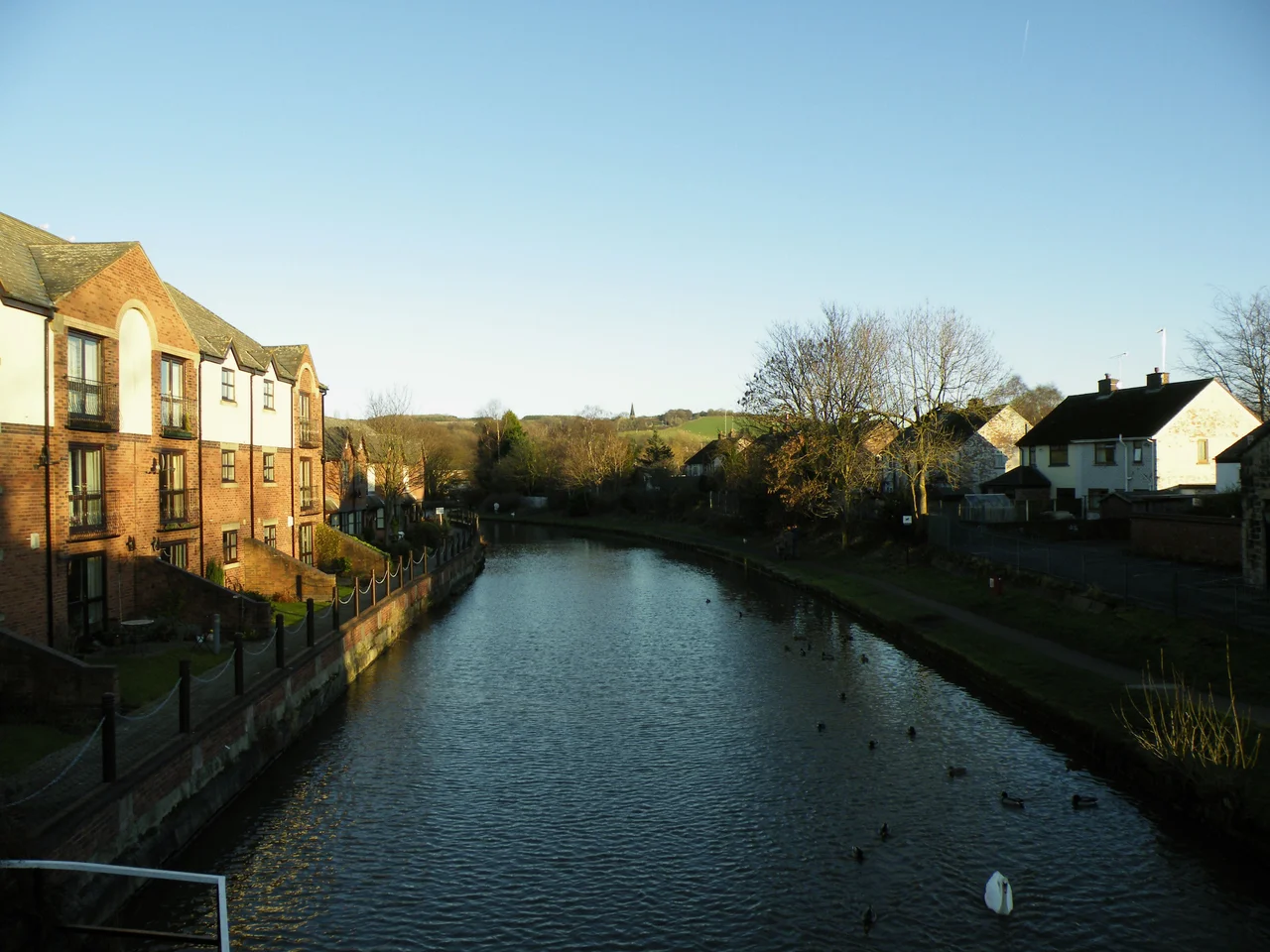

Parbold
The monument on the hillside above Parbold is shaped like a port bottle. It was not designed that way; in 1832, when the locals built it to celebrate the passage of the Great Reform Act, they called it the Reform Pillar and put it proudly on a plinth at the summit of Parbold Hill where it could be seen for miles. It then fell down, the proportions shifted in the 1958 rebuild, and the villagers gave up on Parliament and started calling it the Parbold Bottle. That habit of taking something solemn and renaming it after dinner tells you most of what you need to know about the village in the valley below.
In the Valley of the Douglas
Parbold sits at the foot of Parbold Hill, in the valley of the River Douglas, on the western edge of Lancashire's coal-and-cotton country. The hill rises to four hundred feet behind the village, and from its summit, on a clear day, you can pick out Liverpool to the southwest, Manchester to the southeast, the West Lancashire plain spreading north, and the hills of Wales beyond the Mersey estuary. The first recorded mention of Parbold comes from the late twelfth century, when grants of land here went to the monks of Burscough Priory, pronounced Bursk-owe. After the Norman Conquest the manor sat inside the Barony of Manchester. For something like six centuries nothing much happened. The village did not become a civil parish until 1894, the same year that the Wigan Rural District was created and Parbold was tacked onto it.
The Canal and the Windmill
Two pieces of engineering changed the village. The first was the Leeds and Liverpool Canal, which passes over the River Douglas on a stone aqueduct close to the village centre. The canal hauled coal out of the Wigan field and gave the village an industrial pulse it had never had before. The second was Parbold railway station, opened in the mid nineteenth century by the Lancashire and Yorkshire Railway, which gave middle-class commuters a quick line into Manchester and Liverpool and turned a sleepy farming settlement into a commuter village. The stone windmill that still stands next to the canal was built in 1794, but it stopped milling around 1850 and now mostly sits and looks scenic. It replaced an older watermill on Alder Lane that, surprisingly, was in use until 1985. Almost nothing in Parbold is on a clean timeline.
The Parbold Bottle
The Reform Pillar, raised in 1832 to commemorate the Reform Act that began the long process of widening the British franchise, was originally placed on a large plinth at the top of Parbold Hill. It was visible from miles around. It also got hit, eventually, by weather and neglect, and by 1958 it had fallen apart. The villagers paid for a rebuild by public subscription, but this time they put it lower on the hillside where it would be easier to maintain. The new shape, squatter than the original, reminded everyone of a Georgian port bottle. The name stuck. The monument is still there, accessible through a gate off the Parbold Hill road, looking like nothing so much as an enormous stone wine bottle abandoned by a giant on the slope of a Lancashire hill.
The Village That Made Itself
Parbold today is a village of about 2,600 people, fed by the train and by junction 27 of the M6 a couple of miles to the east. It has two churches and two primary schools and a library built in 1989, a village hall that doubles as the cinema, a doctor's surgery, three hairdressers and Chinese and Indian takeaways and a brew pub and a steakhouse. Composer Hugh Wood, born here in 1932 and active in British modern music until his death in 2021, gave the village a presence in the country's serious music scene. The singer-songwriter Pixey, born Elizabeth Sinead Hillesdon, came up here as well. The annual Parbold Village Show, held the second weekend of July, descends from old agricultural and horticultural exhibitions and still features competitive vegetables alongside crafts, photography and baking, all of it run by volunteers.
What Passes Through
In July 2027, the Tour de France will pass through Parbold as part of the race's 114th edition, the Grand Départ holding in northern England. For a village whose main historical export has been Wigan-bound commuters and Tour-bound river-water, that will be a notable afternoon. Until then the daily traffic is more modest: the fell race that climbs Parbold Hill once a year, the canal boats moving slowly past the windmill, and the trains from Manchester Airport that reach Parbold in about an hour and a quarter, taking just enough commuters home each evening that the platform crowds, briefly, before the village settles back into the quiet that the duke's monks would have recognised in 1180.
From the Air
Located at 53.593N, 2.765W in West Lancashire, about 9 nm west of Wigan and 6 nm south of Preston. Liverpool John Lennon Airport (EGGP) lies 16 nm to the southwest and Manchester Airport (EGCC) 22 nm to the southeast. Recommended viewing altitude 2,000-3,000 ft AGL. At that height look for the line of the Leeds and Liverpool Canal crossing the River Douglas on the stone aqueduct, the windmill beside the canal, and Parbold Hill rising 400 feet immediately east of the village. The M6 motorway runs north-south two miles to the east. Lancashire weather brings frequent low ceilings.
Nearby Stories
- Delamere Forest 4.5 km away
- Macclesfield Canal 4.7 km away
- Top Withens 6 km away
- Moel Famau 13 km away
- Hoylake Lifeboat Station 14 km away
- Whalley Abbey 15 km away
- Brindley Water Mill 18 km away
- Piel Castle 30 km away