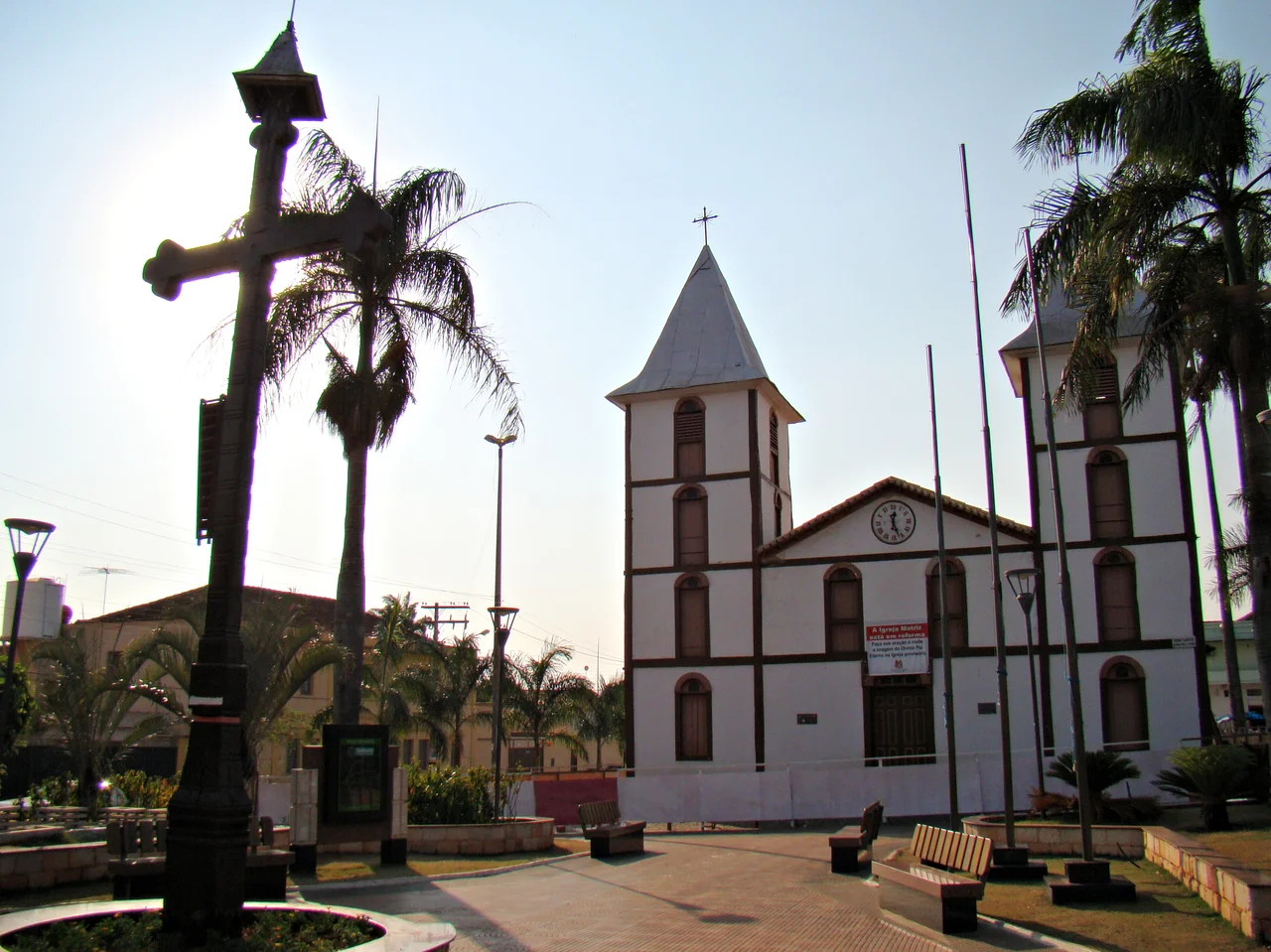

Parish Church of Trindade
Ana Rosa and Constantino Xavier were panning for gold in 1848 when they found the medallion. It had washed down the Barro Preto stream, a small illustration of the Holy Trinity crowning the Virgin Mary, and they pulled it out of the water and knew they had something. The prospecting couple built a small chapel on the spot, covered it with buriti palm leaves, and set the medallion up inside so anyone who wanted to venerate it could. That chapel was the beginning. It took sixty-four more years before the current Parish Church of Trindade was formally built and inaugurated by the Austro-Brazilian priest Antão Jorge on 8 September 1912. What had started as a thatched roof on a streambank became one of the most visited religious sites in Brazil.
The City That Followed The Church
Cities usually come first and then the church follows. In Trindade the sequence reversed. The parish church was built in 1912. The city of Trindade was only formally established eight years later, in 1920, because so many pilgrims had started arriving to worship the Divine Eternal Father that a settlement had to crystallize around them. The gold prospectors had commissioned the sculptor José Joaquim da Veiga Vale - himself a significant figure in Goiás's colonial art history - to produce a larger version of the medallion image, and that larger image drew even more pilgrims. By the time the Redemptorist missionaries took over the site, the buriti chapel could not hold the crowds. Father Antão Jorge and the Archdiocese of Goiânia organized the inauguration of a proper church. The city grew outward from the church's front steps.
Bavarian Bells
Look up at the church's two square towers and you see bells that came from Bavaria - imported by Redemptorist priests who had their own European network for this kind of thing. The clocks came from the same sources. The Redemptorists are a missionary order founded in the Kingdom of Naples in 1732, and by the nineteenth century they had established missions across the world; a significant contingent ended up in Goiás. They built with the materials they had. The church used adobe bricks and wooden structures, techniques that were already old in Brazil by 1912. The main altar still shows its baroque origins: a central tower with roses and daisies leading up to an illuminated image of the Divine Eternal Father, flanked left and right by towers holding images of the Virgin Mary and Saint Joseph. The simplicity was not an affectation - it was what was available on the frontier of Goiás in the early twentieth century.
Brown Becomes Blue
The church has been restored many times. The first major restoration, in 1958 under Father Renato de Ferreira, replaced the original wooden parquet flooring with granite and swapped the windows for stained glass, reopening in December 1960. Critics argued that the restoration had cost the church some of its original character. In 1980 the state of Goiás listed the building as state historical heritage, which gave it new legal protection. A 1984 restoration was meant specifically to highlight the 1912 features and to stabilize the building, which was at risk of collapse. In 2001 fourteen paintings were removed because they were not part of the original structure. In 2010 the roof was renewed. The most visible change came in 2013: the external brown trim was repainted blue for the church's centennial. Today the façade is distinctly turquoise blue against white stucco, and that color has become inseparable from the building's identity.
2.7 Million Pilgrims
Each year in late June and early July, the Feast of the Eternal Father fills Trindade for ten days. It is the second-largest religious pilgrimage in Brazil, behind only the National Shrine of Aparecida, and the largest religious event in Brazil's Central-West Region. The 2016 feast drew 2.7 million worshippers to a city whose own population is a fraction of that number. Pilgrims come by car, by bus, on foot, on horseback. Some ride eighty kilometers on horseback as a traditional act of devotion. The novenas begin in the weeks before. The processions wind through the historic center. The Parish Church of Trindade is no longer the only center of activity - the much larger Basilica of the Eternal Father, built in 1943, became the primary site for the feast - but the Matriz still draws steady streams of pilgrims who want to pay respects at the place where it all began with Ana Rosa and Constantino Xavier's medallion.
National Heritage
On 24 September 2014 the National Institute of Historic and Artistic Heritage listed the Parish Church of Trindade as a National Material Cultural Heritage site - a protection that applies at the federal level and requires approval before any structural change. The designation came under process number 1656 and was approved unanimously by the institute's jurors, who cited the building's "high historical value." The recognition puts the church in company with historic religious structures in Goiás Velho, Jaraguá, and Pirenópolis - the other touchstones of colonial and early-twentieth-century religious architecture in the state. In front of the main door now stands a sculpture of Father Antão Jorge and a plaque honoring Father Renato de Ferreira. The Sanctuary Square where the church stands has been landscaped to handle the crowds, cobblestones laid in 2014 to match the colonial aesthetic.
From the Air
Coordinates: 16.66 S, 49.49 W. Best viewing altitude: 2,000-3,500 feet AGL. Nearest airport: Goiânia Santa Genoveva (SBGO), 14 nautical miles east. The church with its distinctive blue facade and twin towers sits at the center of the urban area of Trindade, in the Sanctuary Square. During the Feast of the Eternal Father in late June/early July, aerial views show extraordinary pilgrim concentrations.
Nearby Stories
- Anicuns 17 km away
- Silvânia 28 km away
- Mossâmedes 40 km away
- Anápolis 47 km away
- Corumbá de Goiás 48 km away
- Orizona 63 km away
- Morrinhos, Goiás 100 km away
- Rio Verde, Goiás 148 km away