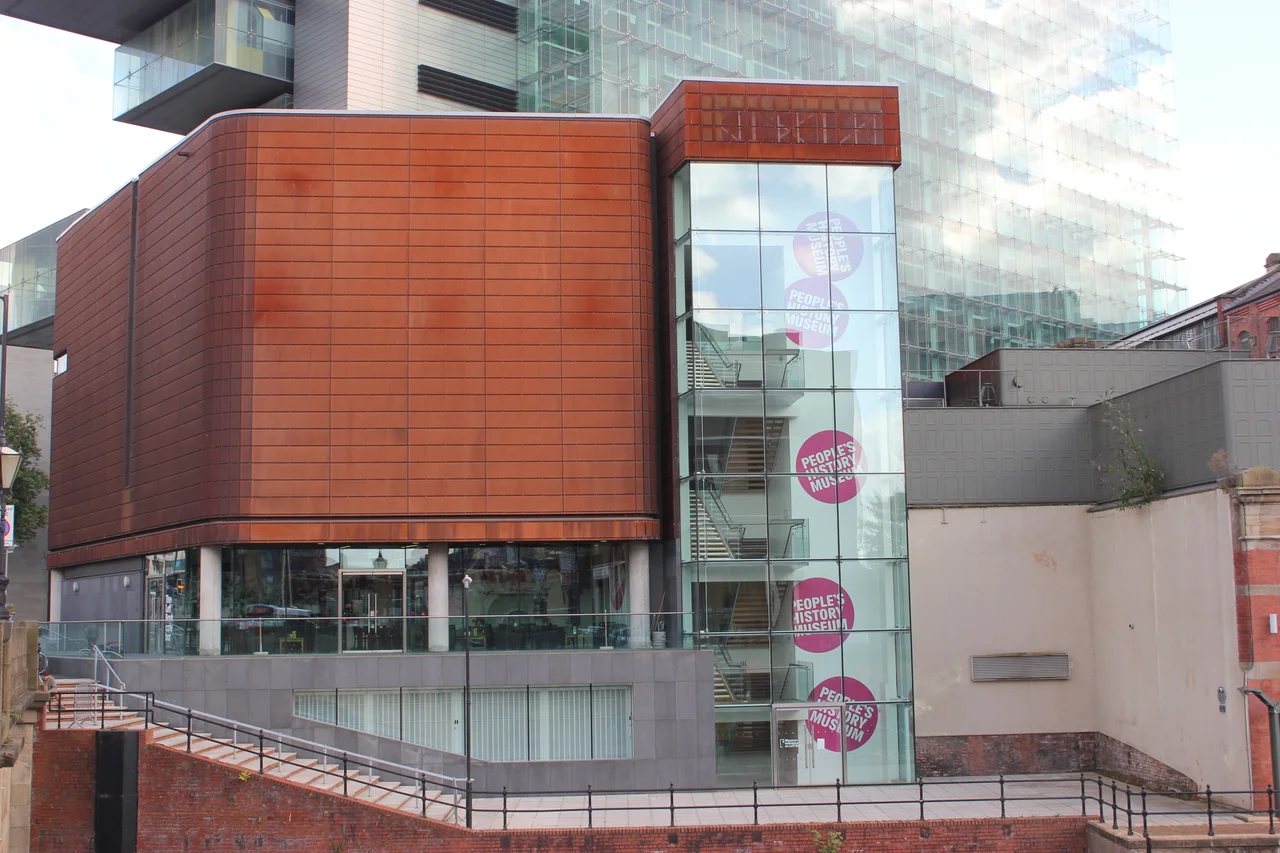

People's History Museum
The building used to push water. From 1909 until the middle of the twentieth century the Pump House on the corner of Bridge Street and Water Street was part of Manchester's hydraulic power network — Henry Price's red-brick station, fitted with enormous accumulators and pistons, drove pressurised water through pipes laid under the city centre to operate lifts, dock cranes and the bascule of nearby bridges. When industrial demand for hydraulics ended, the building sat empty until 1994, when it found a second life housing something equally Mancunian: the largest collection of political banners in the world. The hydraulic engineers who once kept Manchester's lifts moving might quietly approve of what's in there now.
Four Hundred Banners and Counting
Walk into Main Gallery Two and look up. The banners come at you in cascades — silk and oils, gold thread and hand-painted scenes, slogans from Chartism and the Match Girls Strike and the Miners' Welfare and the Wapping dispute. More than four hundred trade union and political banners, the largest such collection on Earth. They were paraded through streets, carried at funerals, hung in union halls and finally — when the unions folded or the halls closed — donated here for safekeeping. The conservators work behind glass in the Textile Conservation Studio in the same gallery, so visitors can watch a 1920s silk banner being painstakingly stitched onto fresh muslin in real time. Each banner is a small museum in itself: stitched portraits of members who died, biblical quotations, the iconography of the eight-hour day, the gold-edged shimmer of marches that mattered.
From National Museum of Labour History
The institution was called the National Museum of Labour History until 2001. Its collections grew out of the Trades Union Congress's archive and the political papers of the Labour movement; in 1990 it moved to Manchester and the Grade II*-listed former Mechanics' Institute at 103 Princess Street, the building where the TUC was founded in 1868. The Pump House gallery on Bridge Street opened in 1994 as a public exhibition space, and the two sites were unified under the People's History Museum name in 2001. A four-storey extension alongside the Pump House, linked by a glass walkway, opened on 13 February 2010 — adding three times the gallery space and giving the textile studio its current home.
What They Collect
Two thousand election posters. Three hundred political cartoons. Seven thousand trade union badges and tokens. Ninety-five thousand photographs. The collection focuses on the long arc of democratic struggle in Britain — the early Chartists, women's suffrage, the campaigns for adult and equal voting rights, the post-1945 settlement, the miners' strike of 1984–85, the long debates within the Labour Party itself. The museum actively chases contemporary material. Curators have tried to acquire the so-called EdStone — the limestone slab on which Ed Miliband had Labour's six 2015 manifesto pledges carved, an object whose fate has become a running political mystery — and the copy of Mao's Little Red Book that shadow chancellor John McDonnell theatrically threw across the despatch box at George Osborne in 2015. The point is not to take sides but to preserve the strange physical artefacts of how political arguments actually get made.
Archive and Study Centre
The Labour History Archive and Study Centre, on the upper floors, is where serious researchers come. Its holdings include the papers of the Labour Party itself, the former Communist Party of Great Britain, the co-operative movement, and the Department for Work and Pensions. There are documents from every general election since the 19th century, from the suffragette campaign, from the First World War conscientious objector tribunals, from the 1984–85 miners' strike. Whole PhDs have been completed in the Centre's reading room. The museum is free to enter — funded by Manchester City Council, Arts Council England and a network of trade union and Labour movement donations — and its gallery captions ask the kind of question that most museums tend to dodge: who shaped this country, and who paid the price for the changes that resulted?
From the Air
Located at 53.481°N, 2.253°W, on the east bank of the River Irwell at the corner of Bridge Street and Water Street in Manchester city centre. The site is roughly a kilometre west of Manchester Cathedral and a few minutes' walk from Spinningfields. Manchester Airport (EGCC) is about 14 km south; Manchester Barton (EGCB) is roughly 6 km west. From the air the redbrick Pump House is identifiable by its squat tower and tall arched windows along the Irwell, just south of the Trinity footbridge.
Nearby Stories
- National Science and Media Museum 0.2 km away
- Jodrell Bank Observatory 3.2 km away
- Siege of Lathom House 5.6 km away
- Chester Zoo 6.2 km away
- Whalley Abbey 8.9 km away
- Haddon Hall 10 km away
- Wentworth Castle 16 km away
- Blackpool 16 km away