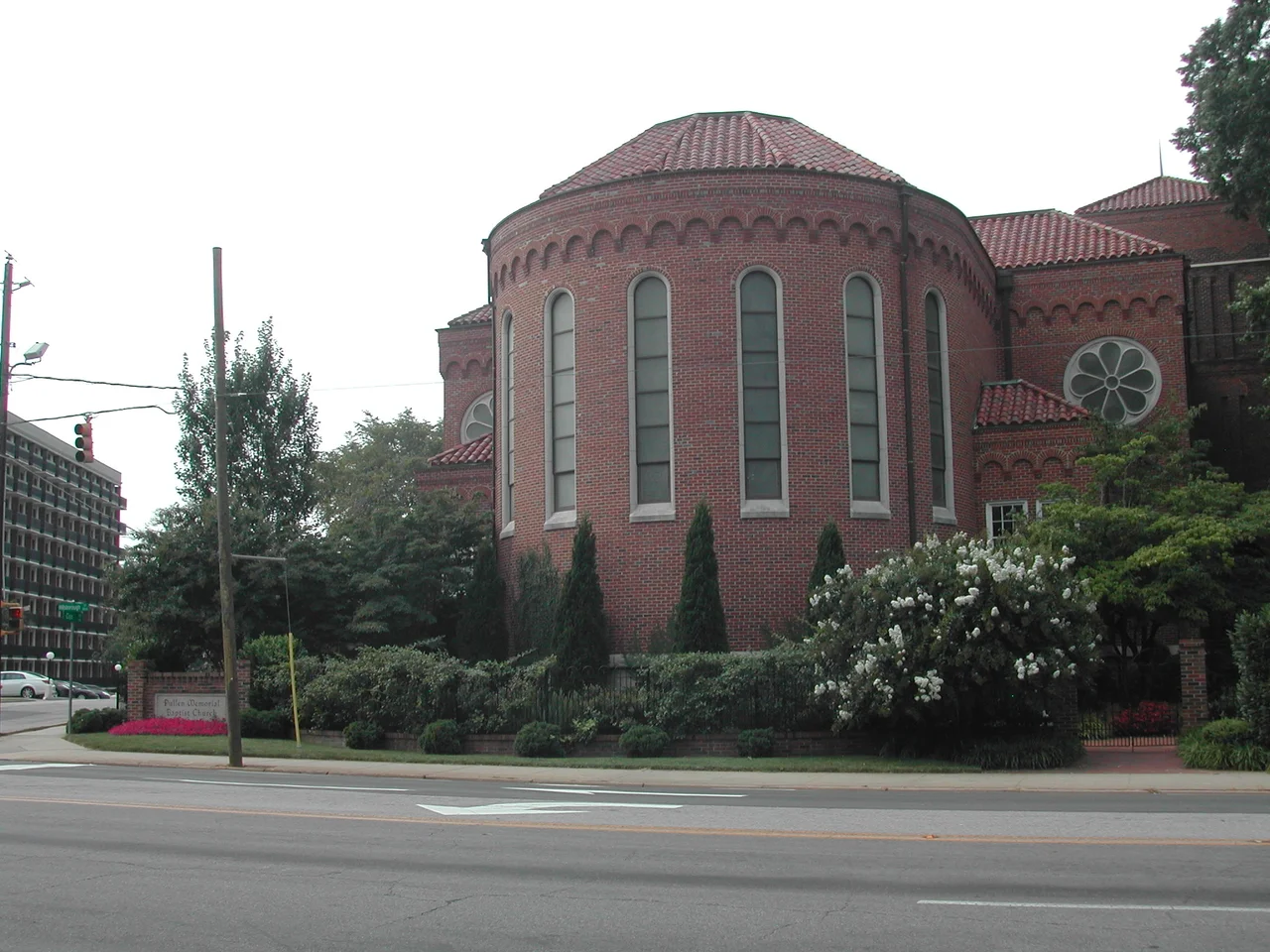

Pullen Memorial Baptist Church
In 1992, the Southern Baptist Convention voted to expel a small congregation in Raleigh for blessing a same-sex union. The vote was decisive, and the church, Pullen Memorial Baptist, was already used to standing alone. Thirty-four years earlier, in 1958, Pullen had declared itself open to all people regardless of race — at a moment when most North Carolina churches were still arguing whether that question was even theirs to answer. The pattern has held for over a century: Pullen tends to arrive at conclusions decades before its denomination, and then waits, patiently and without apology, for the rest of the South to catch up.
Beside the University
Pullen sits on Hillsborough Street directly beside the campus of North Carolina State University, a position that has shaped both its congregation and its self-understanding. Students wander in. Professors pass through. The building itself dates to 1923, but the church was founded in 1884, taking its name from a benefactor whose memorial it became. Calling Pullen 'a fiercely independent Baptist church' is accurate but understated. Observers have called it the South's premier liberal church — a description meant as both compliment and warning, depending on who is doing the describing.
Finlator's Pulpit
William Wallace Finlator became pastor in 1956 and held the pulpit until 1982. He preached against segregation in the late 1950s, when that conviction cost congregants and friendships throughout Wake County. He preached against the Vietnam War in the 1970s, when that position cost still more. Under his leadership in 1958, the church formally declared its membership open to all races — a statement that arrived years before the Civil Rights Act made similar commitments politically safe. Finlator's funeral in 2006 drew a crowd that filled the sanctuary and spilled into the street. The eulogies described a man who never seemed surprised when righteousness made him unpopular.
The 1992 Expulsion
When Pullen voted in 1992 to bless a same-sex union, then formally endorsed the unqualified acceptance of homosexual Christians, the Southern Baptist Convention responded with expulsion. The expulsion shocked very few. Pullen had been drifting away from the SBC's center of gravity for decades, and on this question the gap had become uncrossable. A decade later, in 2002, the congregation chose Nancy Petty as co-pastor with Jack McKinney, making Pullen the first Baptist church in the South known to have selected an openly gay person as lead clergy. McKinney stepped down in 2009. Petty stayed, and remains the church's pastor.
Sister Cities and Solidarity
In 1986, Pullen began a sister-church relationship with Martin Street Baptist Church, a historically Black congregation in Raleigh. Two years later, it added another sister church — First Baptist of Matanzas, Cuba — at a moment when American congregations rarely talked to Cuban ones at all. The relationships have lasted. So have ties to communities in Nicaragua, and in the Republic of Georgia near the Black Sea. The 2009 building expansion added 9,800 square feet, a geothermal heat pump, solar panels, green roofs, and water recycling. The American Institute of Architects' North Carolina chapter cited the design. The church reports about 700 members and 1,200 active participants — small by megachurch standards, large for an institution that the SBC formally disowned.
Moral Mondays
When Moral Monday protests began at the North Carolina General Assembly in 2013, organized by Rev. William Barber and the NAACP against Republican-led legislation, Pullen members were among the early arrests. The church has continued to engage Wake County's debates over sex education, capital punishment, and economic justice. In 2005, People of Faith Against the Death Penalty named Pullen its Faith in Action honoree. None of this is unusual for Pullen. The unusual thing would be silence.
From the Air
Located at 35.79N, 78.66W on Hillsborough Street in downtown Raleigh, immediately adjacent to North Carolina State University's main campus. The brick sanctuary sits about a mile west of the State Capitol. Nearest airport is Raleigh-Durham International (KRDU), 11 miles northwest. Look for the dense university campus and the wedge of green at Pullen Park as visual anchors.
Nearby Stories
- Sanford, North Carolina 7.6 km away
- Wilson, North Carolina 12 km away
- Cherry Hospital 13 km away
- Campbell University 19 km away
- North Carolina Tornado Outbreak of April 2014 21 km away
- Neuse River 23 km away
- Coal Glen Mine Disaster 26 km away
- Alamance County, North Carolina 27 km away