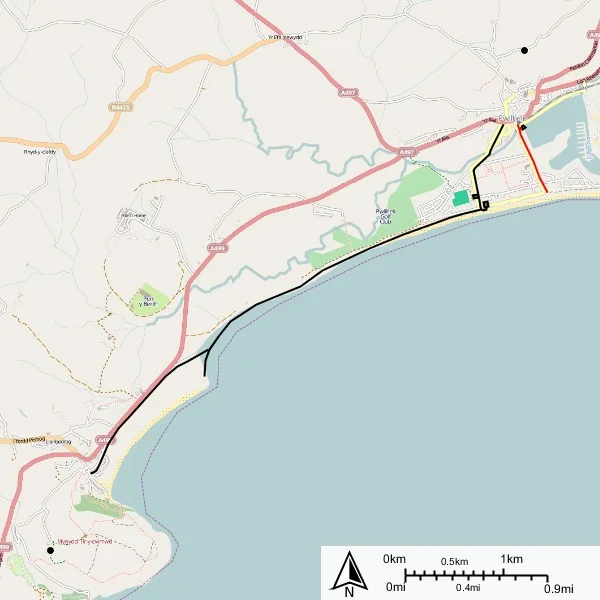

Pwllheli and Llanbedrog Tramway
Imagine the Edwardian seaside in its full bloom: a single horse pulling an open toast-rack tram along a beach-edge track, carrying ladies in straw hats and gentlemen in linen suits from the West End hotels of Pwllheli around the headland to Lady Love Jones-Parry's art gallery at Plas Glyn-y-Weddw in Llanbedrog. The fare was twopence. The line ran for thirty-three summers, until the storm of October 1927 ripped a half-mile section out of the shingle and the operators decided not to put it back.
Solomon Andrews's Project
The tramway was the work of Solomon Andrews, the extraordinary Cardiff-based entrepreneur who built tramways, hotels, omnibus services, and seaside resorts across south Wales and the Bristol Channel. In 1893 Andrews bought substantial landholdings in Pwllheli with a clear plan: develop the West End as a holiday resort, and build a tramway to serve it. The line started as a working operation, not a passenger service. From May 1894 a 2.5-mile section ran from Carreg-y-Defaid quarry south-west of Pwllheli to the West End, carrying stone for the construction of the seawall and the new promenade known as The Parade. In the first twelve months alone, 1,332 wagonloads of stone were brought up the line. Once the promenade was finished and the resort opened, the rails kept running for passengers.
Stone, Storm, and a Toast Rack
The early track was laid along the beach itself, which proved a romantic but ill-advised piece of engineering. A storm in 1896 destroyed much of the line, and Andrews had it rebuilt slightly inland. The 1 August 1896 timetable shows the trams running every forty minutes from 9 am to 8.20 pm, with toast-rack open cars in summer and covered single-deckers when the weather turned. A connecting horse bus ran from the West End into Pwllheli town proper. Then in September 1896 Andrews bought the Llanbedrog estate from the Jones-Parry family, taking possession of Plas Glyn-y-Weddw and the substantial grounds around it. He had the gallery opened to the public in 1896 and the tramway extended along the coast to Llanbedrog by July 1897. The pair of attractions, gallery and tram ride, fed each other handsomely.
The Eisteddfod Summer and the Storm
The line's busiest day may well have been during the 1925 National Eisteddfod, held in Pwllheli, when the tramway was packed to capacity carrying festival-goers along the bay. By then the writing was already on the wall. Service had been reduced significantly from 1909 and reduced again in 1911, as motor charabancs and private cars began to take the holiday traffic. The 28 October 1927 storm settled the matter. A north Wales tempest drove the sea inland for more than half a mile along Embankment Road and tore out the section of tramway between Carreg-y-Defaid and Tyddyn-Caled. The Andrews Estate announced that the main line would not reopen. The short Cardiff Road section within Pwllheli itself, between the West End and Ala Road, ran one final summer in 1928. Pwllheli Corporation was offered the tramway and declined to take it on. The remaining rails were lifted.
What Survives
Most of the route has eroded back into pasture or been overgrown, but the patient walker can still pick out cuttings and embankments along the coastal path between Pwllheli and Llanbedrog. One car, restored to working order, sits on a short stretch of preserved track in the grounds of Plas Glyn-y-Weddw, the destination it once served. The line of the tramway can be traced on a National Library of Scotland Edwardian six-inch Ordnance Survey map, an artefact of cartography catching a transport system that lasted just over three decades and never quite paid for itself, but managed during its short life to put the south coast of the Llyn Peninsula on the British holiday map.
From the Air
The former tramway ran along the shoreline of south Tremadog Bay between Pwllheli and Llanbedrog, roughly 52.883N 4.417W to 52.858N 4.484W, a distance of about four miles. From the air the line of the route is occasionally visible as a slight raised feature or vegetation change along the coast at the foot of low cliffs. Best context flight: trace the A499 along the coast between the two settlements. Nearest airfield is Caernarfon (EGCK) 14 nm north.
Nearby Stories
- Swallow Falls 2.3 km away
- Dinas Dinlle 3.9 km away
- Cardigan Bay 6.7 km away
- Battle of Mynydd Hyddgen 7.5 km away
- Irish Sea Bridge 20 km away
- Ysbyty Ifan 24 km away
- Cantre'r Gwaelod 29 km away
- Irish Sea 46 km away