_(geograph_7299517).jpg)
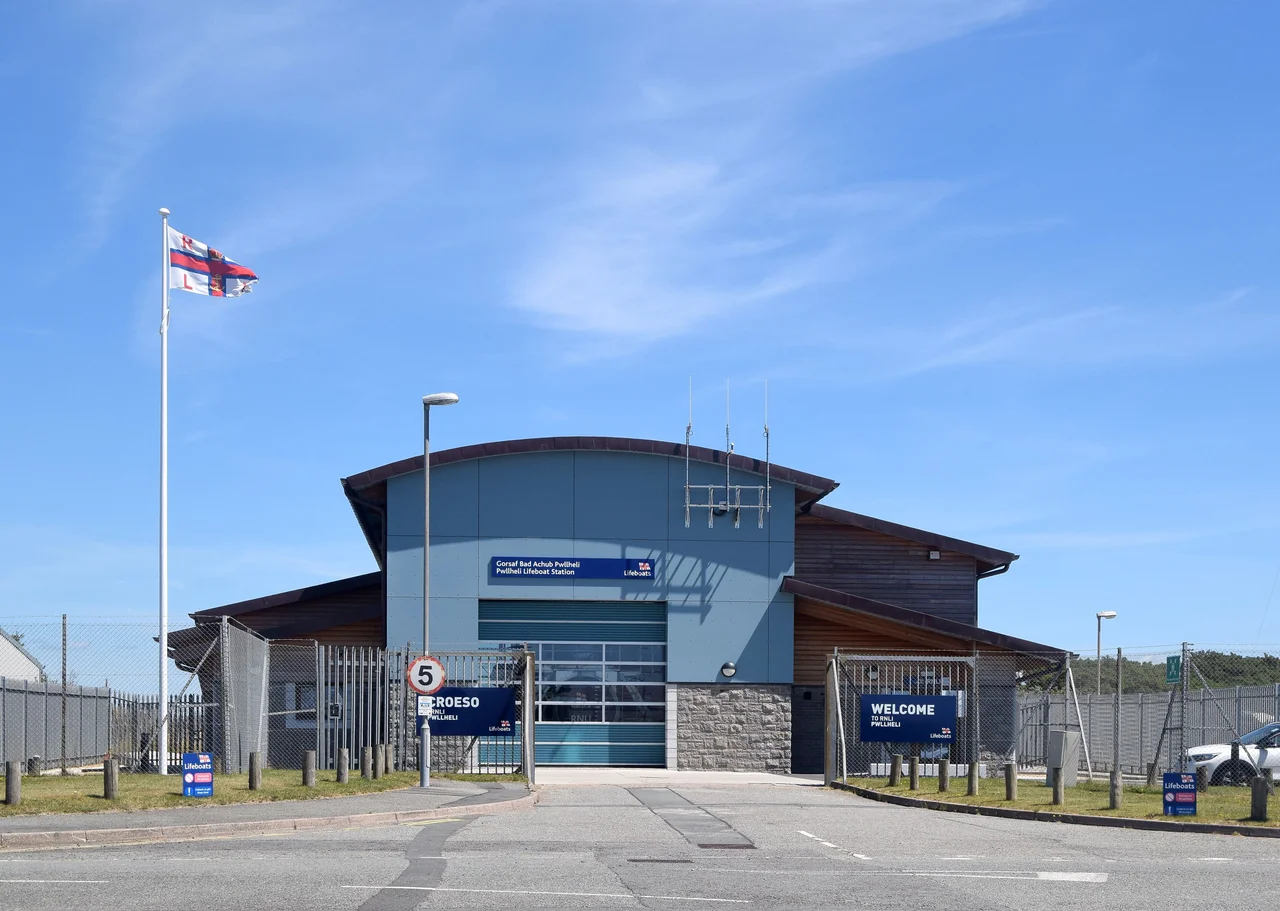
Pwllheli Lifeboat Station
The story of how Pwllheli got its lifeboat station begins with a man whose invention nobody really wanted. Henry Thomas Richardson, a Pwllheli resident in the 1870s, had patented with his father a peculiar craft called the Tubular lifeboat: a flat deck mounted between two buoyant tubes, essentially a catamaran or raft with the deck only eleven inches above the water. When he died in 1878 he left the Royal National Lifeboat Institution ten thousand pounds, a vast sum at the time, on the condition that two of his Tubular lifeboats be built and that a station be opened in his home town. The RNLI took the money, built the boats, opened the station, and almost immediately discovered that the Tubular was unworkable.
The Tubular Disaster
It took years of correspondence with the Pwllheli town clerk before the RNLI agreed in August 1886 to open the station Richardson's bequest had paid for. The boathouse went up at Gimblet Rock to designs by RNLI architect W. T. Douglas, built by the contractor E. Williams for the precise sum of £609 14s 0d. The first Tubular lifeboat, a 35-foot 6-inch craft built by Mechan & Co of Glasgow for £633, was named Caroline Richardson after the donor's mother and arrived in Pwllheli in April 1891. The crew detested it. The Tubular sat too low in the water, handled badly under sail, and felt unstable to rowers used to conventional self-righting lifeboats. It was launched on service exactly once before being transferred elsewhere. The RNLI then took the unprecedented step of going to court to seek permission to reallocate Richardson's bequest to standard-pattern lifeboats. The court agreed.
Margaret Platt to Smith Brothers
The Tubular's replacement, the Margaret Platt of Stalybridge, arrived in November 1892. She was a 38-foot 12-oared self-righting pulling-and-sailing lifeboat built by McAlister and Sons for £423. In her six years at Pwllheli she was launched eight times and rescued twenty-eight people. Through the twentieth century the station progressed through successive generations of boats: a second Margaret Platt of Stalybridge from 1898, motor lifeboats from the 1930s onwards, and inshore craft for the busy summer trade. The current All-Weather boat is the Shannon-class 13-39 Smith Brothers, on station since 2021, capable of 25 knots and carrying a crew of six. Alongside her runs the smaller inshore D-class Robert J Wright, in commission since 2017.
The Coxswain Remembered in a Boat's Name
On 20 September 2015, Pwllheli lifeboat was called out to a grounded yacht. Long-serving coxswain Robert Wright collapsed at the moment the lifeboat reached the casualty and died shortly afterwards of a suspected heart attack. Wright had served the station for decades; the loss was immediate and profound, both to the crew and to the town. Two years later, when a new inshore lifeboat arrived in Pwllheli, the RNLI named her Robert J Wright in his honour. The boat is launched routinely each summer for swimmers in difficulty, capsized dinghies, and inshore powerboat emergencies. The name on her bow carries the coxswain's into every rescue.
Two Ferraris and a New Boathouse
In 2015 the RNLI received what remains the most valuable bequest in its history. The businessman Richard Colton left his estate to the institution, including two extraordinary Ferraris: a silver 1967 Ferrari 275 GTB/4 and a red 1960 Ferrari 250 GT SWB. Both were sent to auction. The 275 GTB/4 sold for £1.93 million. The 250 GT SWB sold for £6.6 million. From this £8.5 million legacy, two new lifeboats were funded (the Richard and Caroline Colton and Richard and Caroline Colton II), and £2.8 million was allocated to the new Pwllheli boathouse at Glan-y-Don. The local fundraising committee had already gathered £100,000; the Ferrari money tipped the project into reality. The new state-of-the-art boathouse was completed in 2020 and officially opened in September 2021. In January 2024 the station was temporarily closed following a breakdown in crew relationships and the all-weather boat was withdrawn to RNLI Poole. The crew were stood down, retraining began, and by July 2024 the Smith Brothers had returned and the station was back in active service. The institution that began with a misfit invention, an awkward legacy, and a decade of arguments now patrols the south coast of the Llyn from a building partly funded by two of the most desirable cars ever built.
From the Air
Pwllheli Lifeboat Station is at the Glan-y-Don Industrial Estate on the western edge of Pwllheli, 52.883N 4.402W, on the south-east coast of the Llyn Peninsula. From the air, look for the marina at Pwllheli Sailing Club, the spit of land protecting the harbour, and the modern boathouse at the harbour entrance. Carn Fadryn rises 9 nm west. Nearest airfield is Caernarfon (EGCK) 12 nm north; Valley (EGOV) 30 nm north.
Nearby Stories
- Swallow Falls 2.3 km away
- Dinas Dinlle 3.9 km away
- Cardigan Bay 6.7 km away
- Battle of Mynydd Hyddgen 7.5 km away
- Irish Sea Bridge 20 km away
- Ysbyty Ifan 24 km away
- Cantre'r Gwaelod 29 km away
- Irish Sea 46 km away