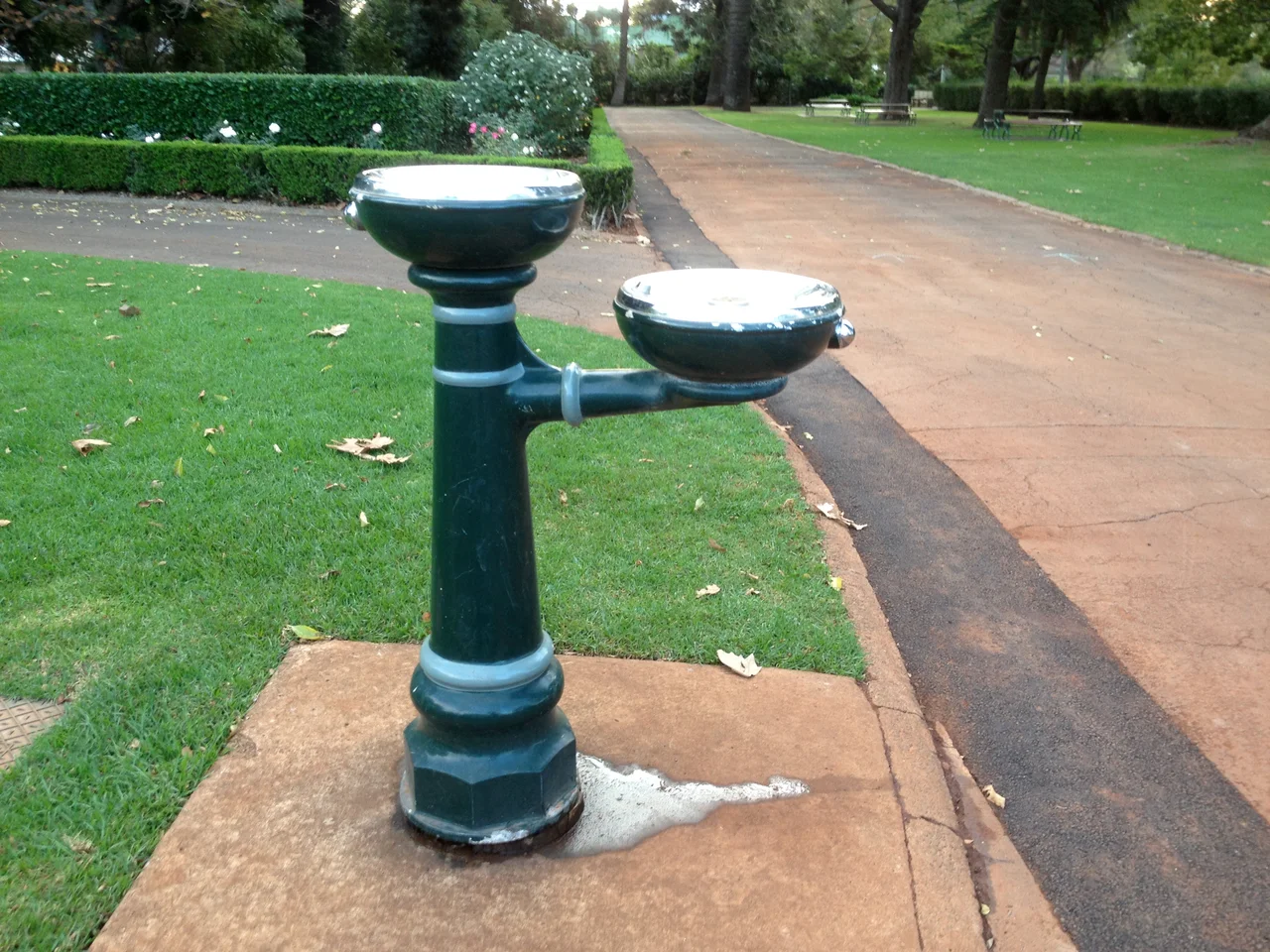

Queens Park, Toowoomba
Before it was beautiful, it was a hole in the ground. The land that is now Queens Park spent its early years as a place to graze cattle and dig clay for government bricks, leaving it pocked with pits and standing water, nothing like the elegant English parks it was meant to imitate. That it became the green heart of a city that calls itself the Garden City of Queensland is a story of stubborn ambition. Each September, when the Toowoomba Carnival of Flowers fills these lawns with colour, the crowds walk over ground that was once swampy, neglected, and used as a tip well into living memory.
A Laboratory With Flowerbeds
The northern arm of the park hides something more serious than a pretty garden. In 1875 the Toowoomba Botanic Gardens were laid out here, the second of eight provincial branch gardens that Brisbane's botanic curator, Walter Hill, established across Queensland during the 1870s. Their purpose was scientific. In a young colony that knew almost nothing about how its plants would behave at altitude, gardens like this were living laboratories. The first curator, Edward Way, planted and tested trees and fruit, ran climate experiments on the high, cool Downs, and reported results back to Brisbane, building a real body of knowledge about what would grow in Queensland and what would not. The flowerbeds were the friendly face of a colonial data-gathering machine.
The Avenue and the Memorial
Walk north along the camphor laurel avenue, established by 1891, and you are following the park's oldest living spine, a corridor of mature trees aligned with its single most prominent monument. At the centre of a circular bed stands the Alfred Thomas Memorial, moved here around the turn of the century to honour the man who supervised construction of the railway up the range from Ipswich, a genuine feat of Victorian engineering. A small cannon was placed beside it in 1900. Around these landmarks survives a remarkable arboretum of imported and native species: bunya pines and bottle trees, English oak and jacaranda, Norfolk Island pine, kauri and swamp cypress, the accumulated harvest of all those decades of patient testing.
Baths, Sport, and the Long Climb to Respectability
For most of its life this was a working people's park, not a showpiece. From 1894 until 1964, municipal swimming baths occupied a corner of the grounds, sited partly to help drain the boggy land locals called the East Swamp. Sporting clubs claimed the open western end from the 1880s, raising a grandstand and running track, and playing fields still dominate that side today. The unglamorous truth is that the council kept using part of Queens Park as a rubbish dump until 1931 and leased ground for grazing horses into the 1920s. Respectability came slowly, through decades of fencing, levelling, draining, and planting, and only gradually did the whole expanse become the unbroken green that Toowoomba now takes for granted.
The City in Bloom
By the 1920s Toowoomba had earned its nickname, and Queens Park with its adjacent Botanic Gardens was the premier example of the lush network of gardens that gave the Garden City its name. That reputation became an institution in 1949, when local businesspeople, looking to lift spirits and trade after the war, founded what grew into the Carnival of Flowers; the first festival paraded through town in 1950 and has returned every spring since. Today the gardens are its showpiece, a stage of massed plantings and floral displays that draws visitors from across the country. The Queensland Heritage Register listed the park in 2001 as a substantially intact nineteenth-century recreation reserve, but its real significance is simpler. It is where a city full of gardeners comes to celebrate the thing it does best.
From the Air
Queens Park lies at 27.56°S, 151.96°E in East Toowoomba, on the plateau atop the Great Dividing Range near 690 metres elevation. From the air it reads as a large green L-shaped block just east of the city centre, bounded by Margaret, Hume, Godsall, Campbell and Lindsay Streets, with the mature camphor laurel avenue running north-south through its heart. The botanic gardens occupy the smaller northern arm. Brisbane West Wellcamp Airport (YBWW) is about 16 km west and Toowoomba City Aerodrome (YTWB) lies just north of the city; Brisbane (YBBN) is roughly 110 km east. In late September the carnival plantings make the park unusually vivid; the cool-climate plateau is often clearer and cooler than the coastal lowlands to the east.
Nearby Stories
- North Ipswich Railway Workshops 20 km away
- Main Range National Park 22 km away
- Cressbrook Homestead 41 km away
- Woodford Folk Festival 41 km away
- Jimbour Homestead 43 km away
- Tamborine National Park 60 km away
- Warialda 217 km away
- Inverell 254 km away