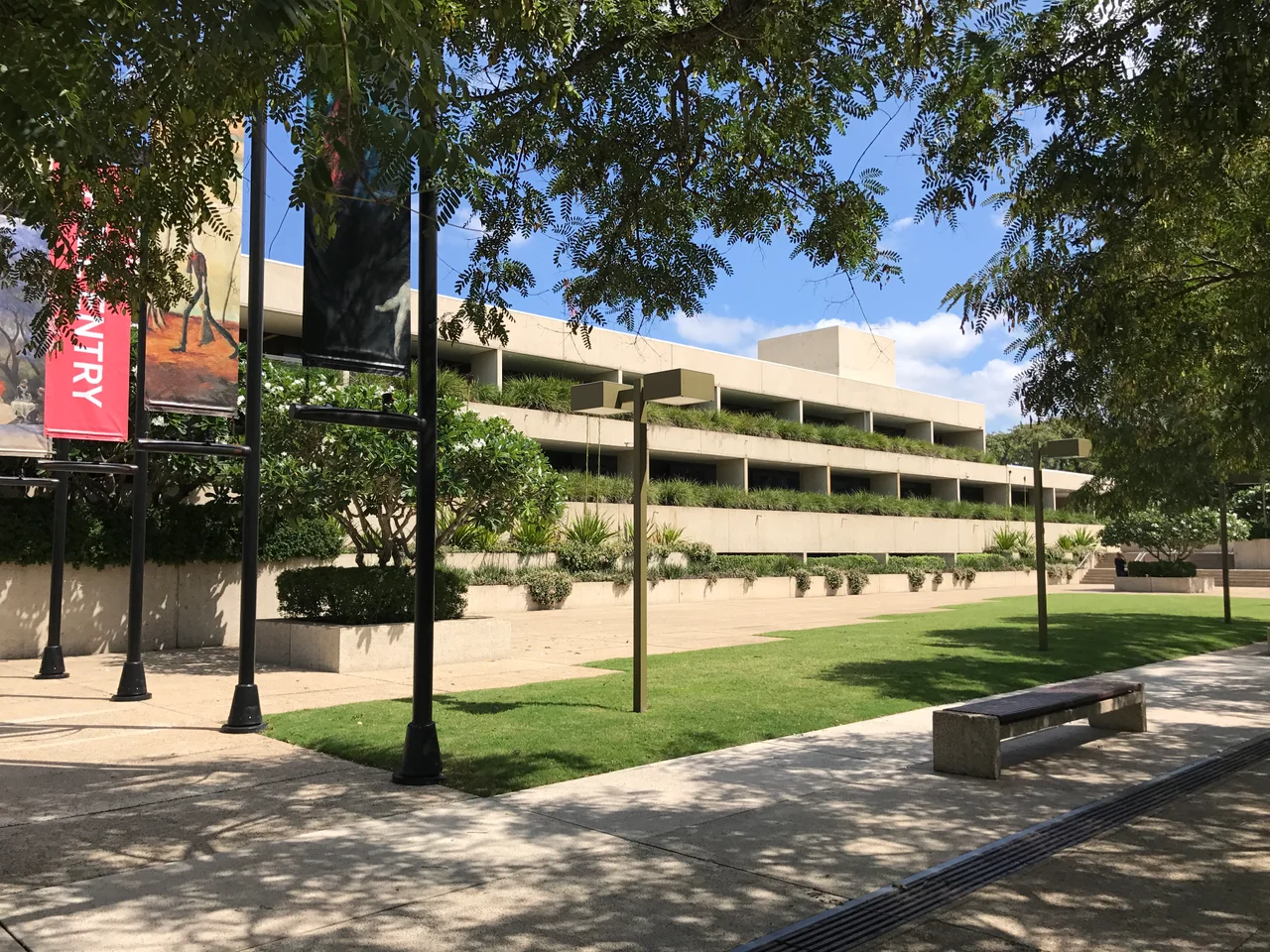

Queensland Art Gallery
Walk in from the South Bank and the first thing you notice is the water. A long, still pool runs straight through the heart of the Queensland Art Gallery, splitting the hushed exhibition halls from the busier rooms beyond, and the whole building seems to organise itself around that quiet line. Architect Robin Gibson called it the Watermall, and it does the work of a spine. Light off its surface plays on the ceilings; footsteps soften near its edge. In a city that swings between subtropical glare and sudden downpours, Gibson built a piece of indoor calm and made it the gallery's beating, reflective core.
A Benchmark on the River's South Side
The institution is older than its building by nearly a century. The Government of Queensland founded it in 1895 as the Queensland National Art Gallery, and for decades it made do with borrowed and temporary rooms. The home it finally got, opened in 1982 as the first stage of Gibson's Queensland Cultural Centre, was a statement. It was the first major building raised on the south side of the river beside the new Victoria Bridge, and it set a standard of scale and finish that everything around it would have to answer to. Gibson worked in pale, low-maintenance materials, concrete chief among them, tuned to the Mediterranean quality of Brisbane's climate. The judgement held: in 2004 the gallery won the profession's award for enduring architecture, and in 2015 it was listed as a State Heritage Place.
The Painting Everyone Came Back For
Some pictures belong to a city. Under the Jacaranda, painted in 1903 by R. Godfrey Rivers, shows the artist and his wife Selina taking tea beneath a jacaranda in full purple bloom, and it has hung at the gallery almost continuously since it was bought that same year for a hundred pounds. The tree was real, a landmark in the Botanic Gardens, almost certainly the first jacaranda grown in Australia, planted by superintendent Walter Hill in 1864 and lost to a storm in 1979. Its descendants now haze whole Brisbane suburbs in violet each spring. The gallery's first-ever purchase, in 1896, had a harder fate: Blandford Fletcher's Evicted was the most popular work it owned until director Robert Campbell pulled it from display in 1949, sniffing that it drew crowds only "because it had a sentimental touch."
Where Asia and the Pacific Meet
The gallery's boldest idea looks outward across the ocean. Since 1993 its flagship has been the Asia Pacific Triennial of Contemporary Art, a recurring survey of work from the region that has become a fixture on the international calendar and made Brisbane a genuine meeting point for artists from across Asia and the Pacific. The ambition built its own scholarly engine, the Australian Centre of Asia Pacific Art, and a collection to match. The Watermall has staged the results at full scale. For the seventh Triennial, Huang Yong Ping suspended Ressort, the vast skeleton of a snake, over the water, a sculpture the gallery acquired in 2012, so that visitors looked up at a serpent floating above Gibson's quiet pool.
Two Buildings, One Idea
Today the gallery is half of a pair. The Gallery of Modern Art, GOMA, opened 150 metres away in 2006, and the two now run as a single two-campus institution under the shared name QAGOMA. By 2014 more than ten million people had passed through the two sites since GOMA arrived. The older building keeps a distinct character through all of it: the patient Watermall, the changing light, the painters Australia loves hung within sight of contemporary work from Jakarta and Suva. The gallery has also become a leader in art made for children, and it sends travelling exhibitions out to regional and remote Queensland, so that a state the size of Western Europe can reach the collection it owns.
From the Air
The Queensland Art Gallery stands at 27.473 degrees south, 153.018 degrees east, on the South Bank of the Brisbane River within the low, pale-concrete spread of the Queensland Cultural Centre, just upstream of the Victoria Bridge. From the air, look for the cluster of flat-roofed Cultural Centre buildings between the river and the green of South Bank Parklands; the gallery and its near neighbour GOMA read as a connected pair. Brisbane Airport (ICAO YBBN) is about 12 kilometres to the northeast, and Archerfield (YBAF) roughly 10 kilometres to the southwest. The sweep of the river and the bridges crossing it into the CBD make the simplest landmarks. Clear, dry winter mornings give the best visibility; summer afternoons can bring haze and storm cloud over the valley.
Nearby Stories
- Redcliffe Peninsula 2.7 km away
- Tamborine National Park 12 km away
- Cressbrook Homestead 27 km away
- Main Range National Park 31 km away
- 2010-2011 Queensland Floods 38 km away
- Cape Byron 96 km away
- Cape Byron Light 126 km away
- HMS Porpoise (1799) 588 km away